Locations:





Chilblain-like skin lesions and rashes are mild (and rare) complications of many viral infections, not just COVID-19
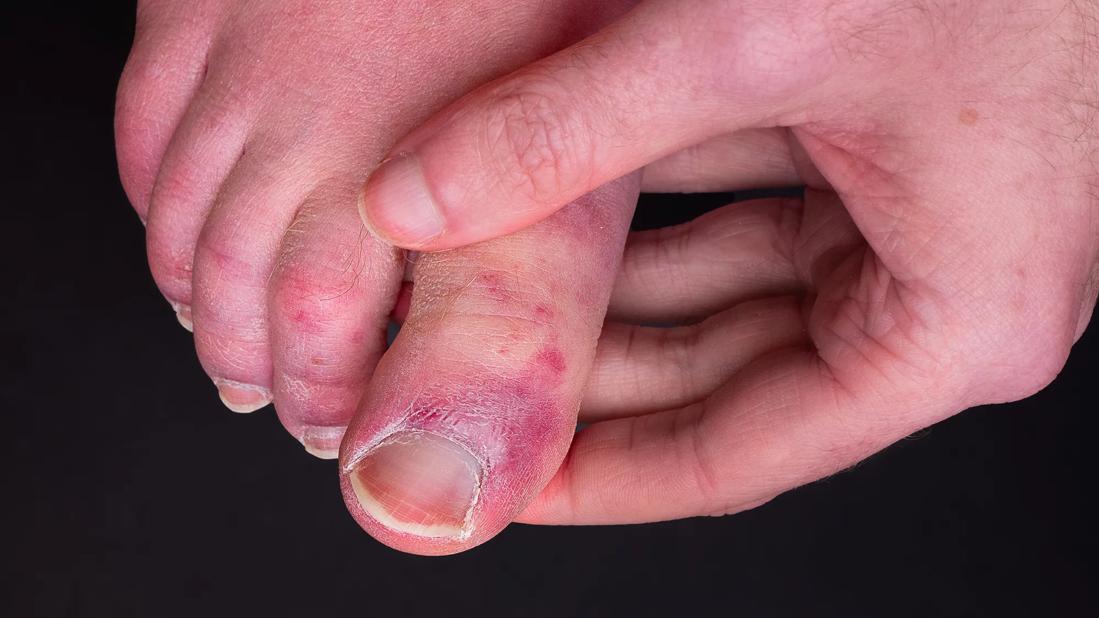
Image content: This image is available to view online.
View image online (https://assets.clevelandclinic.org/transform/0c689e28-c622-4c60-bcaa-76aeee89c137/covid-toes-1250715080)
Hand holding foot with COVID toe
In the years since COVID-19 made its global debut, we’ve learned to expect the unexpected. COVID toes, COVID nails, COVID tongue: It’s wild how many different ways the virus can affect your body. But can it also cause a rash?
Advertisement
Cleveland Clinic is a non-profit academic medical center. Advertising on our site helps support our mission. We do not endorse non-Cleveland Clinic products or services. Policy
In a word: Yes. Pediatric infectious disease specialist Frank Esper, MD, breaks down the most reported COVID-related skin conditions and what to do about them.
It’s actually quite common to get rashes with viral infections, especially respiratory infections like COVID-19.
“The rash is evidence that our bodies react to infections in many different ways,” says Dr. Esper.
While attention-grabbing and unusual, COVID toes and COVID rashes aren’t signs of life-threatening complications.
“These symptoms may be more common in COVID-19 compared with other viral infections,” he adds. “But they don’t affect a majority of people by any means. And they don’t necessarily mean you’re sicker than somebody else who has COVID.”
When it comes to COVID rashes, one size definitely doesn’t fit all. The kind of skin reaction you have depends on what’s causing it. It could be:
Dr. Esper walks us through the different skin conditions that have been associated with COVID-19.
If you have discolored, painful and itchy spots or lesions on your feet or hands, it could be “COVID toes,” to use the term that was common in the early days of the pandemic.
Advertisement
Many infectious disease specialists now believe that COVID toes are actually just chilblains, painful patches of skin that occur in response to cold air exposure. But there are other explanations, too.
“It’s possible that COVID toe is the result of a small clog or microclots in the blood vessels in the toes. It could also be caused by a narrowing of those blood vessels (vasoconstriction),” Dr. Esper explains. He’s seen similar chilblain-like lesions on ICU patients with sepsis and people on life support. Hives can also be a sign that you’re allergic to a medicine you’re on.
Hive-like welts are one of the most common skin conditions to pop up during or after a COVID-19 infection. In fact, it’s sometimes the first sign that you’re sick.
“It’s not unusual to see hives when your immune system is in overdrive, like during allergic reactions or when your body’s fighting off certain viruses,” Dr. Esper reports. “It’s especially common in children.”
Morbilliform rashes are angry red bumps (papules) or raised spots (macules) that can be so numerous that they blend together. This type of rash, which is most commonly associated with measles, usually starts on your back or abdomen and spreads outward.
Like hives, this rash (while still rare) is one of the most common skin-related side effects of COVID-19.
“Many different viruses can cause a morbilliform rash, but so can certain medications,” Dr. Esper says. “It could be that something you’re taking to address your COVID symptoms is causing the skin reaction.”
While sometimes referred to as a rash, petechiae and purpura are actually caused by bleeding under the skin, not inflammation of the skin.
The main difference between petechiae and purpura is their size. Petechiae are tiny red spots, less than 2 millimeters wide, caused by burst capillaries, the smallest blood vessels in your body.
Purpura, on the other hand, is the result of damage to multiple capillaries or larger blood vessels. The result? Larger spots — sometimes up to an inch wide — that sport a red, brown or purple hue.
“Call your provider if you notice petechiae or purpura,” Dr. Esper stresses. “It could be a sign that there’s a more serious underlying condition that needs to be addressed, beyond COVID.”
If you’ve had chickenpox, shingles or herpes, you’ve had a virus-induced vesicular rash. While rare, there are reports of the same thing happening to some people while sick with COVID-19.
Advertisement
The rash has four basic stages:
Research suggests that a COVID-related vesicular rash should resolve in about 10 days.
Livedo reticularis isn’t a rash, but it does change the appearance of your skin. It’s a bluish red, lace-like pattern you see under your skin. It can happen for all sorts of reasons, some minor and some major.
When it happens with COVID, it’s a sign that the virus is somehow impacting your circulation.
“Mottled skin isn’t dangerous, but vascular complications from COVID can be,” Dr. Esper explains. “I’d recommend seeing your provider just to rule out a more serious issue. It’s always better to be safe than sorry.”
Advertisement
There’s only one way to know if a sudden change to your skin is a sign that you have COVID-19: Take a COVID-19 test.
“Mercifully, we’re past the stage of the pandemic where we can’t be sure whether or not we’re infected,” Dr. Esper says. “The bigger question is whether your skin symptoms are COVID-related or there’s something else going on.”
If you test positive for COVID-19 and have skin symptoms, Dr. Esper recommends contacting your healthcare provider. They may prescribe medication to treat your skin or toes. And if your age or health status raises your risk of complications, they may suggest going on an antiviral like Paxlovid® or Molnupiravir®.
Most of the time, a rash with COVID-19 requires little or no treatment. But it’s still important to tell your provider about it and monitor your condition closely. If you notice something about your skin changing, it could be a sign that you’re experiencing a more serious COVID-19 complication. (More on that later.)
While we don’t yet know whether “COVID toes” are actually chilblains, Dr. Esper says the treatment is the same.
“Most of the time, chilblains go away on their own without treatment within a couple of weeks,” he reports. “If you’re struggling with pain, itching or the lesions don’t seem to be going away, call your provider. They can prescribe topical and oral medications to speed up your recovery.”
Advertisement
While they may be a rare response to the COVID-19 virus, COVID rashes tend to be mild and short-lived. They’re often treated at home with:
How long do viral and post-viral rashes last? Dr. Esper says it depends on the type you’re dealing with, whether you’re scratching and more. If your skin hasn’t improved within a week (or if it’s worsening), follow up with your provider.
COVID toes and COVID rashes are a minor inconvenience, but if you notice significant changes to your skin symptoms, it could be a sign of a more serious complication, like a bacterial infection or vasculitis.
It could also mean you have another illness, like mononucleosis (mono) or meningitis, at the same time that you’re dealing with COVID-19. Talk about bad luck!
Let your doctor know if:
“If your COVID rash is causing serious itching or pain, that’s reason enough to call your provider,” Dr. Esper emphasizes. “Some discomfort is expected, but severe symptoms should be investigated.”
Call a provider if you test positive for COVID-19 and are experiencing skin symptoms. They’ll look at the rash to confirm that it’s a side effect of your infection and — if needed — prescribe medication to help manage your symptoms.
COVID toes and rashes aren’t an emergency, but COVID-19 can be. Call 911 or emergency services if you tested positive and are:

Sign up for our Health Essentials emails for expert guidance on nutrition, fitness, sleep, skin care and more.
Learn more about our editorial process.
Advertisement

Most can return to work or school when they’re symptom-free for 24 hours

Covering your mouth when you cough and staying home when you’re sick are a couple ways to help keep yourself and others COVID-free

This vital nutrient supports your health, but its role in COVID-19 prevention and treatment isn’t proven

Studies have shown promising results, but additional research is needed

Infection and inflammation can cause you to lose your voice and have other voice changes until you’re fully healed

A COVID-19 infection can bring on depression or anxiety months after physical symptoms go away

Just like the flu, COVID-19 continues to evolve every year with new and smarter variants

The latest omicron subvariants carry specific mutations that may allow the SARS-CoV-2 virus to be better at evading immune protection
Eyes typically increase to full size during two growth spurts in childhood

To start, opt for calorie-dense foods that are rich in protein and healthy fats

Pre-birth injections and monoclonal antibodies can help prevent serious complications
 Search










