Locations:
Search IconSearch

First Aid Treatment for Burns

Follow the 4Cs — cooling, cleaning, covering and comforting — to start the healing process

Stovetops and grills. Coffee pots. Curling irons. Hot items are everywhere — and they can scorch your skin in a moment. Some burns, of course, are little more than owies. Others qualify as a five-alarm emergency.

Advertisement

Cleveland Clinic is a non-profit academic medical center. Advertising on our site helps support our mission. We do not endorse non-Cleveland Clinic products or services. Policy

The treatment for a burn depends on factors such as the severity of the injury and its location. We asked urgent care physician Allan Capin, MD, to take us through the process.

How to treat a burn

Start by assessing the seriousness of a burn, which is generally classified in one of three ways:

  • First-degree burn: A superficial and generally mild skin injury. Examples would include sunburn or the tenderness you feel after briefly touching a plate that’s too hot (even though the waitress warned you).
  • Second-degree burn: These burns affect both the top (epidermis) and second (dermis) layers of skin. Blistering is possible. Scarring may occur. This type of burn could be caused by a hot water spill or touching a hot stove.
  • Third-degree burn: These burns extend past the skin into deeper body tissue, like fat, muscle or even bone. Damage can be severe. It could be caused by prolonged contact with fire or hot metal, or electrical or chemical burns.

Any burn believed to be worse than a first-degree burn should be seen by a medical professional immediately, advises Dr. Capin. Quick treatment reduces the risk of an infection that could complicate recovery.

“The more time you take, the higher the likelihood you can have an infection or mismanage the treatment of it,” he says. “If you’re not sure what to do, don’t guess: Go to your local urgent care or emergency room immediately.”

Advertisement
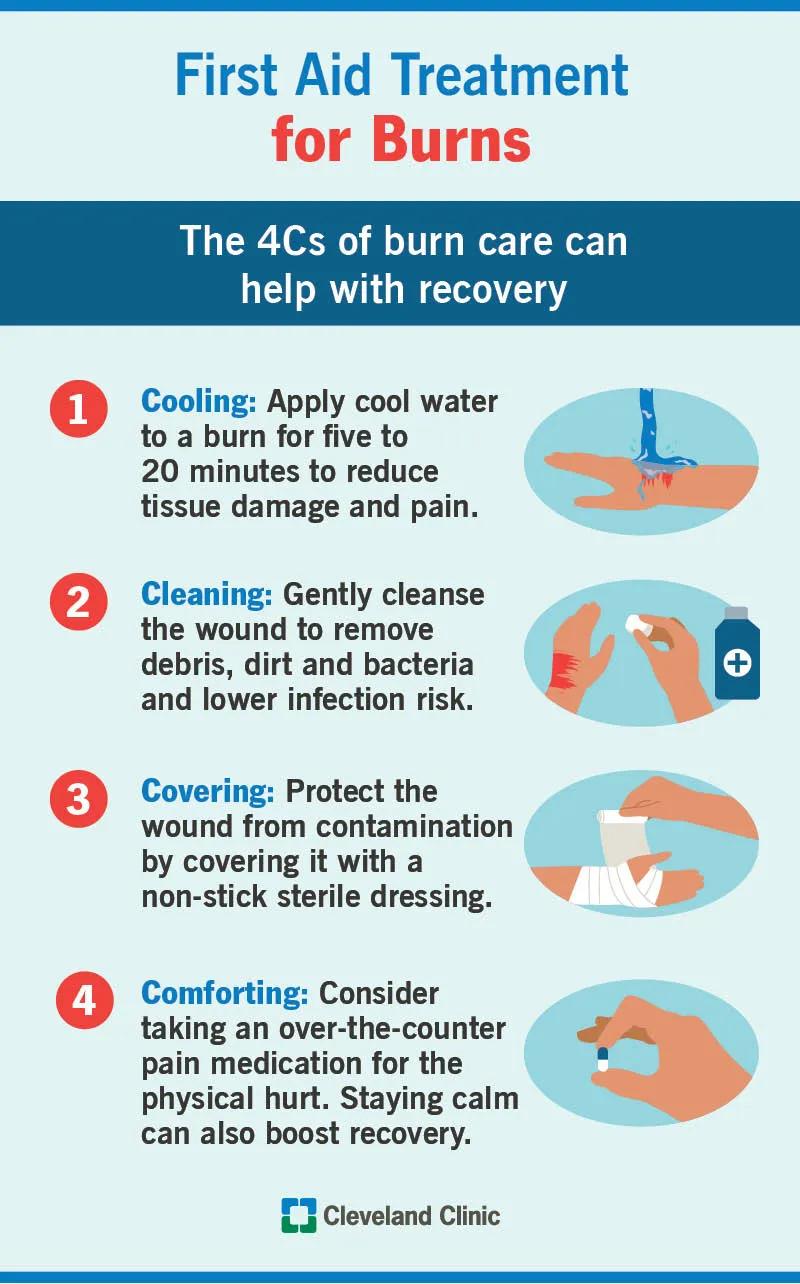
The 4Cs of burn care

First aid treatment for burns, the 4cs of burn care

The 4Cs of burn care — cooling, cleaning, covering, and comforting — offer a game plan for the all-important initial treatment of burns. Each step plays a role in reducing damage, limiting complications and healing.

Here’s what to do:

  1. Cooling: Apply cool water to a burn for five to 20 minutes by gently running tap water over the burn, dipping the burned area in water or using a wet towel. This helps stop the burning process to reduce tissue damage and pain.
  2. Cleaning: Gently cleanse the wound with mild soap and water or an antiseptic solution to remove debris, dirt and bacteria. This lowers the risk of infection, including serious ones like sepsis.
  3. Covering: Protect the wound from contamination by covering it with a non-stick sterile dressing. (Plastic wrap can work in a pinch.) This can reduce pain by shielding nerve endings from air exposure and promote healing by maintaining a moist environment.
  4. Comforting: Burn injuries can be painful and distressing. Consider taking an over-the-counter pain medication like ibuprofen (Advil®) or acetaminophen (Tylenol®) for the physical hurt. Staying calm also helps your body heal.

For more serious burns, a fifth C — “calling” for help — should be included.

The don’ts of treating a burn

  • Never use ice or ice-cold water, as this could reduce blood flow to the injured area and delay healing.
  • Don’t use water that might be contaminated, like from a lake, river or stream. Bacteria in the water may cause an infection.
  • Don’t pull stuck clothing away from a burn. Forcing it off may tear away skin and worsen your wound. Leave the removal to healthcare professionals in a safe environment.
  • Never pop a burn blister. The skin beneath the blistered area can easily become infected. If a blister pops on its own naturally, cover the area until you’re able to see a healthcare provider.
  • Don’t use any ointments or sprays. Butter, oil, ointment and first-aid sprays can slow the release of heat from your skin, making the wound worse.

When to seek medical care

Any burn beyond the skin surface or involving broken skin should be seen by a healthcare provider right away. They’ll be able to assist with cleaning and treating the burn, as well as provide stronger forms of pain management.

You also may need medical attention if the burn is:

  • More than 3 inches wide
  • Covering a joint
  • On your face, neck, hand or foot
  • Causing pain that doesn’t go away
  • Not healed in one to two weeks

Any burn brings a risk of infection that could result in the need for medical care, too. Symptoms to watch for include:

Advertisement

  • Fever
  • Pus
  • Increased pain or pain that expands or spreads to other areas of your body

“The worse the burn is, the longer it takes to heal,” explains Dr. Capin. “Third-degree burns can take months or more to heal and may need surgical interventions like skin grafting. First- and second-degree burns can take a week or more to heal, depending on the severity of damage.”

But the sooner you start treating the burn, the better the outcome.

Advertisement

Learn more about our editorial process.

Related Articles

Metal bowl of icecubes on wooden block on table
March 6, 2025/Skin Care & Beauty
Never Use Ice on Burns — Here’s Why

Ice and ice-cold water can damage tissue, restrict blood flow and delay the healing process

Fireworks in the night sky
July 2, 2024/Primary Care
Fireworks Safety: How You Can Prevent Injuries

Stay safe while celebrating by using legal fireworks, keeping a safe distance and disposing of them properly

Person sitting on bed moisturizing legs after razer burn.
June 22, 2023/Skin Care & Beauty
How To Heal a Bad Case of Razor Burn

Cold compresses, aloe vera and colloidal oatmeal can all help you find relief
Large shower head with water running out
January 6, 2026/Skin Care & Beauty
How Often Should You Shower?

Bathing once a day is the general guidance, but you could also have reasons to soap up twice a day or not at all

Person next to oversized cell phone with food tracking app and calendar
January 6, 2026/Skin Care & Beauty
Is There an Eczema Diet? Here’s What Works

There’s not one specific cure-all diet for eczema, but it helps to keep track of what you eat and when you experience symptoms

Person looking in a hand-held mirrro at pimple on their face, with close-up of pimples
January 5, 2026/Skin Care & Beauty
Pimple Popping: Is It Safe To Do?

It’s best to avoid picking at zits, which can damage your skin (though there are ways to minimize the risk)

Person touching skin condition on their throat
January 5, 2026/Skin Care & Beauty
Eczema and Psoriasis: Which Do You Have?

Both inflammatory conditions have varying triggers and symptoms

Person in towel in their bathroom applying lotion to their face
January 2, 2026/Skin Care & Beauty
Skin Care Trends: What’s New and What To Avoid

Strengthening your skin barrier, simple routines and minimizing products are ongoing, popular trends

Trending Topics

Person looking at ovulation app on their smartphone
When Should You Have Sex To Get Pregnant?

Start having sex about 72 hours before ovulation, then at least every other day during your fertile window

Happy baby lying on back with hand in their mouth
What Is Attachment Theory? And How Does It Impact You?

Attachment theory suggests that your earliest relationships shape connections throughout your life

Person surrounded by social media podcasts and information
Is It Possible To Become Addicted to Social Media?

It isn’t a recognized mental health disorder, but research shows that problematic social media use can negatively affect your mental health, self-esteem and sleep

Ad