Locations:





 Search
The semi-permanent tattoo can enhance your lip color and give the illusion of fullness
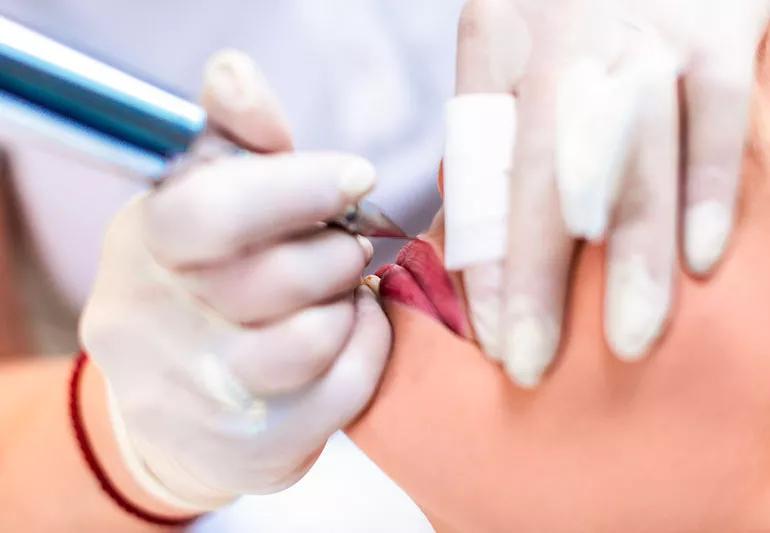
Image content: This image is available to view online.
View image online (https://assets.clevelandclinic.org/transform/5e9d1f54-b341-4b72-abaa-25da44e670a0/lipBlushing-1158407522_770x533_jpg)
woman having lip blushing technique performed
Just like microblading, a semi-permanent tattoo to make your eyebrows fuller and darker, lip blushing can enhance the look and appearance of your lips through tattooing.
Advertisement
Cleveland Clinic is a non-profit academic medical center. Advertising on our site helps support our mission. We do not endorse non-Cleveland Clinic products or services. Policy
Lip blushing is becoming a popular treatment for those who want the illusion of fuller lips. While cosmetic products can plump lips temporarily and lip fillers can add volume, a lip blush tattoo can enhance your natural lip color and shape.
But is this new trend right for you?
Dermatologist Shilpi Khetarpal, MD shares what the procedure is like and if it’s safe.
Lip blushing is a semi-permanent tattoo that can enhance the color and shape of your lips and give the impression of more fullness. This is done by depositing color ink into your lips and along your lip line to improve the overall look. The color is subtle to give natural-looking results.
How does lip blushing compare to popular lip fillers like Juvederm® and Restylane®?
Lip fillers are a gel made of hyaluronic acid, a substance that’s found naturally in your skin. The gel is injected into your lips. It’s easy to control the outcome of how full you want your lips to look.
“With fillers, some are very thin like water, others are very stiff like Jell-O™,” says Dr. Khetarpal. “Depending on what people’s goals are, we determine which product is best for them.”
Lip blushing enhances your lip color and creates an illusion of bigger lips without adding volume, while lip fillers add volume, but not color.
Advertisement
Some estimates say lip blushing can last about two years, but results can vary from person to person. Sun exposure and smoking can speed up how quickly your color fades.
“Lip blushing is something that would need to be repeated at certain intervals to maintain the results,” says Dr. Khetarpal.
But if you aren’t happy with the results, since it’s a semi-permanent tattoo, the results are hard to reverse.
Lip blushing isn’t covered by insurance. Services can cost between $500 to $1,500 per session, but it all depends on where you live.
Unlike a regular tattoo that uses a needle to deposit ink, lip blushing uses a tiny blade to make cuts into your skin. Ink is deposited into each cut.
“You can add a layer of color at a time until you reach your desired results,” explains Dr. Khetarpal. “It’s typically done in numerous sessions until you get the results you want.”
Lip blushing is usually performed by a licensed tattoo artist or an esthetician.
The pain level has been described as minimal. A topical anesthetic is typically applied for about 20 minutes to numb your lips. Then, the technician draws the shape of what you want your lips to look like.
You can enhance your cupid’s bow or make your lips look more symmetrical. A lot of times, ink will be deposited into the sides of lips, as those areas tend to lose their natural color as you age. Your technician will walk through what they plan to do and you can make any changes or adjustments before they begin.
After the procedure, which should take about an hour, you may experience swelling, redness and potential bruising.
You can use ice or a cold compress to help reduce swelling. Avoid smoking, and if you have a history of cold sores, make sure you disclose that to your technician beforehand.
There’s a small chance of an infection. Keep your lips clean and don’t pick at any scabs. Make sure you follow whatever aftercare instructions you receive. It may take up to four weeks to see the final results.
Anytime you get a tattoo, there are some potential risks. You may be allergic to the tattoo dye, especially since it’s typically a variation of red.
“Red is one of the most common allergenic tattoo colors,” says Dr. Khetarpal. “With lips being pink or red, when you’re depositing that color, there’s a risk of an allergic reaction.”
And since tiny cuts are made to deposit color, there’s also a risk of creating scar tissue.
Lip blushing may be good for those who are concerned about the color of their lips or if they have uneven pigmentation they’d like to fix.
But it pays to do your homework. Dr. Khetarpal suggests having a consultation with the tattoo artist or esthetician beforehand.
“Ask about cleaning techniques and their sterilization process,” she advises. “Ask how many lip blushing treatments they’ve done and look at before and after photos. You want to make sure you like their style and that it’s going to give you the natural results you want.”
Advertisement

Sign up for our Health Essentials emails for expert guidance on nutrition, fitness, sleep, skin care and more.
Learn more about our editorial process.
Advertisement
Do a test area first to see how your skin reacts

Shaving your face can actually give you smoother skin
What you need to know about micropigmentation straight from a cosmetic dermatologist

Avoid at-home options and trust medical professionals to cut, burn or freeze off skin tags
Sweat less by using antiperspirant, wearing breathable fabrics and talking to a provider about medical options

Stress, tight clothing and even sunlight can cause this itchy condition

Treatment is tailored to you and may involve medications like antihistamines, corticosteroids or antidepressants
OTC medications, loose clothing, sun protection and other health habits can help manage flares

This ‘harm reduction’ approach to sobriety involves subbing one substance for another — a method that isn’t backed by research
Educate your child about body image, expectations and skin care first

A true chlorine allergy is extremely rare — it’s far more likely that you have a damaged skin barrier











