Locations:





If it’s brown, yellow or green, there’s typically no need to worry, but call your pediatrician if your little one’s stool is red, black or white

Image content: This image is available to view online.
View image online (https://assets.clevelandclinic.org/transform/4e10f410-9456-4244-9b8d-754ec662bd9b/changing-baby-diaper-2175472313)
Caregivers adoring baby in diaper on diaper changing table
As a new parent, you expect to change hundreds — if not thousands — of poopy diapers. Yet the broad range of colors and textures you’ll encounter can be, at times, concerning or downright shocking.
Advertisement
Cleveland Clinic is a non-profit academic medical center. Advertising on our site helps support our mission. We do not endorse non-Cleveland Clinic products or services. Policy
Pediatrician Jason Sherman, DO, demystifies which baby poop colors are healthy and which warrant a call to your pediatrician.
The color and texture of poop evolve dramatically — sometimes, alarmingly so — over baby’s first days and months. Don’t spend any longer than necessary pondering a stinky bowel movement.
Stool from babies should be an applesauce-type of consistency for the most part. But as kids get a little older, from about 4 to 6 months of age, their stool will become more pasty — like toothpaste or peanut butter — and should stay that way until they reach 2 years old (then, it should become more solid like adult stool).
Here’s what you can expect.
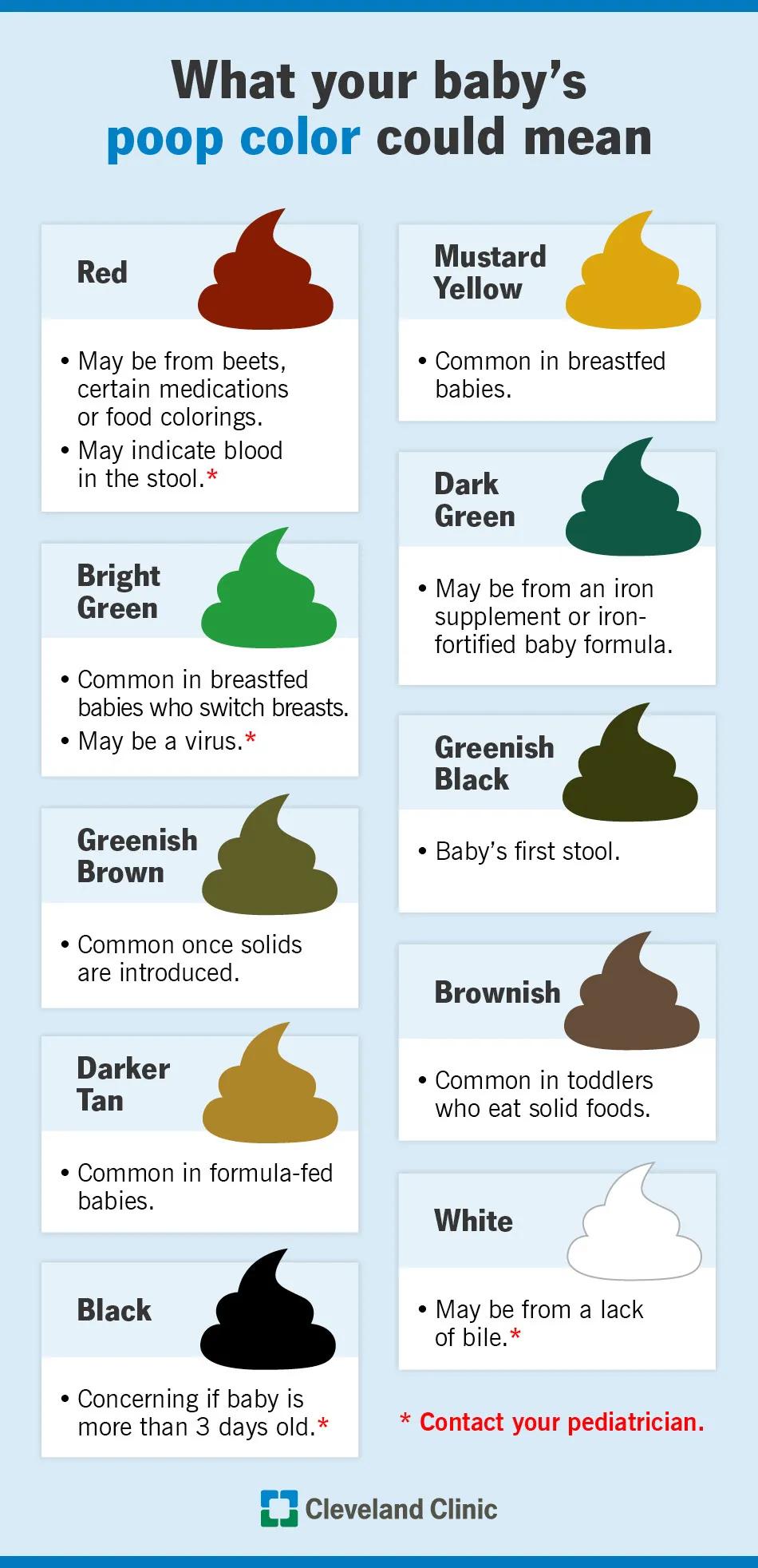
Image content: This image is available to view online.
View image online (https://assets.clevelandclinic.org/transform/e892867d-4919-4d82-9eb5-4c68489e84f0/color-of-baby-poop-inset)
Baby’s first stool, within the first few days of life, called meconium, rids your newborn baby of all the materials swallowed in utero: amniotic fluid, intestinal epithelial cells, lanugo, mucus, bile and water. (If you don’t see it within 48 hours, mention it to your pediatrician.)
It’s very sticky and you may need an entire tub of wipes for this one.
“After the first few days, meconium stools should never be black again,” says Dr. Sherman. “If the stool is black, white, clay-colored or you can see blood or mucus in the stools, you need to call your pediatrician and let them know.”
Advertisement
In their first week of life, breastfed babies have three to four mustard-yellow, seedy, loose stools every 24 hours. Many babies poop after each feeding, so don’t worry about not using up the newborn-size diapers before they outgrow them. Later on, they may continue to poop after nursing, or only poop once a week. Either is normal.
Formula-fed babies have thicker, darker stools once a day (or more often) from day one. They’re usually tan but can also be yellow or greenish. The consistency is similar to peanut butter or hummus.
Should you freak out if baby poop is a green color? Not necessarily. Once you introduce solids, know that you’ll find a new “guacamole-esque” hue awaiting you at diaper changing time. As more foods are added, you might notice other colors — such as orange and yellow — and occasionally, whole beans or raisins. Formula can also make your baby’s poop green.
Toddlers’ stools gradually bulk up to a Play-Doh®-like consistency. Toddlers should poop daily or every other day, and most importantly, the consistency should be soft-formed, like a log or canoe shape. It shouldn’t be hard or lumpy. The downside of toddler poop? It starts smelling more like regular grown-up poop.
A thick, dark-as-a-pine-tree-at-night poop may look off-putting, but it’s typically no cause for concern. The most usual culprit: an iron supplement or iron-fortified baby formula. The discoloration has no effect on your baby’s health — just possibly your appetite!
This hue may be seen in breastfed babies who switch breasts often, consuming more lower-fat than full-fat milk. Try nursing until your baby drains the breast before switching. Viruses can also cause bright green stools, so contact your pediatrician if your baby isn’t acting as they normally do.
Baby poop shouldn’t be red. The harmless causes? Eating beets, certain medications or food colorings. But red streaks in a diaper may indicate blood in the stool. Small amounts may be caused by constipation, while larger amounts are cause for a greater concern. If there is red stool in the diaper, call your pediatrician and bring in a stool sample for them to test for blood.
Ghostly-looking poop is no joking matter. If your baby isn’t producing bile (which gives your stool its characteristic color), it will look colorless, white or chalky. This can be a sign of a serious liver or gallbladder problem. You should call your pediatrician right away.
Advertisement
While tar-like stools are normal in newborns, they’re a cause for concern if your child is more than three days old. Called melena, this type of thick, black stool may be a sign that blood has entered your baby’s gastrointestinal tract.
“Brown, yellow and green are all normal baby poop colors,” says Dr. Sherman. “It can often go back and forth between them, but if it’s yellow, brown or green you likely have nothing to worry about.”
Some babies poop with every feed and other babies poop every five to seven days. If your baby is one who poops less frequently, as long as they are going once a week, their abdomen doesn’t get distended, and they aren’t overly fussy or irritable, then you can have peace of mind.
“Stool patterns typically change around two to three months,” he adds. “Often, babies will poop multiple times per day and then, around two to three months of age, this changes to daily or every other day. As long as the stools are soft, this is nothing to be concerned about.”
You may also encounter times when your baby has diarrhea or constipation.
While baby poop isn’t as solid as adult poop, if it’s extremely loose and watery — that’s diarrhea. Don’t ignore these diapers, as they can be a sign of an infection and put your little one at risk for dehydration.
Advertisement
Other causes: food sensitivities/allergies, giving your toddler too much juice, a side effect of antibiotics, or a symptom of inflammatory bowel or celiac diseases. Call your pediatrician if it lasts for more than 24 hours. Most cases resolve in two to three days.
If your baby is straining before bowel movements and producing dark, hard stools, your little one is constipated. Sometimes, it’s just that a baby’s digestive tract absorbs too much water — ask your pediatrician because there may be some simple solutions.
Other possible causes: food sensitivities/allergies, dehydration or, in rare cases, more serious conditions such as anatomical problems, thyroid dysfunction, metabolic disorders or Hirschsprung’s disease.
As your baby grows, you’ll come across a whole variety of poop colors and textures.
“Odds are, over the course of changing hundreds of diapers, you’re sure to run across a few that surprise you,” shares Dr. Sherman. “Since it’s not always easy to tell what’s normal and what’s not, call your pediatrician if you have any doubts.”
Advertisement

Sign up for our Health Essentials emails for expert guidance on nutrition, fitness, sleep, skin care and more.
Learn more about our editorial process.
Advertisement
Get help if it lasts more than a couple days or comes with other worrying symptoms
For a more efficient and pleasant bathroom routine, raise your feet onto a small stool and don't overdo the wiping
Bowel movement frequency varies person to person, ranging from a few times a day to a few times per week
There’s usually a simple answer, like what you ate, but the color can also be a cause for concern

Excess mucus, ulcers, a high-fat diet and pancreatic conditions can make stool sticky

Stomach bugs, foods and excess bile or fats can cause yellow diarrhea

Diet offers a rainbow of possibilities when it comes to the hue of your stool

Yes, diarrhea is common after drinking too much alcohol — and the best treatment is to hydrate and wait it out

Rapid weight loss can cause loose skin, facial volume loss and body contour changes

Swallowing too much air, certain foods and drinks, and digestive conditions can all make you belch more

From poor hand hygiene and ventilation issues to contaminated food, many factors can make infectious diseases spread quickly
 Search










