Locations:





Changes to your vision may have an impact on the way your brain processes information
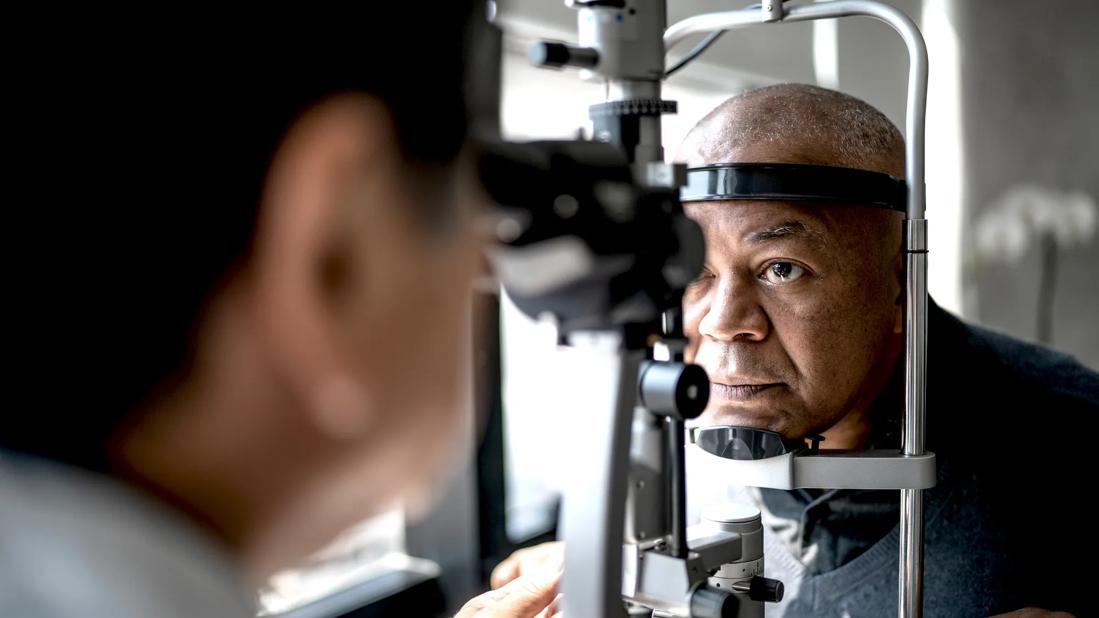
Image content: This image is available to view online.
View image online (https://assets.clevelandclinic.org/transform/41ce6d47-03a9-46fd-a07f-8d4a857c7940/eye-exam-1343839248)
Person with head against eye exam equipment, with provider looking through other end at eyes
Sometimes, you have to see something to believe it — and that’s at least partially true when it comes to dementia. Studies have shown that vision loss, impairment or other changes to your vision can predict dementia up to 12 years before an actual diagnosis.
Advertisement
Cleveland Clinic is a non-profit academic medical center. Advertising on our site helps support our mission. We do not endorse non-Cleveland Clinic products or services. Policy
That means treating vision issues and testing your vision on a regular basis may help healthcare providers catch early signs of dementia far sooner than normal.
Neuropsychologist Aaron Bonner-Jackson, PhD, explains why your eyes can be a window into dementia, how your vision connects with cognitive function and what you can do to reduce your risk of developing dementia down the line.
Vision loss and changes to your vision are often associated with early signs of dementia. That’s because our brains have the ability to process, interpret and perceive information based on what we see with our eyes. From reading books and scanning articles to understanding depth perception and spatial awareness while driving on the road — our eyes not only help us navigate, but they also inform our understanding of the world around us.
“If you’re not properly processing information visually, that can have an effect on your brain function if you’re not seeing things well or if you’re not properly visually processing,” says Dr. Bonner-Jackson. “These vision changes can result in some reduced stimulation for your brain, as will the isolation if you’re not getting out and doing things and engaging in your normal activities.”
Advertisement
The Lancet Commission on Dementia Prevention, Intervention and Care has identified 14 lifestyle risk factors that can reduce your risk of developing dementia if you modify or address them during the course of your life. By improving on the following 14 risk factors, they estimate that up to 45% of all cases of dementia are potentially preventable:
“All those things that are associated with poor brain function, poor brain health and dementia are also associated with vision changes,” says Dr. Bonner-Jackson.
For example, if you have diabetes and it’s not well-managed, that can affect your vision while also affecting your brain function and putting you at elevated risk for stroke.
“We think all of these things are tied together,” he adds. “Vision changes can trigger further changes that then can lead to dementia, or changes in the brain related to dementia could also have effects on vision. It could go both ways.”
A recent study found that changes to vision sensitivity may be an early predictor of dementia. After a follow-up period of up to 14.8 years, researchers discovered that 533 out of 8,623 participants, aged 48 to 92, developed dementia.
All 8,623 participants were given a simple and complex visual sensitivity test to assess their visual processing speed and reaction times at the start of the study. During these tests, participants were instructed to hit the space bar as soon as they detected a triangle forming in a field of moving dots.
The 533 individuals who eventually developed dementia showed slower visual processing speed and reaction times than those who never developed dementia. Those same individuals also self-reported having other conditions associated with dementia such as diabetes, stroke and visual and hearing problems.
Vision loss and changes to your vision don’t always lead to dementia, but they can certainly increase your risk of developing the condition down the line. If you have a family history of dementia, working on reducing your risk by focusing on the 14 modifiable lifestyle risk factors is just as important as trying to reduce your risk for heart disease, diabetes and other chronic conditions that directly impact cognitive function.
“We want to help people keep their vision as healthy as possible for as long as possible because we know that those who have poor vision are much more likely to have cognitive decline in dementia,” notes Dr. Bonner-Jackson. “That’s why it’s important to have regular vision check-ups.”
Advertisement
Making sure your vision is corrected as well as possible, and removing or remedying issues that are potentially causing vision problems like cataracts or treating conditions like macular degeneration and glaucoma can help reduce your risk for developing dementia down the line.
Advertisement

Sign up for our Health Essentials emails for expert guidance on nutrition, fitness, sleep, skin care and more.
Learn more about our editorial process.
Advertisement

Delirium is a sudden change in mental status, while dementia is a long-term, progressive decline

If you’re frequently dealing with short-term memory loss, confusion or issues around spatial awareness, you may need to see a neurologist

Alzheimer’s is just one common cause of cognitive decline categorized as ‘dementia’
Your risk for familial Alzheimer’s disease and other forms of hereditary dementia increases if an immediate family member has it

Difficulty staying asleep at night or sleeping too much during the day are common issues

A Q&A to help you understand the research — and how to protect you and your loved ones

Socializing is linked to a healthier and more resilient brain, while loneliness can lead to an increase in dementia symptoms

Memory gaps can trigger uncertainty and confusion, which can cause this common symptom

Managing your weight through physical activity may lower your chances of getting this common cancer

It typically starts in October and winds down in early spring, with cases at their highest in the middle of winter

Anxiety disorders, health conditions and past trauma can make driving nerve-wracking — help is available
 Search










