Locations:





Getting back to normal after a head injury takes time — and patience
If you’ve had a concussion, don’t think of your recovery as a get-over-it-quick sprint. Your brain needs time to rest and recover. The process is a gradual journey, made one careful step at a time.
Advertisement
Cleveland Clinic is a non-profit academic medical center. Advertising on our site helps support our mission. We do not endorse non-Cleveland Clinic products or services. Policy
“There’s no one-size-fits-all recovery timeline for concussions,” says sports medicine specialist Marie Schaefer, MD. “But following a structured, symptom-guided plan helps people safely get back to their normal routines — and back to play if they’re athletes.”
Here’s what concussion recovery typically looks like, step by step.
Video content: This video is available to watch online.
View video online (https://cdnapisec.kaltura.com/p/2207941/sp/220794100/playManifest/entryId/1_9317t83e/flavorId/1_5f3sgelj/format/url/protocol/https/a.mp4)
Concussion recovery starts with relative rest to avoid symptom flare-ups. Begin light activity as tolerated, since gentle movement may support healing.
Recovery from a concussion is typically mapped out in six stages that take you from rest to a full return to activity. How quickly you move through each step depends on your symptoms and how your brain responds to the challenge.
Let’s walk through each stage and how they fit into your recovery plan.
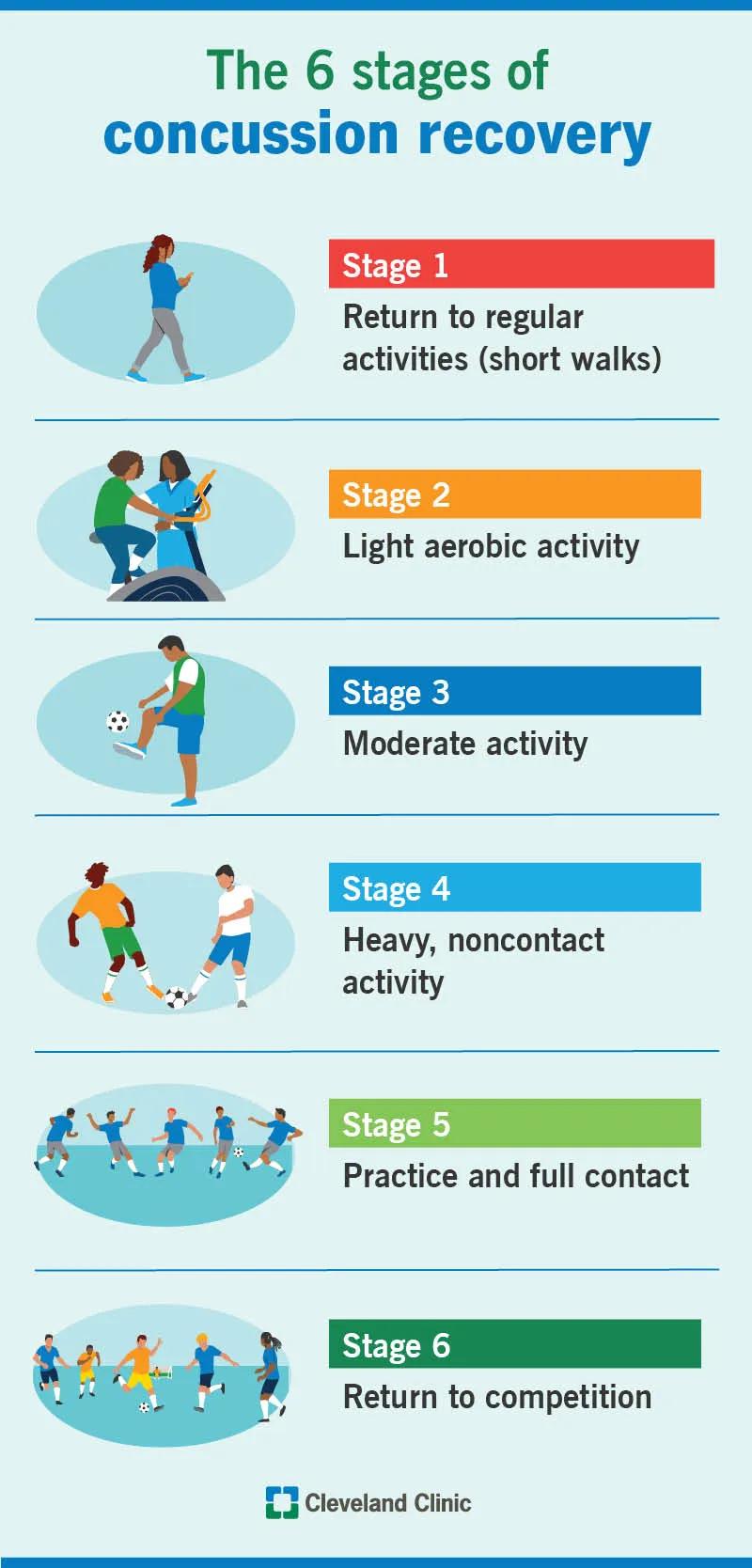
Image content: This image is available to view online.
View image online (https://assets.clevelandclinic.org/transform/7e665f9f-8434-490c-b70f-a12bd073a473/6-Stages-ConcussionRecovery-infographic-final)
This initial recovery stage focuses on relative rest. That means you should feel free to move around a bit and engage in limited daily activities, as long as you feel steady on your feet and comfortable.
You don’t necessarily need total isolation in a dark room, cut off from all technology or outside contact, Dr. Schaefer emphasizes.
That being said, it’s important to listen to your body and brain.
“Over these first few days, you should stop doing an activity if it’s making symptoms worse or bringing them back,” she continues. “Take a break if something makes your headache spike or brings on dizziness. You shouldn’t try to ‘push through’ concussion recovery.”
Advertisement
Dr. Schaefer recommends scoring your symptoms on a scale of 1 to 10. If your discomfort level doing an activity is 3 or higher, it’s a sign you’ve done too much.
During this stage, try to:
Once your concussion symptoms begin to lessen, gently reintroduce exercise once you feel up to it. Look for light or mild physical activities without aggressive up-and-down or side-to-side motions. That means nothing that involves running or jumping.
“Walking or using a stationary bike are great ways to start,” suggests Dr. Schaefer. “Avoid anything with bouncing or head movement, as that might worsen your symptoms.”
Stay away from the weight room at this stage, too: “Lifting weights increases your intracranial pressure and blood pressure, which can put too much stress on your brain early on in the recovery pattern,” she cautions.
You can try some light resistance training exercises using your body weight, but stop if symptoms return or worsen.
Spend at least two full days at this stage with no symptom flare-ups before the next step.
You’re making progress! Given that, you can increase your activity intensity level, like going from walking to slowly jogging. “It’s all about taking a small step forward in the recovery process,” says Dr. Schaefer.
If you’re in a sport, look to reintroduce noncontact drills specific to your activity. That could include things like:
These drills are typically done off to the side at a team practice. “You want to be away from the main activity area, where it’s more likely you could accidentally get hit in the head by something,” notes Dr. Schaefer.
A light weightlifting session is OK at this stage, but keep the weight low and reps to a minimum to avoid straining.
“These activities should feel easy,” she explains. “If you feel worse after doing something, that’s a sign you’re trying to do too much. Scale things back and try again the next day.”
Spend at least one full day at this stage before going to the next.
Advertisement
It’s time now to return to a full workout — just without any contact to avoid potential reinjury. You can ramp your weightlifting routine back up to normal levels, too.
Athletes can rejoin team drills, condition with their teammates and up the intensity level. The only caveat? It’s still best to sit out scrimmages or training sessions where you might get conked on the head.
“Focus on staying sharp and symptom-free,” says Dr. Schaefer. “If you feel good through a full day of this stage, you’re likely ready for full practice with no restrictions.”
Now, you’re back in full practice, including contact if your sport involves it. But it isn’t game day just yet.
“We know athletes are more likely to get re-injured in a game than in practice,” reports Dr. Schaefer. “So, we always make sure they can handle contact in practice first before any sort of competition.”
Once you’ve completed a day of full-contact practices without symptoms, you’re ready to return to competition or full activity.
But it’s critical not to rush this.
“Your brain is at its most vulnerable right after a concussion,” emphasizes Dr. Schaefer. “If you return too soon and get hit again, your recovery could take much longer — or the symptoms could be worse.”
Advertisement
Following a step-by-step recovery plan after a concussion isn’t just about playing it safe. It’s about the healing process. Each stage gives your brain the chance to adjust, respond and recover fully.
“The stages help you monitor how your brain is doing,” says Dr. Schaefer. “If you try something and feel worse, that tells us something isn’t right. There’s some trial and error to it — and you need to be honest with yourself during the process as to how you feel.”
Remember this, too: Pushing through concussion symptoms can set you back. Progress happens when you listen to your brain — and take recovery one careful step at a time.
Advertisement

Sign up for our Health Essentials emails for expert guidance on nutrition, fitness, sleep, skin care and more.
Learn more about our editorial process.
Advertisement

It’s a myth that you should avoid sleep (or have someone wake up throughout the night) after a head injury
Yes, there is a connection between this injury and disease, and not just for athletes who play high-impact sports

Both are a collection of blood in your brain, but they happen in different parts, for different reasons and with different symptoms

Watch for severe symptoms in older kids and adults, but kids under age 2 should always see a provider

Receiving this diagnosis can be scary, but there are ways to manage symptoms and reduce stress
Repeated trauma over time can have a cumulative effect
Researchers are testing a new immunotherapy for brain cancer
Consider the severity and location of your arthritis to decide on the right support

Managing your weight through physical activity may lower your chances of getting this common cancer

It typically starts in October and winds down in early spring, with cases at their highest in the middle of winter

Anxiety disorders, health conditions and past trauma can make driving nerve-wracking — help is available
 Search