Locations:





Getting the right flange fit can make pumping breast milk more comfortable and effective
Maybe pumping breast milk isn’t going as well as you hoped. You may not be getting as much as you expected. Or maybe your nipples are sore. What gives? The flange size you’re using could be the problem.
Advertisement
Cleveland Clinic is a non-profit academic medical center. Advertising on our site helps support our mission. We do not endorse non-Cleveland Clinic products or services. Policy
The flange size is the width of the tunnel that your nipple goes into. But one size doesn’t fit all — or even most — when it comes to flanges.
“Everyone’s body is different. And it’s common for nipples to stretch or change shape while breastfeeding or pumping,” explains pediatrician and breastfeeding medicine specialist Heidi Szugye, DO, IBCLC. “That’s why it’s important to check the fit often and adjust if needed.”
Finding the right fit might feel like rocket science amid postpartum brain fog. But Dr. Szugye breaks down the steps and what a well-fitting flange looks and feels like.
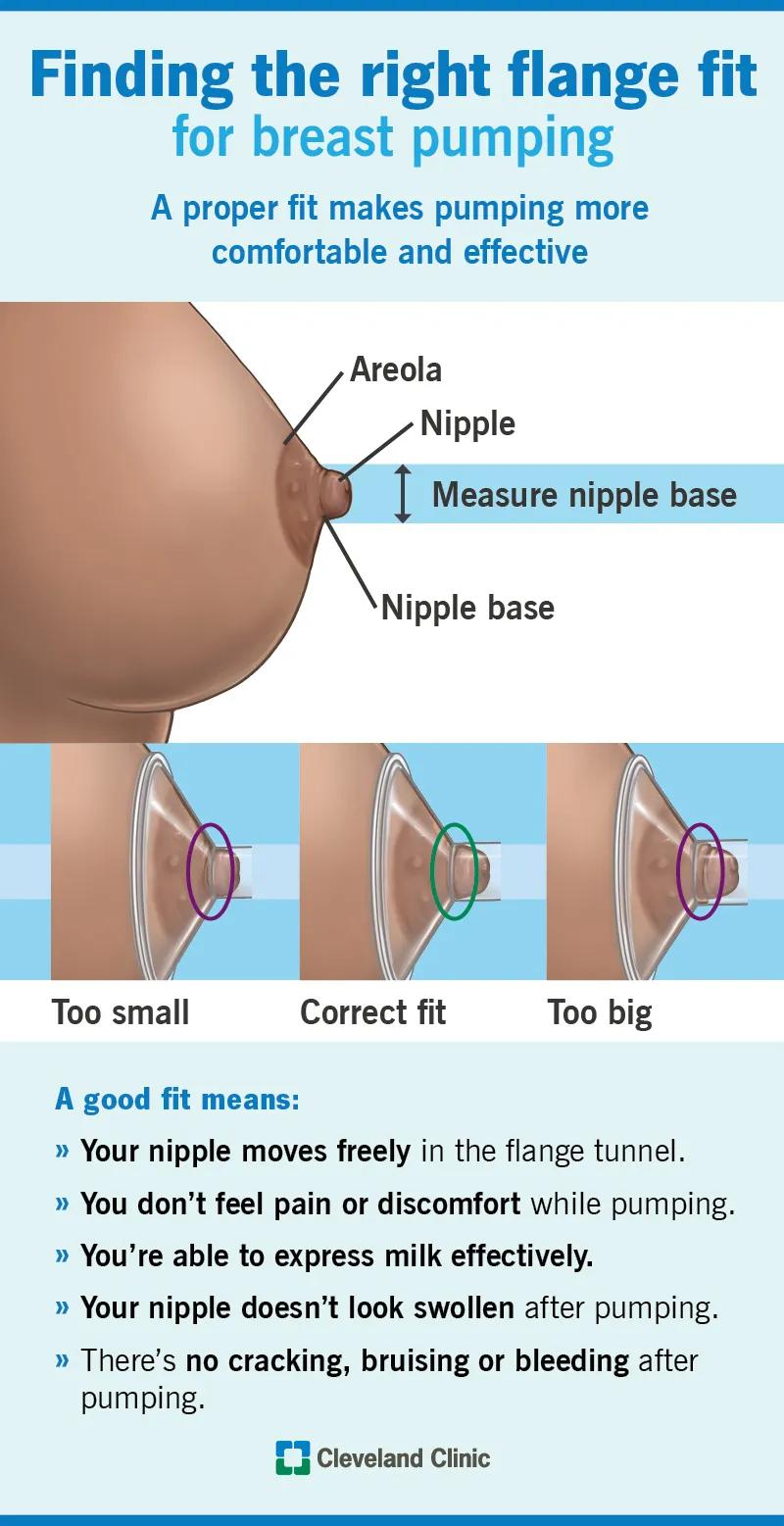
Image content: This image is available to view online.
View image online (https://assets.clevelandclinic.org/transform/de17b2e4-be5e-4a29-bad4-b2d749729507/BreastPumpFlangeSize-infographic-master-800x1557)
The flange (breast shield) is the cone-shaped cup that looks a bit like a small megaphone. The flange part rests on your areola and breast. The tunnel is where your nipple moves in and out. “A proper flange fit makes pumping comfortable, prevents nipple trauma or swelling, and allows for effective milk removal,” Dr. Szugye says.
Almost all flange tunnel sizes are measured and labeled in millimeters (mm). Sizes range from 13 mm to over 30 mm. Many breast pumps come with a standard “medium” size (usually around 24 mm). But this doesn’t fit everyone.
The right flange size mainly depends on the size (width) of the base of your nipples.
Advertisement
If you’re still pregnant and eager to know your size, it may be best to wait until after birth. “Hormones can change your nipple size throughout pregnancy and after birth,” she adds. “Measuring too early may lead to frustration later when it’s time to pump. But it can give you a general ballpark.”
A lactation consultant or breastfeeding medicine specialist can help you through the measuring process. Or you can do it at home following these steps.
Using your pointer finger and thumb, gently roll your nipple for a few seconds to stimulate it. Think of your nipple as a radio dial. Do this before pumping or nursing when your nipples are in a “neutral” state.
Use a measuring tape or a printable measuring ruler to find the width (diameter) of your nipple. If your breast pump brand has a printable ruler, it may help to use that.
Measure your nipple in millimeters at the widest part. This is typically the base of your nipple. Don’t measure your areola — the darkened tissue around your nipple.
Measure both nipples, as they may be different sizes.
So, now you have your nipple measurement. That’s it, right? Not quite.
“Most women find that adding 2 to 4 mm to their nipple size provides the most comfortable and effective flange size,” Dr. Szugye explains. “But there’s no evidence-based tried and true formula — this just gives you a starting point. Like shoes, sometimes, you have to try different sizes and see what works best.”
For example, if your nipple is 18 mm, it may fit best in a 20 mm or 21 mm flange. But for some, 18 mm may also work.
On top of that, flanges typically increase in 3 to 4 mm increments (for example, from 21 mm to 24 mm). So, you may need an insert that goes into a bigger flange to create the best fit.
If this math has you confused, reach out to your provider or a lactation consultant for help.
You may be wondering what a good flange fit looks and feels like. Especially when your nipple may act or look differently under a pump’s suction.
A good fit means:
Here are some tips for getting the best fit:
Advertisement
The main signs that your current flange size isn’t right for you are pain and less milk output than expected. The specific signs vary a bit depending on whether the flange is too small or too big for you.
If your current flange is too small, you may:
If your current flange is too big, you may:
It may take a few days to receive the correct flange size if you’ve ordered it online. To try to save your nipples while you wait, you can care for them in these ways:
If the thought of using your breast pump has you wincing, consider hand-expressing breast milk. You likely won’t get as much milk out. But it can give your nipples a rest until you get your new flange.
Advertisement
Pumping is a lot of work. It’s OK to feel frustrated — the wrong flange size can cause irritation in more ways than one. The good news is that the proper size can make a world of difference.
“Any breast milk is beneficial to your baby,” Dr. Szugye reinforces. “Try to take it one session at a time and get support.”
Advertisement

Sign up for our Health Essentials emails for expert guidance on nutrition, fitness, sleep, skin care and more.
Learn more about our editorial process.
Advertisement
Proper timing and storage matter when it comes to harvesting this liquid gold
A flexible pumping schedule, the right gear and a few smart habits can make pumping at work smoother and more successful

Look at weight gain, wet diapers, signs of dehydration and more

Yes, you can have honey if you’re breastfeeding — but never feed it directly to babies under 1

Intermittent fasting could impact your milk supply and energy levels, so it’s best to wait until you’ve weaned your baby from nursing
Ease into exercising, focus on sleep and follow a balanced diet — and be patient with yourself

If your baby has problems switching between breast and bottle, talk to your provider to get to the bottom of the confusion

It’s highly unlikely your baby will have an allergic reaction to food you eat while you’re breastfeeding

Managing your weight through physical activity may lower your chances of getting this common cancer

It typically starts in October and winds down in early spring, with cases at their highest in the middle of winter

Anxiety disorders, health conditions and past trauma can make driving nerve-wracking — help is available
 Search










