Locations:





Feelings of stress or anxiety can cause an increase in hormones and a tightening of the chest muscles, which can lead to chest pain
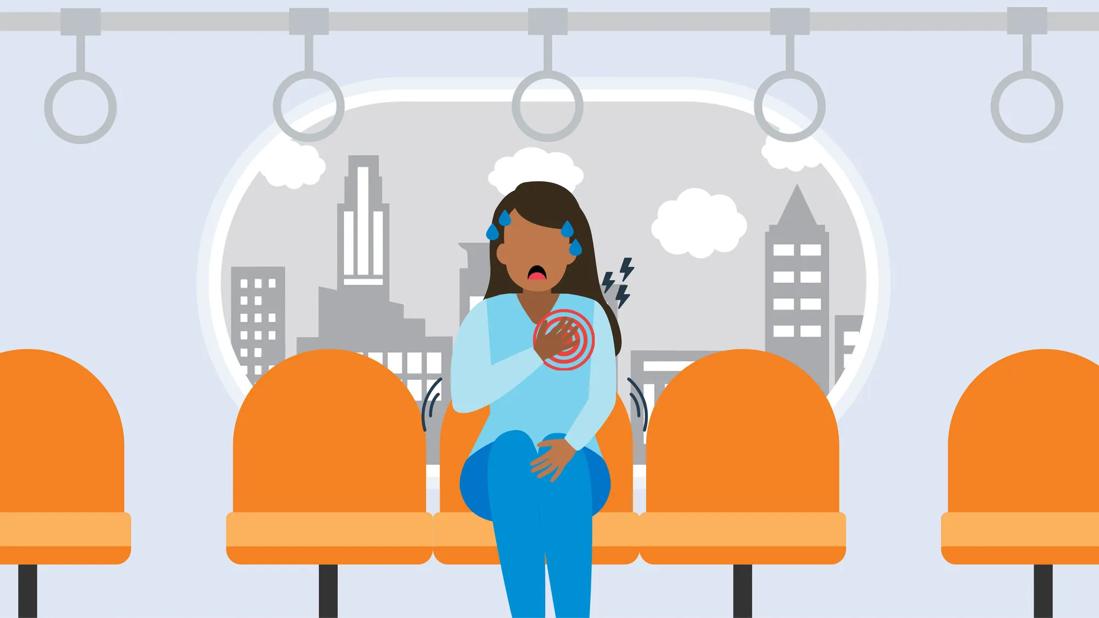
Image content: This image is available to view online.
View image online (https://assets.clevelandclinic.org/transform/77dc807e-9b33-43c5-a6c8-a370a4a1b78c/anxiety-chest-pain-train-1721833337)
A person sitting on a train sweats and clutches the left side of their chest, which has a red target over it
When you become overly anxious, your brain sends a series of alarm bells to the rest of your body. Sometimes, it’s more subtle, like sweaty palms or faster breathing. Other times, anxiety can cause chest pain.
Advertisement
Cleveland Clinic is a non-profit academic medical center. Advertising on our site helps support our mission. We do not endorse non-Cleveland Clinic products or services. Policy
This can feel alarming, but it’s more common than you think. When your body goes into fight-or-flight-mode, it causes a rush of hormones that can lead to a sharp pain in your chest.
“The body is very wise,” asserts behavioral health specialist Leopold Pozuelo, MD. “It picks up when there’s a lot of emotional overload going on. When chest pain occurs from anxiety, there’s a heart, brain and body connection happening.”
Here, Dr. Pozuelo explains why anxiety can cause chest pain, and how to identify it.
When you start feeling your anxiety in your chest, a couple different things are happening at once. Your body releases adrenaline and cortisol into your bloodstream. This can cause physical symptoms like an increased heart rate and hyperventilation.
This combined burst of energy puts stress on your muscles and can cause spasms in your chest. “When you feel that pain in your chest area, it’s your intercostal muscles, which are between your ribs, that are getting a workout,” Dr. Pozuelo points out. All of these factors together contribute to a sharp pain in your chest.
“At the same time, you’re also feeling heart palpitations caused by anxiety, as well,” Dr. Pozuelo continues. “So, you’ve got this storm of energy happening.” Not to mention, the sudden chest pain likely makes you more anxious, making the discomfort worse.
Advertisement
Anxiety-induced chest pain doesn’t only happen when you’re in the middle of a stressful situation. Sometimes, you may feel like you’re having a full-blown panic attack, but other times, you may feel “fine” when the pain suddenly hits.
You may be carrying a lot of stress that you don’t feel on a conscious level, or maybe it’s not at the forefront, notes Dr. Pozuelo. But it can still affect you. That sudden chest pain is your body letting you know that you may be holding onto some stress that you’re not addressing.
Chest pain due to anxiety can feel like a sudden, sharp stabbing in your chest area. The pain can slowly fade but still linger throughout the center of your chest.
It’s also common to experience symptoms alongside the chest pain, including:
According to Dr. Pozuelo, it’s hard to pinpoint exactly how long anxiety-related chest pain can last. “The pain can go on for minutes, or even an hour or two,” he points out.
“Because these events of anxiety tend to linger, the symptoms tend to last for a while, too,” says Dr. Pozuelo.
Eventually, the pain should go away on its own. It’s not forever, even if it may feel like it in the moment.
However, if you experience this for the first time, it is a good practice to talk to your doctor first to make sure it’s not a cardiac source of chest pain.
It’s understandable to feel like any kind of chest pain is tied to a heart attack. The combination of symptoms can feel frightening in the moment. But even if you’re feeling an increased heart rate and heart palpitations, it doesn’t necessarily mean you’re having a cardiac event.
Here’s what to keep in mind: “Chest pain due to anxiety is typically a little more of a sharp type of pain rather than a heavy, crushing weight like most people describe cardiac-related pain,” Dr. Pozuelo emphasizes.
He also adds that chest pain due to a heart attack tends to radiate to your arm, shoulder or even jaw area.
You can do a couple of things to find relief from anxiety-induced chest pain. If you’re feeling that sudden sharpness in your chest, here’s what you can do in the moment:
Advertisement
While you may not need to run to the emergency room due to anxiety-related chest pain, it’s still a good idea to get it checked out by your healthcare provider. If your anxiety or stress is causing this intense physical symptom, it may be a sign that your mental health is affecting your physical health. Your healthcare provider can help you by assessing the pain you’re feeling, providing more tools for relief and referring you to a counselor or psychiatrist.
Advertisement

Sign up for our Health Essentials emails for expert guidance on nutrition, fitness, sleep, skin care and more.
Learn more about our editorial process.
Advertisement

It’s an emergency if the pain doesn’t go away, gets worse or you have other worrying symptoms
From heartburn and panic attacks to muscle spasms and heart attacks, lots of medical conditions can cause chest pain
If you have other cardiac symptoms, and antacids aren’t working, it’s time to call emergency services

If your provider has ruled out a serious cause, you can treat chest pain at home with antacids, inhalers or anti-inflammatory medications
Don’t ignore chest pressure that lingers and can’t be explained
Not all chest discomfort is a symptom of a heart attack
Why the condition, also called jackhammer esophagus, is missed
That unnerving sense that something terrible is about to happen can be a sign of serious distress — trust your gut

Managing your weight through physical activity may lower your chances of getting this common cancer
It typically starts in October and winds down in early spring, with cases at their highest in the middle of winter
Anxiety disorders, health conditions and past trauma can make driving nerve-wracking — help is available
 Search










