Locations:





Overusing your biceps can cause inflammation
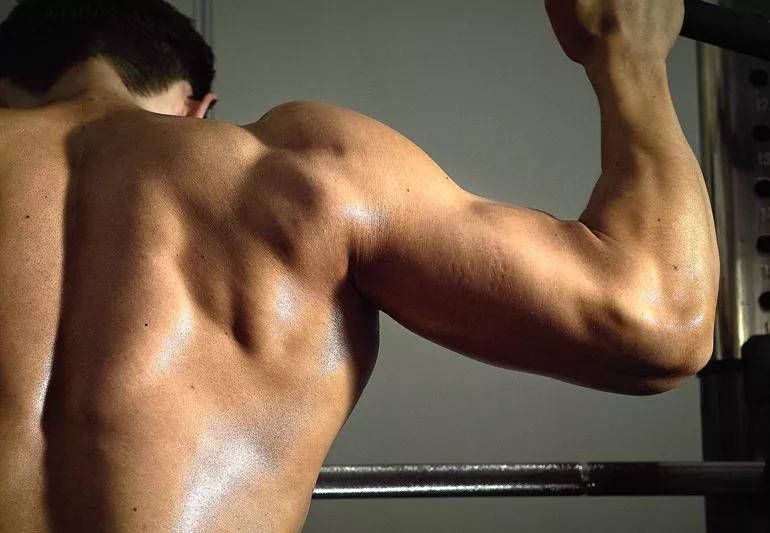
Image content: This image is available to view online.
View image online (https://assets.clevelandclinic.org/transform/e0016f17-028b-438f-8aba-2c6692e0bad4/bicepPopeye-1010358974-770x533-1_jpg)
man lifting weights for biceps
Lifting weights can help strengthen and tone your upper arms. But if you overdo it when lifting weights or even just moving heavy boxes, you can make your biceps pop — and not in a good way. A tear can produce a painful injury known as a Popeye deformity.
Advertisement
Cleveland Clinic is a non-profit academic medical center. Advertising on our site helps support our mission. We do not endorse non-Cleveland Clinic products or services. Policy
There are two tendons in your biceps — one connects to the short head of the biceps and the other connects to the long head. The long head of your biceps goes into your shoulder.
“When that tendon tears, your muscle contracts like a ball that looks like Popeye when he eats spinach, which is why this injury is colloquially known as the Popeye deformity,” says sports medicine physician Dominic King, DO.
Here are three ways to avoid this injury.
Overusing your biceps over time can inflame the tendons. If those inflamed tendons are not properly treated, they can lose their ability to function.
“That degeneration can cause weakness and can lead to a tendon tearing and rupturing,” Dr. King says.
So try not to overwork your muscles. And don’t lift heavy objects on your own. Ask for help, he advises.
If you’re lifting something heavy from the floor, always bend at the knees instead of bending over from the waist. Also, never lift something heavy above your shoulders.
Be careful if you’re learning a new weightlifting technique or starting a new, intense fitness training regimen, such as CrossFit.
Even if you’re feeling fine and feel as though you’re in great physical shape, you always want to go low and start slow, Dr. King says.
Advertisement
“If you’ve never lifted heavy weights or participated in CrossFit or done those big, explosive types of boot camps, you really should ease into it,” he says. “In addition to the chronic change your tendon undergoes before tearing, a large load placed on your arm very quickly is what typically causes it to tear.”
There’s a difference between soreness and pain and it’s important to understand that difference. Soreness is a discomfort that you get after exercising that goes away in a couple of days after rest. Pain is something that you experience during exercise.
“If you have significant pain during activity, it’s a warning sign from your body telling you that this is not just the normal soreness you get from exercising and using muscles,” Dr. King says. “There actually might be something wrong.”
Immediately stop the activity once you start to feel pain, he advises. Anti-inflammatory medicine and icing the source of the pain may help at the beginning. But don’t ignore the pain if it continues.
“If there is damage, your body is actually really good at taking care of it,” he says. “But if your body cannot take care of it on its own, taking anti-inflammatories and icing for months on end will not heal what is going on. It will reduce some inflammation but it will not actually fix what’s wrong.”
If you have significant pain for longer than two weeks and it is reducing your ability to function, it’s time to see a physician.
For this type of injury, your doctor will evaluate your entire shoulder to make sure there’s no rotator cuff tear or other shoulder damage, Dr. King says.
“If it’s just a tear of the long head biceps tendon, it’s routinely taken care of non-operatively,” he says. “In the short term, we work on range of motion to ensure that the shoulder doesn’t get stiff.”
Since the Popeye deformity causes a large amount of bruising and swelling, alternating between warm compresses and ice can help in reducing inflammation and keeping the muscles from getting stiff.
Through physical therapy, patients will undergo a progressive program of stretching and strengthening to get back as much normal function as possible, Dr. King says.
“John Elway [former Denver Broncos quarterback] tore his long head biceps tendon and he didn’t get it surgically fixed,” he says. “And he went on to win two Super Bowls.”
Advertisement

Sign up for our Health Essentials emails for expert guidance on nutrition, fitness, sleep, skin care and more.
Learn more about our editorial process.
Advertisement

Managing your weight through physical activity may lower your chances of getting this common cancer
Physical activity, even a couple times a week, can potentially benefit your sex life and overall health over time
It helps to build up your strength and balance before tackling these more resistance-heavy TRX exercises
Glute bridges are simple bodyweight exercises worth adding to any workout

Any extra calorie burn from exercising in cold or hot temps is minimal
The amount you sweat doesn’t affect how many calories you burn

Stay afloat with bicycle kicks, alternating punches and water jogging
Aerobic, strength training, flexibility and balance exercises are all important parts of maintaining movement

Hormonal changes, a slower metabolism and muscle loss can make weight gain more common around menopause — healthy habits can help you manage it
Life-threatening complications include sepsis, stroke, pneumonia and more
Fruity-smelling breath can happen when your body burns fat for energy, and in some cases, can signal a medical emergency
 Search










