Locations:





The terms are often used to describe intense feelings of fear and anxiety
You were fine a minute ago. Now, your heart is racing, your hands and feet have gone numb, and you feel like you can’t get enough air. You’re stressed out.
Advertisement
Cleveland Clinic is a non-profit academic medical center. Advertising on our site helps support our mission. We do not endorse non-Cleveland Clinic products or services. Policy
So, are you having a panic attack or an anxiety attack? Or are they the same thing?
Clinical psychologist Regina Josell, PsyD, explains what’s going on when your body goes haywire — and how to get back to a place of calm.
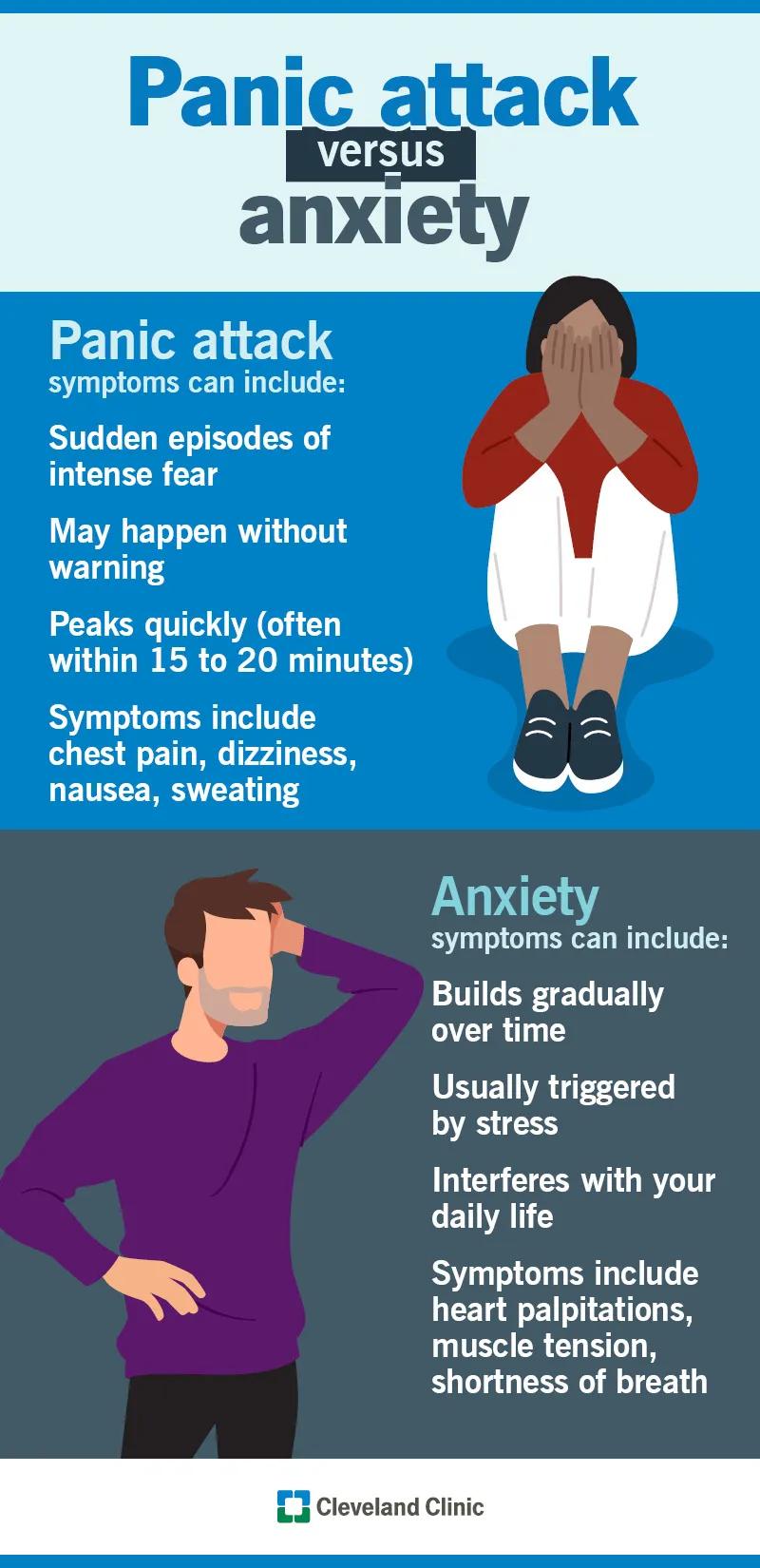
Image content: This image is available to view online.
View image online (https://assets.clevelandclinic.org/transform/2e5c1db5-ccd8-4b4f-abb6-7d2e752f3a66/panic-atack-versus-anxiety-infographic)
A lot of people use the terms “panic attack” and “anxiety attack” interchangeably, but panic attacks and anxiety attacks are slightly different beasts.
The main difference is that certain stressors often trigger anxiety, and they may build up gradually. In contrast, panic attacks typically happen unexpectedly and suddenly.
Panic attacks are intense attacks of fear and uneasiness that may occur without warning. A key factor in panic disorder, they often occur in response to a stressful event. For example, if you have a phobia of flying, getting on an airplane could trigger a panic attack.
But sometimes, they strike for no apparent reason.
“The body’s fight-or-flight response gets triggered when it shouldn’t,” says Dr. Josell. “The body thinks it’s in danger, but it’s not.”
Panic attacks are scary, but they’re not dangerous and usually last just 15 to 20 minutes. (Though that feels like a long time when you’re in the middle of one.)
We don’t know exactly what causes a panic attack. It may have something to do with your amygdala, the part of your brain that deals with emotions. An imbalance of hormones like cortisol and serotonin may also cause them.
Advertisement
Certain factors can also contribute to panic attacks, such as:
By definition, a panic attack features four or more of these symptoms:
Unfortunately, if you have one panic attack, it’s common to have another. People often become so worried about it happening again that it becomes a self-fulfilling prophecy, shares Dr. Josell.
“People sometimes start to avoid certain situations or places where they had a panic attack before,” she says. “They might even avoid leaving home.”
To tackle panic attacks, mental health professionals often use a technique known as cognitive restructuring. You learn to identify and change the thoughts that go hand-in-hand with panic triggers.
“Once you learn to manage those thoughts instead of dreading them, it tends to reduce both the intensity and frequency of the panic attacks,” Dr. Josell says.
There are some strategies you can try at home to help, like:
An anxiety attack isn’t technically a thing, at least not according to medical terminology. The Diagnostic and Statistical Manual of Mental Disorders, Fifth Edition, Text Revision — DSM-5-TR, the current gold standard for the diagnosis of mental illness, doesn’t recognize or define an anxiety attack.
Advertisement
In most cases, an anxiety attack is used as a layperson’s term for a panic attack.
But anxiety is a typical human emotion. You might have big nerves before a big test, feel super-stressed before a work presentation or notice fear before a medical exam. Anxiety is unpleasant in the moment, but it can also motivate us and protect us from threats.
“Everybody experiences anxiety,” says Dr. Josell.
We don’t know the exact cause of generalized anxiety disorder (GAD), a constant fear of feeling overwhelmed. But certain factors can contribute to it, like:
When you have GAD, you tend to have trouble managing your worries. You may worry excessively about everyday things, like a work presentation.
That constant worry can result in physical symptoms, such as:
If you think you have GAD, talk to a healthcare provider. They may recommend talk therapy, like cognitive behavioral therapy (CBT), or medication. Often, it’s a combination of both.
Anxiety happens over a prolonged time of worrying, while panic attacks tend to come on unexpectedly. But both are treatable.
Advertisement
Mental health professionals can help you find ways to manage anxiety, as well as treat panic attacks and panic disorder. And if you feel like panic attacks are controlling you, flip the script and start controlling them instead.
“If panic attacks are interfering with your daily life, it’s a good time to get help,” encourages Dr. Josell.
Advertisement

Sign up for our Health Essentials emails for expert guidance on nutrition, fitness, sleep, skin care and more.
Learn more about our editorial process.
Advertisement

Anxiety disorders, health conditions and past trauma can make driving nerve-wracking — help is available

This simple mindfulness exercise can help interrupt anxious thoughts by bringing your attention to your five senses

Challenging negative thoughts and making a game plan for future events can help

Going home isn’t always easy, but there are ways to ease any stress you might feel

This fast-acting anxiety medication should never be taken with alcohol, despite what you may see on The White Lotus

Deep breathing, positive mantras and tackling negative thoughts can help get you out of your head and cool down your anxiety

Focusing on what you can see, feel, touch and hear can help you feel more present in the moment
Performance anxiety and stage fright are outsized stress responses that can creep up when you’re put on the spot

Managing your weight through physical activity may lower your chances of getting this common cancer

It typically starts in October and winds down in early spring, with cases at their highest in the middle of winter
Anxiety disorders, health conditions and past trauma can make driving nerve-wracking — help is available
 Search










