Locations:





Allergies, indigestion and the effects of gravity can all mess with your nose at night
Ah ... bedtime. Time to do away with the cares of the day and get some much-needed shut-eye. But your nose has other plans. Hello, congestion, runniness and stuffiness.
Advertisement
Cleveland Clinic is a non-profit academic medical center. Advertising on our site helps support our mission. We do not endorse non-Cleveland Clinic products or services. Policy
Why does your nose get stuffy at night? And what can you do to get some sweet relief?
Family medicine physician Josue Limage, MD, offers advice.
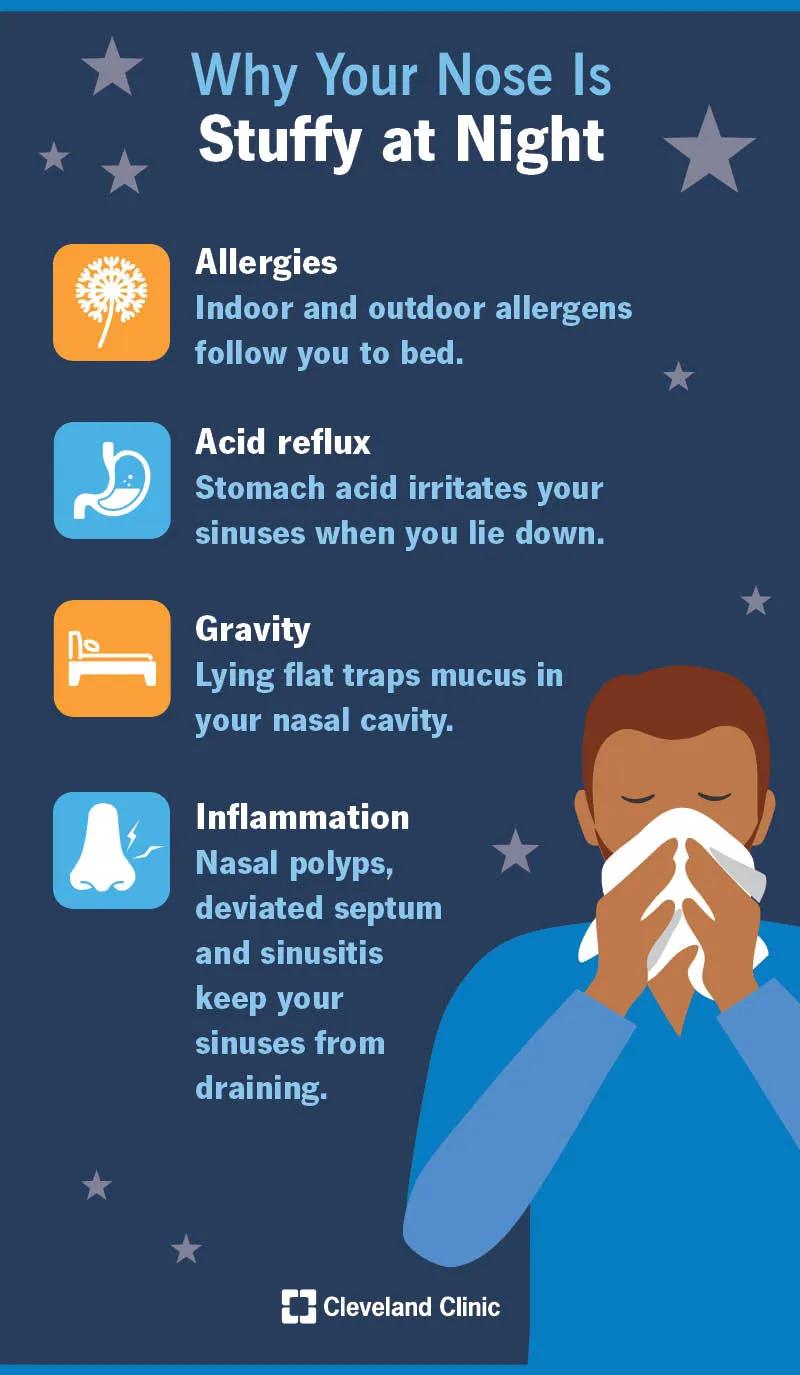
Image content: This image is available to view online.
View image online (https://assets.clevelandclinic.org/transform/456ef551-36dd-44aa-93f5-b067e69c27b9/NoseGetsStuffyAtNight-infographic-800x1375)
Even if you don’t feel congested during the day, your nose can get blocked at night for a few reasons.
“It’s pretty common for people to feel more congested or stuffed up at night,” Dr. Limage acknowledges. “It’s often because of allergens in your home or the way your body reacts when lying down.”
Let’s sniff out the reasons you might feel clogged up after the sun goes down.
During the day, you’re exposed to all kinds of allergens, like pollen, ragweed and grass. The onslaught doesn’t stop when you come home at night.
“Your home has dust, pet dander, mold and other particles in the air that can trigger allergies to be worse at night,” Dr. Limage points out. “And that’s in addition to any allergens you bring in from outside that stick in your hair or on your skin and keep irritating you at night.”
All those allergens can rile up your immune system, triggering more mucus that causes congestion.
It might not be intuitive, but what’s going on in your belly can affect your sinuses. Acid reflux and gastroesophageal reflux disease (GERD) can make your nose stuffy at night.
Advertisement
“As you lie down, your stomach contents and stomach acid can travel up your esophagus,” Dr. Limage explains. “That’s what causes symptoms of acid reflux, like heartburn and indigestion.”
That acid can also irritate your throat and sinuses, triggering inflammation, mucus and, yes, congestion.
You might not want to think about it, but you swallow a lot of mucus during the day. And that’s a good thing.
Your body makes mucus (or phlegm, if you prefer) to trap dirt, germs and other particles that can get you sick. When you swallow it, it helps clear that gunk out of your nasal passages.
But when you lie down at night, your body can’t drain mucus as effectively. You don’t have gravity working on your side to help it slide down your throat. Instead, that mucus pools in your sinuses and gives you that stuffed-up feeling.
Having a cold or another viral bug can lead to temporary inflammation in your sinuses. Conditions like nasal polyps or a deviated septum can cause stuffiness, too, as well as chronic sinusitis (long-lasting inflammation in your sinuses).
In both cases, extra mucus fills up your nasal passages. That means more stuffiness at night, and throughout the day, too.
“People with sinus inflammation often feel worse lying down because the mucus can’t drain,” Dr. Limage reports.
You deserve a good night’s rest. Your health and well-being depend on it. But when your nose is stuffed up at night, sleep can be hard to come by.
Dr. Limage shares these tips:
If those steps don’t do the trick, talk with a healthcare provider. If reflux is contributing to your congestion, they may prescribe medications that can help. And they can check to see if conditions like polyps or a deviated septum are causing your nighttime stuffiness.
Advertisement

Sign up for our Health Essentials emails for expert guidance on nutrition, fitness, sleep, skin care and more.
Learn more about our editorial process.
Advertisement

A few simple steps — including a well-placed pinch on your nose — can help the healing

Correct positioning is one of the keys to getting the best results

If your nose is constantly running, it could be allergies, chronic sinusitis, nasal polyps or other concerns

Dry air, allergies or nose-picking may be to blame for nighttime epistaxis

Take care of your runny or stuffy nose by staying hydrated, using a humidifier and considering a medication

Allergies, acid reflux and even pregnancy can increase drainage and upset your stomach
Seek help if bleeding doesn’t stop or they’re interfering with your life

It’s usually the way your nose manages airflow, but sometimes, it could be other issues

Managing your weight through physical activity may lower your chances of getting this common cancer

It typically starts in October and winds down in early spring, with cases at their highest in the middle of winter

Anxiety disorders, health conditions and past trauma can make driving nerve-wracking — help is available
 Search










