Locations:





Nicotine and other lingering chemicals from smoking can harm people who don’t smoke, including children
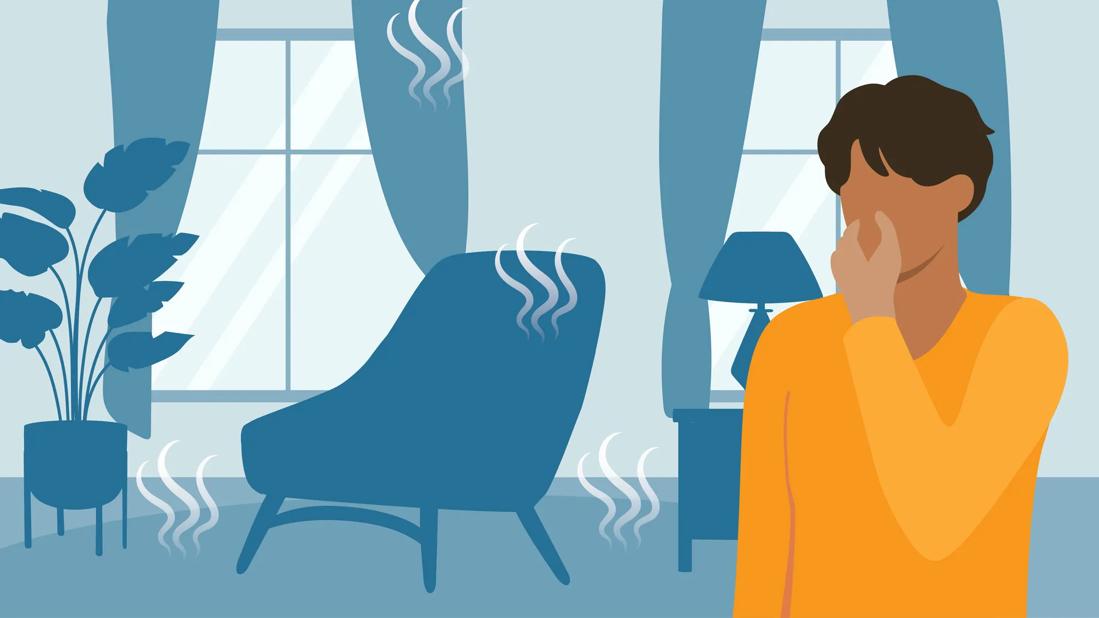
Image content: This image is available to view online.
View image online (https://assets.clevelandclinic.org/transform/c032a129-20a4-43f6-8901-d3fb324ef1ea/living-room-smells-2148379115)
Person holding their nose in a smelly home
You probably already know that smoking is bad for you, and that even secondhand smoke is extremely dangerous. But what about thirdhand smoke? The term may be new to you, but chances are you — like most everyone else on the planet — have been exposed to it many times.
Advertisement
Cleveland Clinic is a non-profit academic medical center. Advertising on our site helps support our mission. We do not endorse non-Cleveland Clinic products or services. Policy
Pulmonologist Peter Mazzone, MD, MPH, Director of Cleveland Clinic’s Lung Cancer Screening Program, explains what thirdhand smoke is, the potential risks it poses for your health and what to do about it.
Thirdhand smoke (THS) is the residual — or leftover — nicotine and chemicals that remain long after someone smokes in the area. THS hangs around on:
The toxic residue from tobacco (or in the case of vaping, a chemical mist) can hang around for weeks, months or even years after the smoke clears.
“THS resists normal cleaning methods. You can’t air it out or vacuum it up,” says Dr. Mazzone.
The possible health effects of THS exposure are concerning. But Dr. Mazzone says “the specific risks of thirdhand smoke aren’t clear yet.” That’s, in part, because the concept is pretty new. The authors of a study in the medical journal Pediatrics coined the term “thirdhand smoke” in 2009.
The following year, researchers found that when residual nicotine in your environment reacts with nitrous acid (HNO2) in the air, it forms carcinogens — compounds that can cause cancer.
“Although this suggests a dangerous connection, it doesn’t prove that thirdhand smoke is correlated with any other conditions,” Dr. Mazzone clarifies. “And that part will be very difficult to prove because we’re all exposed to it, no matter how hard we try to avoid it.”
Advertisement
When you smoke in a room or car, toxic chemicals like nicotine cling to walls, clothing, upholstery and other surfaces, as well as to your body.
“Children are often the most vulnerable to thirdhand smoke because they’re exposed to surfaces like the floor, other people’s clothing and all sorts of household objects,” Dr. Mazzone reports.
This is particularly true for young children, who frequently touch objects and then put their hands in their mouths. This can increase their exposure to toxic chemicals.
Dr. Mazzone adds that adults who live with someone who smokes are also at a much higher risk for THS exposure.
You’re most likely to encounter THS in enclosed, shared spaces where people are either currently smoking or have smoked in the past. After all, it used to be common practice to have “smoking sections” in public places (including airplanes, if you can believe it).
Common THS hotspots include:
Keep in mind that all smoke is dangerous, not just tobacco smoke. More and more research is coming out that shows similarly long-term negative health effects of smoke inhalation and damage after house fires and wildfires, for example.
If someone asked you to make a list of lung cancer risk factors, first- and secondhand smoke would probably sit firmly at the top. Early research increasingly suggests thirdhand smoke exposure might belong on the list, too.
“There’s been an increased interest in thirdhand smoke in recent years because we’re seeing more lung cancer cases that aren’t related directly to firsthand or secondhand smoke,” Dr. Mazzone shares. “So, we’re looking at other causes for cancer aside from direct exposure.”
Lung cancer is just one of a range of medical conditions that early-stage research has associated with THS exposure. But none of these studies have established a causal link, meaning we don’t know for sure whether THS is actually causing lung cancer. But researchers are noticing a connection.
Possible health risks include:
This list could easily be longer. Studies in 2013 and 2020 found that THS is genotoxic, meaning thirdhand smoke may cause damage and breaks in human DNA.
Advertisement
“More research is needed. But it seems clear that DNA damage is a real risk and can increase your chances of disease,” Dr. Mazzone says.
You can’t avoid THS exposure completely, but you can take steps to reduce it. But it’s not easy — and for many, it isn’t affordable either. To get your home as close to THS-free as possible, you’d have to:
Clearly, it’s expensive to completely rid a room of thirdhand smoke and eliminate the risk of exposure for future tenants or owners.
Dr. Mazzone stresses that the best solution for managing the dangers of thirdhand smoke is to stop smoking. If you live with someone who smokes, try to make sure they don’t do it inside. If they decide to kick the habit, encourage and support them.
“The best way to reduce exposure risk is to have a smoke-free environment, especially where you live,” he says. “It’s not just about cutting down, but quitting altogether.”
Dr. Mazzone concludes: “If you smoke, never smoke inside your house because even if you don’t smell the smoke anymore, it’s still there. The best and healthiest possible approach is to avoid smoking completely.”
Advertisement

Sign up for our Health Essentials emails for expert guidance on nutrition, fitness, sleep, skin care and more.
Learn more about our editorial process.
Advertisement
Nicotine in any form is hazardous to your health

Even without nicotine, vapes can contain volatile organic compounds that may damage your lungs and enter your bloodstream
Vaping exposes you to thousands of chemicals, including many that are known to cause cancer and lung disease
Smoking can make symptoms from cancer treatment worse, and can even make treatments less effective

From dental diseases to cardiovascular problems, the harmful effects of smoking hookah have plenty of downsides for your health
They don’t contain tobacco, but these toxic, highly addictive products can permanently damage your health

Nicotine replacement products and relaxation techniques can help you ditch the dip
Even only a couple cigarettes a day can lead to potentially deadly lung diseases like COPD and emphysema

Rapid weight loss can cause loose skin, facial volume loss and body contour changes
Swallowing too much air, certain foods and drinks, and digestive conditions can all make you belch more
From poor hand hygiene and ventilation issues to contaminated food, many factors can make infectious diseases spread quickly
 Search










