Locations:





 Search
The list includes eating a healthier diet, managing your weight and reducing stress
Biologically speaking, we all start from two ingredients: One sperm from a man and one egg from a woman. That’s the basic recipe for creating human life.
Advertisement
Cleveland Clinic is a non-profit academic medical center. Advertising on our site helps support our mission. We do not endorse non-Cleveland Clinic products or services. Policy
But like any recipe, success can depend on the quality of the ingredients. That’s why the reported decline in sperm health and male infertility detected by researchers over the past 50+ years is a concern.
So, why is this happening and what can you do to increase your chances of becoming a father? Let’s talk it through with urologist Raevti Bole, MD, who specializes in male reproductive health.
Video content: This video is available to watch online.
View video online (https://cdnapisec.kaltura.com/p/2207941/sp/220794100/playManifest/entryId/1_sacol7fc/flavorId/1_5f3sgelj/format/url/protocol/https/a.mp4)
Learn how to improve sperm health and fertility with lifestyle, diet and fitness strategies.
Conception is a complicated process. A lot must go right for a single sperm to fertilize a female’s egg to start a pregnancy. It’s estimated that about 15% of couples have trouble getting pregnant.
Sperm health plays a big role in whether conception happens and a pregnancy begins. Dr. Bole says key factors influencing sperm health include:
Advertisement
Your healthcare provider may order a semen analysis to check sperm quantity and quality if there are concerns about infertility, says Dr. Bole. The lab test is typically done if you’ve been trying to conceive for a year with no luck.
There’s no definitive answer to that question. “But there are a lot of different thoughts as to why it might be happening,” notes Dr. Bole.
Explanations behind the infertility trend often focus on:
Fertility can also be affected by medical conditions, like:
These types of situations typically require some sort of treatment to resolve.
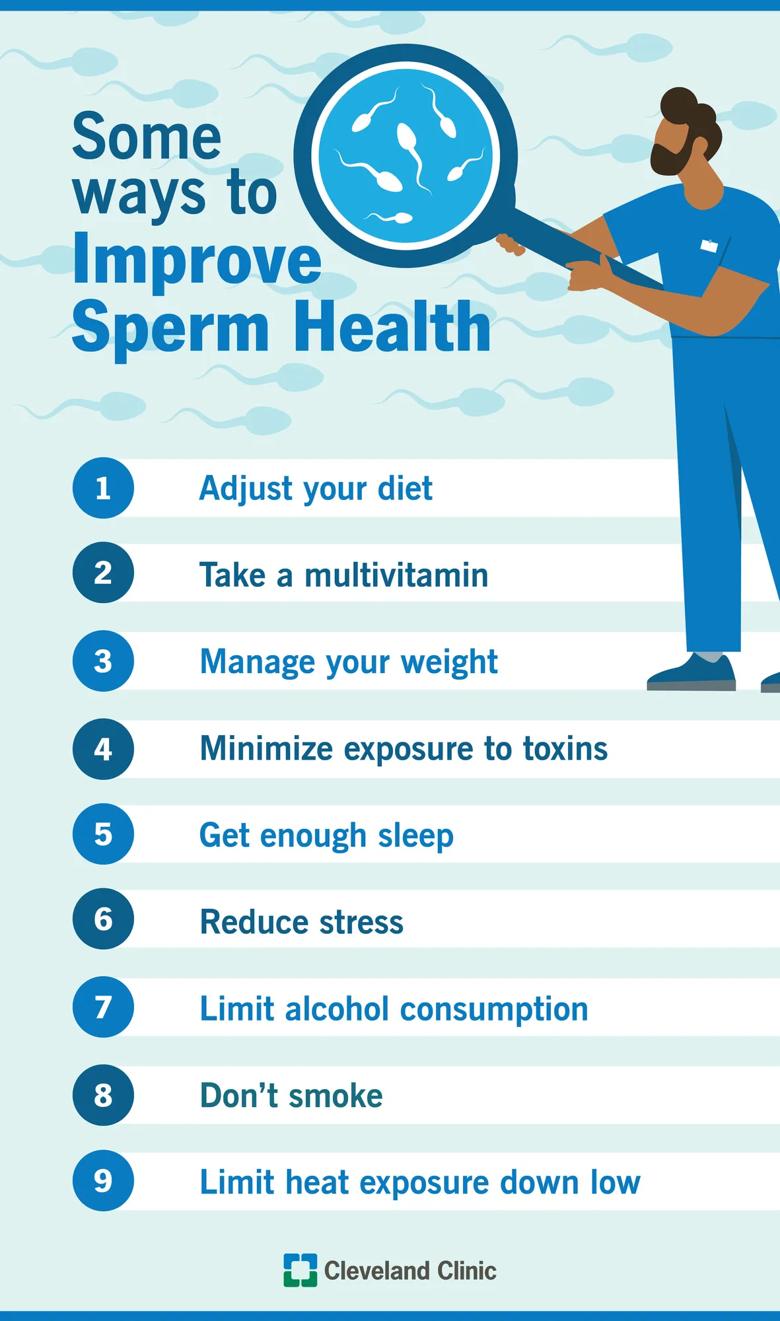
Image content: This image is available to view online.
View image online (https://assets.clevelandclinic.org/transform/cfe90935-2c56-4541-b482-98f991acd93e/improve-Sperm-Health-infographic_2169214364)
Changing your daily routine may help improve your fertility, particularly if the cause seems to be related to lifestyle instead of a medical issue. “There are strategies to improve sperm health,” says Dr. Bole.
It usually takes at least three months — the lifecycle of sperm — to see results. Here are a few things to try.
A nutritious and balanced diet focused on whole foods can support sperm health and raise sperm count. Research shows that the Mediterranean diet, which emphasizes plant-based options and healthy fats, promotes fertility.
“You want foods high in antioxidants that are anti-inflammatory, noncarcinogenic and good for your hormonal profile,” states Dr. Bole.
That means eating more foods like leafy greens and fish high in omega-3 fatty acids. To make room for them on your plate, try to cut back on ultra-processed foods, sugary treats and menu items high in saturated fat.
Taking a multivitamin supplement is a way to ensure you’re getting the vitamins and nutrients your swimmers need. “It’s a good way to address any deficiency you may have in your diet,” notes Dr. Bole.
But don’t take a testosterone supplement thinking it will boost fertility. It actually does the opposite. “Taking testosterone suppresses your natural production of sperm,” she cautions. “It will drive your sperm count way, way, way down.”
Having obesity can affect your health in many ways, including fertility.
Research shows that your risk of infertility increases by 10% with every 20 pounds of excess weight. Adjusting your diet and following a regular exercise routine can bring positive changes to your weight and sperm health, says Dr. Bole.
Research is ongoing regarding the effects of nanoplastics and other common toxins on the body, but nobody thinks they’re a good thing.
Advertisement
Limiting your exposure to plastics may help reduce potential risks. Try to:
Sleep deprivation isn’t good for your reproductive health, emphasizes Dr. Bole. Studies show that men who sleep fewer than six hours reduce their chances of successful conception by more than 40%.
Getting too much sleep — or more than nine hours a night — has also been associated with poor sperm health, as chronic sleepiness or fatigue could be a sign of another health issue.
“Ideally, you want to be getting about seven to eight hours of sleep per night,” she recommends.
Stress can create hormonal imbalances that lead to fertility problems. “We can see that stressful periods in life really affect sperm count,” reports Dr. Bole. “It takes a toll.”
Relaxation techniques like guided imagery, breathing exercises or yoga may help you chill.
Studies show that excessive alcohol consumption — defined as more than seven drinks a week — can reduce semen production and sperm quality. “Alcohol causes stress in your body, and, ultimately, that can affect your sperm health,” states Dr. Bole.
Advertisement
Chemicals in tobacco can lower sperm count and sperm’s ability to move spontaneously and actively. Tobacco also appears to fragment the DNA in the sperm, which damages genetic material.
Dr. Bole also advises against smoking marijuana if you’re trying to have a child. “You want to try to avoid having any extra chemicals in your body if you’re trying to conceive,” she says.
Heat is not kind to sperm. “We know it clearly affects sperm health,” shares Dr. Bole.
Given that, it’s best to stay away from hot tubs and saunas if you’re trying to conceive. Avoid keeping a laptop computer on your lap, too, as the heat generated by the device can be enough to stress your testicles and reduce sperm production if you do this regularly.
But when it comes to warmth down low, don’t worry about whether you’re wearing boxers or briefs. “It doesn’t make a difference,” she clarifies.
Conceiving a child isn’t an on-demand request. It can take time under the best of circumstances. But if you and your partner have been trying to get pregnant for six months to a year without success, it may be time to get a fertility evaluation.
Consider talking with your doctor earlier if you have a known fertility risk factor, like a previous testicular injury or medical condition.
Advertisement
“Starting the conversation is the first step toward finding a solution,” encourages Dr. Bole.

Sign up for our Health Essentials emails for expert guidance on nutrition, fitness, sleep, skin care and more.
Learn more about our editorial process.
Advertisement

Tips for making food and lifestyle choices that improve fertility
Most fibroids don’t affect fertility — but some can, depending on their size and location

A variety of factors can cause temporary or more lasting changes in penis length

When you’re living with this chronic condition, early diagnosis and treatment can improve your chances of getting pregnant down the road

An unexplained lump, swelling, discomfort or changes to your testicles shouldn’t be ignored

Arousal without orgasm can be uncomfortable, but it’s no reason to pressure sexual interactions

Adjusting your diet to focus on plant-based, whole foods may improve erectile function
Here’s what you need to know about ED, which most men experience to some degree during their lives

Getting back to normal after a head injury takes time — and patience

Dressing in multiple layers, drinking warm liquids and taking breaks indoors can help prevent these cold-weather injuries

Pick bell peppers to help fight cancer, memory decline and joint pain











