Locations:





Exercising at about 70% of your maximum heart rate can help you burn fat
If you’re trying to lose weight or change your body composition through exercise, you may be advised to stay within a fat-burning heart rate. That usually means doing lower-intensity exercises for longer periods, so your body uses more fat for energy than carbohydrates.
Advertisement
Cleveland Clinic is a non-profit academic medical center. Advertising on our site helps support our mission. We do not endorse non-Cleveland Clinic products or services. Policy
It’s not the only way to achieve those goals, but it’s popular for a reason: It usually works.
Sports cardiologist Tamanna Singh, MD, explains what a fat-burning heart rate is and the best way to calculate it.
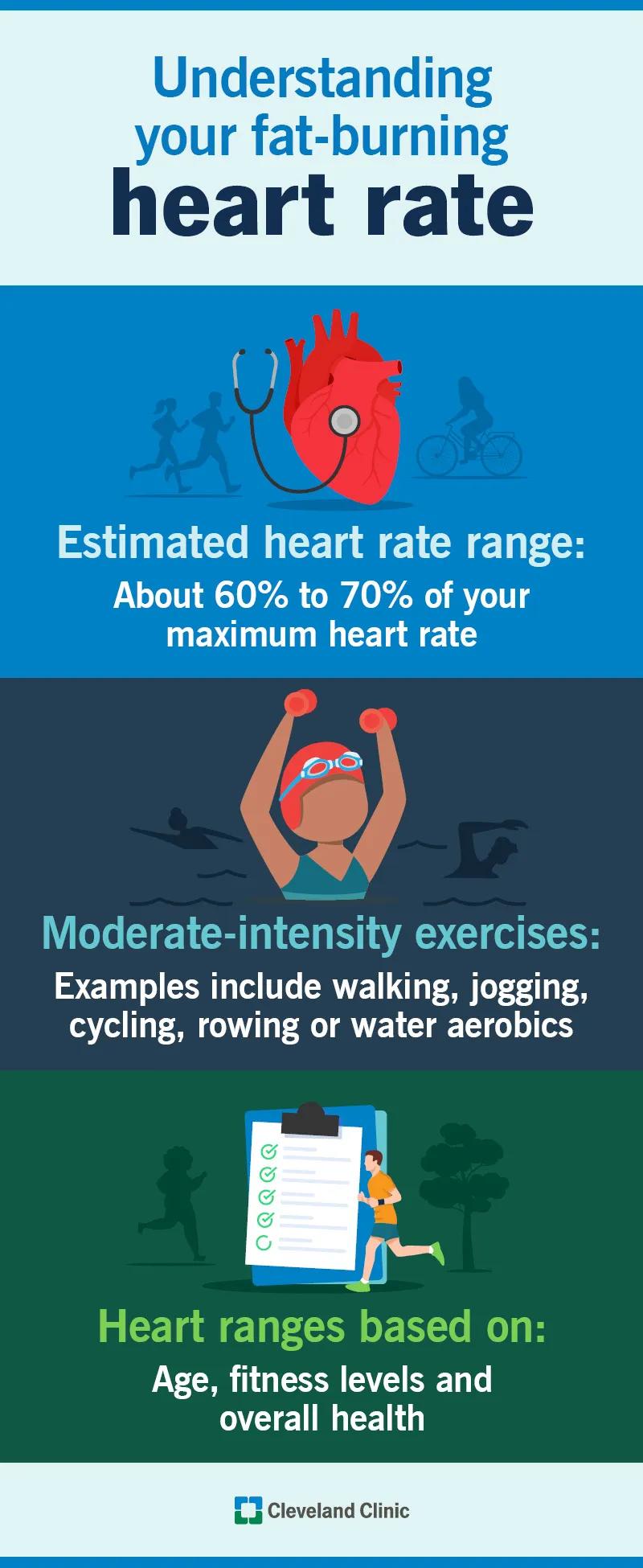
Image content: This image is available to view online.
View image online (https://assets.clevelandclinic.org/transform/3484a48e-ed00-4e70-9d67-5a5546bb64a9/fat-burning-heart-rate-infographic)
Your fat-burning heart rate is about 60% to 70% of your max heart rate. When you exercise, your body generates energy from a mix of carbs, sugar and fat. This specific heart rate allows your body to burn a greater percentage of fat than usual.
For many people, their fat-burning heart rate is typically categorized as a zone 2 heart rate, but it may also be considered a zone 1 heart rate for some.
“We typically think of these zones as having lower heart rates. In terms of exercise, zones 1 and 2 are activities with minimal effort,” explains Dr. Singh. “Zone 1 is typically between 50% to 60% of your max heart rate, while zone 2 is about 60% to 70%.”
The American Heart Association recommends the Fox formula to determine your maximum heart rate. To calculate your fat burn heart rate, you’d have to figure out 60% to 70% of that number.
And while that method can be a good baseline, Dr. Singh says it’s not all that accurate, as it relies solely on your age and doesn’t account for factors like your biological sex or fitness level.
Advertisement
“The gold standard would be to determine your fat-burning heart rate in a lab during a cardiopulmonary exercise test,” she notes. “During this test, we can actually push you to your maximal effort and get you to your maximum heart rate. We can even calculate when you’re transitioning from predominantly burning fat to burning carbohydrates as you start to ramp up the effort.”
Types of zone 2 exercise are usually considered moderate in intensity (as opposed to high-intensity options). Some examples can include:
But the types of exercise or activities that burn fat can vary from person to person. One way to think about it? You shouldn’t be working so hard that it becomes difficult for you to carry on a conversation.
That doesn’t mean you shouldn’t mix up your exercise routine.
“Your body is so good at figuring out how to work efficiently without utilizing much energy,” says Dr. Singh. “Eventually, you’ll get to a point where you’ve maximized your ability to utilize as little energy as possible to sustain your effort.”
Dr. Singh recommends increasing your exercise volume, meaning the total amount of exercise you do each week. There are a few ways you can do this, including:
“I would change only one of those variables at a time to help prevent overtraining or injury,” cautions Dr. Singh. “If you change one of those up, then you’ll start to see your body responding to this new stimulus.”
There are a few ways you can track your heart rate:
While working out at your fat-burning heart rate can help you lose weight, Dr. Singh says it should be just one part of your wellness goals.
“Don’t just target burning fat, target being well-rounded in your fitness journey,” she concludes. “Strength training is a great complement to cardio. Different stimuli will lead to different gains, but all of them, cumulatively, will help you be as healthy as possible.”
Advertisement
Advertisement

Sign up for our Health Essentials emails for expert guidance on nutrition, fitness, sleep, skin care and more.
Learn more about our editorial process.
Advertisement

Nine ‘pulse points’ around your body offer key information about your heart and blood flow

Your pulse and heart rate measure different body processes, but in most cases, they’re the same number

Deep breathing, yoga and meditation are just some ways to bring your heart rate down right away

Lifestyle changes can help strengthen your heart so it doesn’t have to work as hard when your body is at rest

A resting heart rate below 35–40 beats per minute or over 100 beats per minute may be cause for concern

Your heart rate naturally slows down while you sleep, but lower numbers aren’t always concerning
Both are related to your cardiovascular system, and both can impact the other

Bradycardia, or a low heart rate, is more likely as you age — and could be a sign of health issues
Eyes typically increase to full size during two growth spurts in childhood

To start, opt for calorie-dense foods that are rich in protein and healthy fats

Pre-birth injections and monoclonal antibodies can help prevent serious complications
 Search










