Locations:





Nine ‘pulse points’ around your body offer key information about your heart and blood flow
Your pulse is your heart’s rhythm — and the easiest places to catch that beat are your pulse points. At these spots throughout your body, you can feel the pressure wave created by blood pumping through your system.
Advertisement
Cleveland Clinic is a non-profit academic medical center. Advertising on our site helps support our mission. We do not endorse non-Cleveland Clinic products or services. Policy
But what exactly are pulse points, where are they located and what can you learn by tuning in? Let’s find out from interventional cardiologist Aravinda Nanjundappa, MD.
Pulse points are specific areas on your body where your arteries run close to the surface of your skin. You can use them to check your heart rate — but they can tell a lot more than that, too. Each location also offers hints about your body’s blood circulation and overall cardiovascular function.
“Every pulse point gives us different information,” says Dr. Nanjundappa. “Just from the neck, I can tell whether there’s carotid artery disease or an aortic valve problem. And if the pulse at the apex of the heart is displaced, that can mean the heart is enlarged.”
Providers often turn to these pulse points during physical exams, especially to check for blockages or other vascular issues.
“This is old-school medicine, but it still applies — and it’s helpful,” he adds.
Looking beyond medicine, there’s a reason you might’ve learned to dab perfume, cologne or essential oil on pulse points, like the inside of your wrist. The blood flow just beneath the skin creates extra warmth at pulse points, which helps diffuse and amplify scents.
Advertisement
Here’s a breakdown of your body’s nine primary pulse points, including where they are and what they can tell you and your healthcare provider about your health.
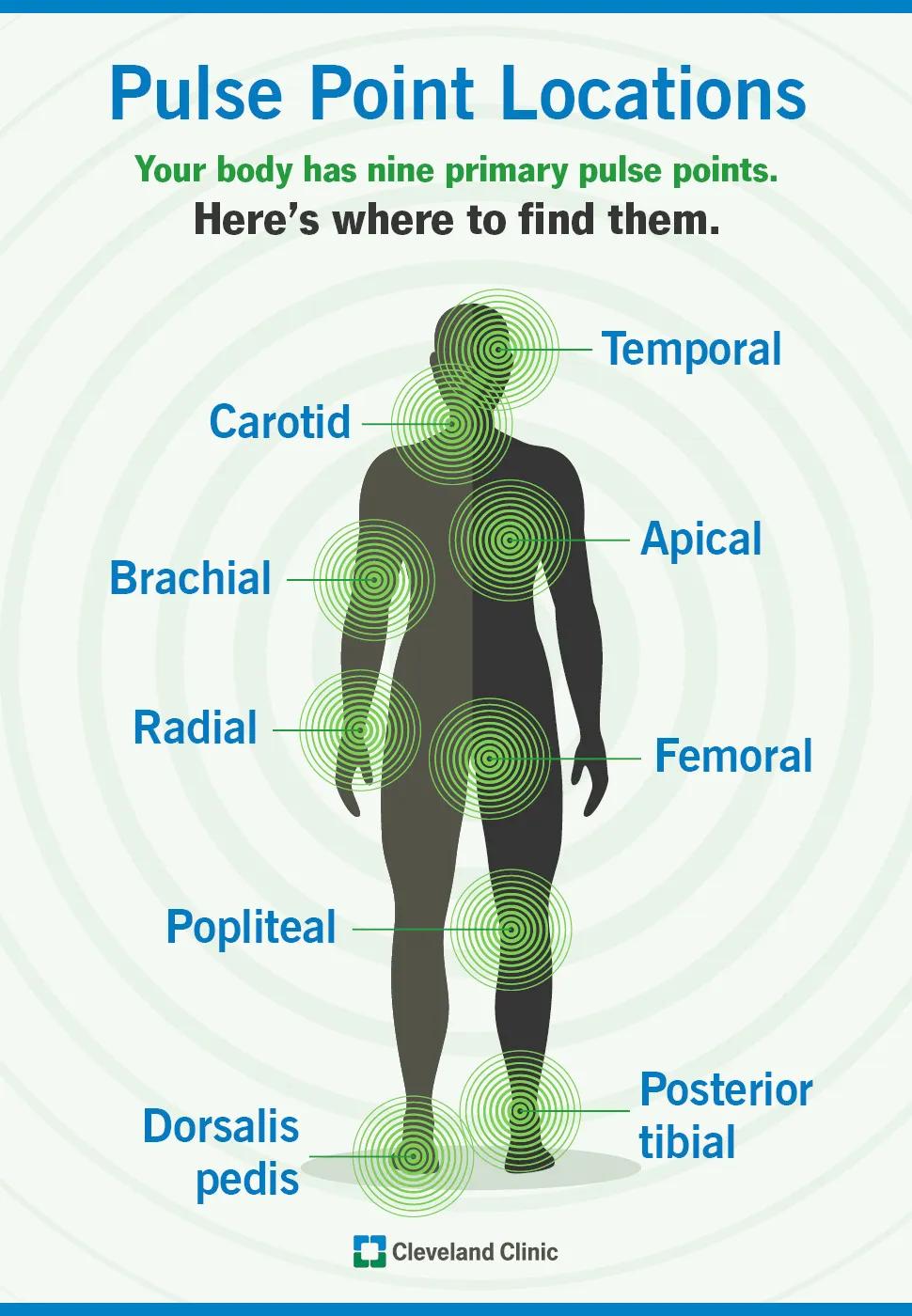
Image content: This image is available to view online.
View image online (https://assets.clevelandclinic.org/transform/56343abf-e00a-48f1-9356-d712dfcfca80/pulse-points-infographic)
Location: Inside of the wrist, near the base of the thumb
Why it matters: “This is the most commonly used pulse point because it’s easy to access,” says Dr. Nanjundappa. “We’ll often feel a person’s radial pulse while listening to their heartbeat with a stethoscope. That way, we can check if they’re in sync.”
If they don’t match, the pulse deficit may be a sign of an irregular heart rhythm (like atrial fibrillation, or AFib).
Location: On either side of the neck, next to the windpipe
Why it matters: “If someone goes into cardiac arrest, the carotid artery is the first place we check for a pulse,” explains Dr. Nanjundappa. “It gives us a quick sense of whether there’s any cardiac activity.”
Just don’t check both sides of the neck at the same time: If you push too hard, that can cut off blood flow to the brain, so always do one side only.
Location: Inside of the upper arm, near the elbow crease
Why it matters: “If the radial pulse is hard to find, we go higher up to the brachial artery,” says Dr. Nanjundappa. (It’s also the main site for checking a baby’s pulse. The reason? It’s larger and easier to locate on their tiny bodies than the radial pulse point.)
Location: In the groin, where the thigh meets the torso
Why it matters: “If we can’t find a femoral pulse, that could mean there’s a blockage in the aorta,” says Dr. Nanjundappa. “We also might check it during emergency situations, when the carotid pulse is hard to find.”
Location: Behind the knee
Why it matters: “If the femoral pulse is there but the popliteal isn’t, the blockage is likely in the thigh,” notes Dr. Nanjundappa. “These different pulse points help us map where a circulation problem may be.”
Location: Behind the inner ankle bone
Why it matters: “If we don’t feel this one, it often means there’s poor circulation in the lower leg,” shares Dr. Nanjundappa. “I’ll have patients walk 20 steps and come back, then check again. If the pulse is absent, that’s a sign of significant blockages.”
Location: Top of the foot, near the center
Why it matters: This is the toughest pulse point to find, says Dr. Nanjundappa, but it can play an important role in checking blood flow to the feet. That’s particularly important if you have conditions like diabetes or vascular disease, which commonly affect this part of the body.
Location: Side of the forehead, above the temple
Why it matters: “This one’s usually checked if someone has symptoms like headache and joint pain. If it’s tender, it could mean there’s inflammation of the artery,” says Dr. Nanjundappa.
Advertisement
Location: At the apex of the heart, on the left side of the chest
Why it matters: “We check the apical pulse in every cardiac patient,” reports Dr. Nanjundappa. “If it’s shifted to the side, it can mean the heart is enlarged. It also helps us detect murmurs.”
While pulse points all connect back to your heartbeat, each offers a different insight into how your heart and circulation system are operating. In some cases, they may reveal signs of disease.
“It’s certainly not going to be as accurate as a CT scan,” acknowledges Dr. Nanjundappa, “but it’s a simple way to gather information that can be pretty valuable.”
Want to check your pulse at home? Find the pulse point on one of your wrists and gently press with your fingers (not your thumb). Count the beats for 30 seconds, then double the number. That’s a rough estimate of your pulse and heart rate in beats per minute.
Advertisement

Sign up for our Health Essentials emails for expert guidance on nutrition, fitness, sleep, skin care and more.
Learn more about our editorial process.
Advertisement

Exercising at about 70% of your maximum heart rate can help you burn fat
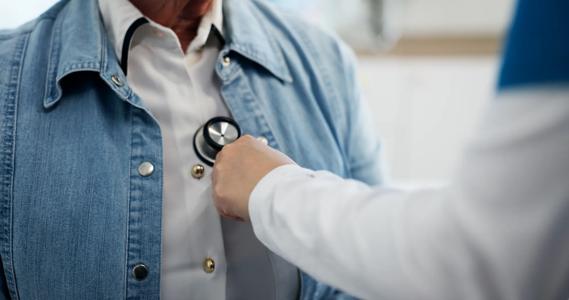
Your pulse and heart rate measure different body processes, but in most cases, they’re the same number

Deep breathing, yoga and meditation are just some ways to bring your heart rate down right away
Lifestyle changes can help strengthen your heart so it doesn’t have to work as hard when your body is at rest

A resting heart rate below 35–40 beats per minute or over 100 beats per minute may be cause for concern
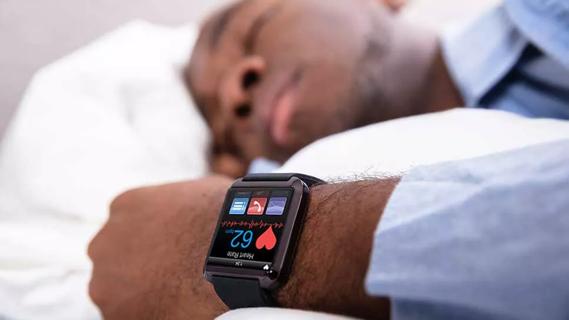
Your heart rate naturally slows down while you sleep, but lower numbers aren’t always concerning
Both are related to your cardiovascular system, and both can impact the other
Bradycardia, or a low heart rate, is more likely as you age — and could be a sign of health issues

Hormonal changes, a slower metabolism and muscle loss can make weight gain more common around menopause — healthy habits can help you manage it

Life-threatening complications include sepsis, stroke, pneumonia and more

Fruity-smelling breath can happen when your body burns fat for energy, and in some cases, can signal a medical emergency
 Search










