Locations:





You can improve strength and stability with these eight easy exercises

Image content: This image is available to view online.
View image online (https://assets.clevelandclinic.org/transform/fd991841-7b0a-4f9a-ac27-d2a893885eb5/tip-toes-645622310_jpg)
Calf raises on tip toe.
Do you worry about twisting an ankle and taking a spill? Are you noticing problems with foot pain, balance and mobility as you age? These issues could be a sign that you have weak ankles.
Advertisement
Cleveland Clinic is a non-profit academic medical center. Advertising on our site helps support our mission. We do not endorse non-Cleveland Clinic products or services. Policy
Weak ankles tend to sprain more easily. And a sprain can put you out of commission for weeks. In fact, thousands of people sprain an ankle every year simply by stepping off curbs, stumbling in high heels or rolling an ankle while running or playing sports.
As you move throughout your day, the joints in your ankles and surrounding muscles absorb a lot of force. And that can take a toll.
The good news: You can work to strengthen your ankle muscles and adjoining ligaments. This will help ward off injuries and improve your stability and mobility.
We talked to exercise physiologist Christopher Travers, MS, about how we can all — regardless of our age or fitness levels — protect ourselves against ankle problems.
According to Travers, if you make alterations at your base (your feet and ankles) you’ll affect the rest of your joints.
One of the greatest worries about a weak base is the effect it has on your knees and how much internal rotation it puts into your hip. If you’re deficient at the bottom, the joints and muscles in your knees and hips can weaken as well. This can cause your gait to change, ultimately making it more difficult for you to walk.
That, Travers explains, is why it’s important to dedicate time in your fitness routine to stretching and strengthening your ankles.
Advertisement
Whether you do it or not, you’re probably aware that it’s important to stretch before exercising. But did you know that stretching your ankles should be part of your routine?
Especially if you’re going to do a high-impact activity like running, stretching your ankles is vital. According to Travers, “You want to make sure that you’re not going from sitting straight into exercise. You want to make sure your ankles have had plenty of movement, and that there’s been plenty of blood flow through the joint muscles surrounding it as well.”
Not sure how one goes about stretching their ankles? Check out the four quick and easy daily exercises below!
This one is as simple as A-B-C.
Begin by lying on your back or standing. If you’re standing, use a sturdy chair for support as needed.
Lift one leg and draw the alphabet with your toes as you flex your foot. Then repeat with the other leg. Do the whole alphabet twice — once for each leg — once a day.
It’s time to get on your tiptoes!
Stand on the edge of a step (if you have one) or an exercise step platform, using a banister or other support structure to keep your balance. Keep your feet hip-width apart.
Lift yourself up as high as you can onto your toes and then slowly lower your heels. Repeat the motion 10 times in a row. Do this exercise once a day.
“Supine” is a fancy way of saying “lying on your back.” Lie down and, using your ankle, arch your foot so that it’s pointing toward the ceiling. Hold this backward stretch — also known as dorsiflexion — for 30 seconds. Do this stretch twice for each ankle (a total of two minutes) once a day. Keep hanging out on the floor, because our next stretch also requires you to lie down.
While lying down on your back, point your foot forward like you would if somebody told you to point your toes. Hold the pose — also known as plantarflexion — for 30 seconds. Relax and repeat. Do this stretch twice for each ankle (a total of two minutes) once a day.
Improving ankle stability is all about balance. Just standing on one leg and practicing balance can build the coordination needed to prevent ankle injuries from happening — or at least decrease their severity. Standing on one leg while brushing your teeth, doing dishes or watching TV, for example, may have a positive impact.
The four exercises below will help you be steady on your feet. If you’re concerned about falling while doing these exercises, place a sturdy chair next to you that you can use to catch yourself if you get wobbly.
This one is as simple as it sounds. Just stand on one leg, with your stance leg slightly bent. Maintain your balance for 20 seconds. Do this three times for each leg — a total of two minutes, altogether — once a day.
Advertisement
This exercise is a slight modification of the SLS. Stand on one leg with your knee slightly bent on the stance side. Maintaining your balance, hold your other leg out in front of you. Hold that pose for 20 seconds, and then return to standing. Do this three times for each leg — a total of two minutes, altogether — once a day.
This is the third iteration of the SLS. Once again, stand on one leg with your knee slightly bent. Next, reach forward with your opposite arm as far as you can without losing your balance. Hold the position for 20 seconds. Repeat three times for each leg for a total of two minutes a day.
Tandem walking closely resembles tightrope walking, without the associated danger. Because you’re in motion for this activity, a chair isn’t going to help you maintain your balance. Instead, walk alongside a wall, touching it as needed to steady yourself.
Stand with one foot directly in front of the other so the toes of one foot touch the heel of the other. Every time you take a step, make sure the heel of your front foot is touching the toes of your back foot. If you’re able, try walking backward. Whether going forward and backward or simply turning around, cross the room or hallway you’re exercising in three times.
Advertisement
The right footwear can also help prevent an ankle injury or sprain.
While most people can do these exercises safely, we recommend talking to your doctor before beginning any exercise program — especially if you’re carrying extra weight. Having obesity (BMI >25) can lead to weak ankles. That’s because the more weight you’re carrying, the more stress you’re placing on your hips, knees and ankles.
Weak ankles could also be a sign of other medical issues that require a doctor’s attention. For instance, if you have balance issues, it might not be because you have weak ankles — it could be a signal of a neurological disorder.
So, get checked out first. Once your doctor gives you the go-ahead, take time for these exercises every day. Incorporating them into your routine can help you maintain good balance, stability and posture for the long term.
Advertisement

Sign up for our Health Essentials emails for expert guidance on nutrition, fitness, sleep, skin care and more.
Learn more about our editorial process.
Advertisement

It helps to build up your strength and balance before tackling these more resistance-heavy TRX exercises
Glute bridges are simple bodyweight exercises worth adding to any workout

Stay afloat with bicycle kicks, alternating punches and water jogging

Plyometric training uses explosive movements to improve speed, power and agility
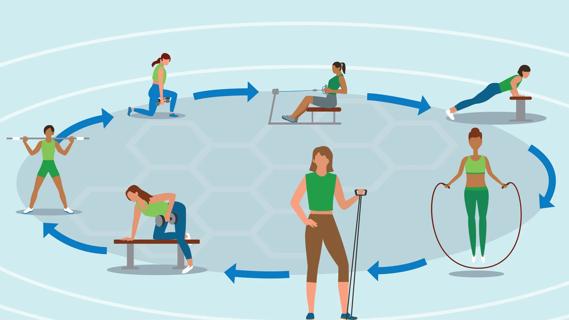
Circuit training combines strength and cardio exercises into one efficient workout

One helps with quick, intense bursts, while the other helps carry you for the long haul

It depends on your symptoms and where you feel them in your body, but you may want to sit this one out

This 75-day challenge provides a balanced approach to physical fitness, mental health and healthy habits

Managing your weight through physical activity may lower your chances of getting this common cancer

It typically starts in October and winds down in early spring, with cases at their highest in the middle of winter

Anxiety disorders, health conditions and past trauma can make driving nerve-wracking — help is available
 Search










