Locations:





 Search
The size, shape and color of moles may offer clues that point to melanoma
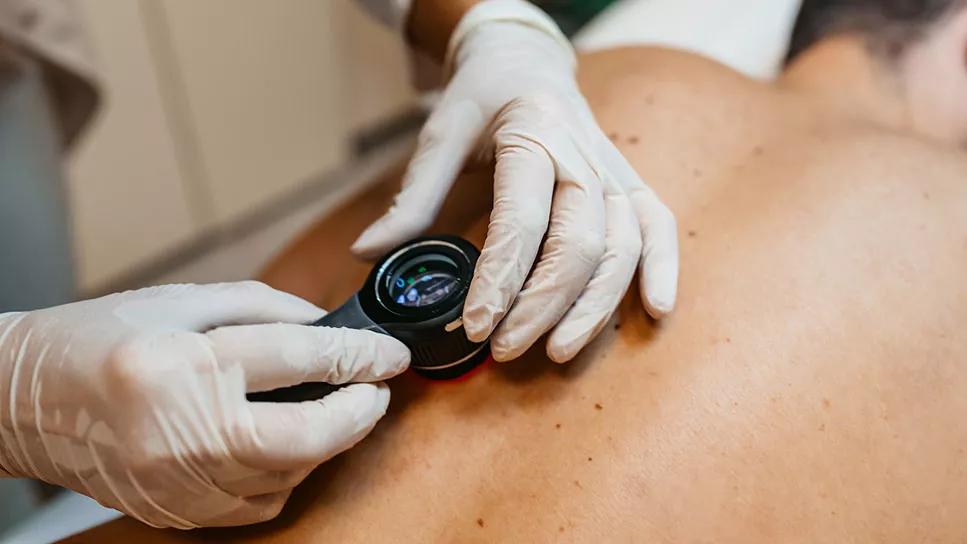
Sometimes you look at a mole and think, “That doesn’t look quite right.” Don’t ignore those suspicions. There’s a chance that what you’re seeing may be a sign of melanoma, a dangerous form of skin cancer.
Advertisement
Cleveland Clinic is a non-profit academic medical center. Advertising on our site helps support our mission. We do not endorse non-Cleveland Clinic products or services. Policy
So, how can you tell if you might have a cancerous mole? There are definite hints visible to the naked eye. Dermatologist Christine Poblete-Lopez, MD, explains how to spot potential trouble.
Moles aren’t unusual. In fact, most adults have between 10 and 40 of them scattered around their bodies. These so-called “beauty marks” are typically harmless and nothing to worry about, either.
But certain characteristics of a mole can offer hints when it comes to melanoma. Dr. Poblete-Lopez says the rule of thumb is to consider the ABCDEs when looking for signs of cancerous moles.
Each letter represents a warning sign of a potentially cancerous mole.
Let’s take a closer look at those clues, plus a few more.
Do you have a mole in which one half doesn’t quite match the other? If so, that may spell trouble, as an uneven shape could indicate the presence of cancerous cells growing and dividing.
“Normal moles are typically symmetrical,” explains Dr. Poblete-Lopez. “That can change when cancerous cells are present.”
Healthy moles usually have smooth, well-defined borders. Cancerous cells can make those edges fuzzy, poorly defined, ragged or blurred. Melanoma also may lead to a small notch or protrusion along the edge of a mole.
Advertisement
“Those are all red flags,” says Dr. Poblete-Lopez.
Healthy moles tend to be one shade of brown. If you have a mole that looks like a paint color card with two or three different variations of brown … well, that might be a bit suspicious.
Moles colored blue, gray, red, black or white may also signal possible melanoma.
Size matters when it comes to moles. Any moles larger than 6 millimeters — roughly the size of the eraser atop a pencil — tend to be more worrisome. That’s especially true if the growth is sudden or rapid.
“Moles are usually small,” emphasizes Dr. Poblete-Lopez. “If they get larger, it could be a sign of cancerous cells growing.”
Consider noticeable changes in a mole to be one of the biggest warning signs of all. Concerns increase if a mole bleeds or begins to ooze with minimal trauma.
“Moles shouldn’t really change,” says Dr. Poblete-Lopez. “If they do, it’s best to find out why.”
More than 70% of melanomas begin as a new mole, which is why any mole that randomly appears deserves your attention. (This is especially true if the new mole checks boxes on the ABCDE list noted above.)
To be clear, though, not all new moles signal melanoma. Most are benign and nothing more than a new mark on your skin. But that doesn’t mean they should be ignored.
“It’s best to get new moles checked by your healthcare provider,” says Dr. Poblete-Lopez.
Moles can become itchy for a variety of reasons. It might be something as simple as dry or irritated skin, for example, or an allergic reaction to whatever laundry detergent you just picked up.
But there’s also a chance that urge to scratch could be a sign of a cancerous mole, says Dr. Poblete-Lopez. Concerns increase if the mole bleeds or begins to ooze.
Bottom line? Get it looked at by a medical professional sooner rather than later.
For someone with a lot of moles, healthcare professionals often look for atypical moles, often called “ugly ducklings.” These moles stand out and look different. They often check more than one of the ABCDE characteristics, too.
The good news? It is extremely rare for the average atypical mole to transform into melanoma. The risk is estimated at 1 in 10,000.
But a high number of atypical moles on your body raises your skin cancer risk, states Dr. Poblete-Lopez. If you have 10 or more atypical moles, you are statistically 12 times more likely to eventually develop melanoma.
It’s important to note that the warning signs noted above don’t guarantee melanoma in a mole. The indicators, however, do signal an increased possibility of skin cancer. They deserve some attention.
Advertisement
“Many mole changes are nothing to worry about,” says Dr. Poblete-Lopez. “But it’s best to get them checked out by your doctor just to make sure everything is OK.”
That’s because early detection is key to treating melanoma. That’s why Dr. Poblete-Lopez suggests doing skin self-checks once a month. Use the inspection to look for new moles or any unusual changes to existing moles.
Melanoma is one of the most common forms of cancer in the United States, representing about 5% of all new cancer diagnoses. Case counts have been steadily rising for decades, too, reports the National Cancer Institute.
Fortunately, the survival rate for melanoma has recently shown an increase. That’s largely due to more attention to detection.
“The beauty of dermatology is that we can quickly see if there’s a problem on the surface and then do a skin biopsy, a simple in-office procedure,” says Dr. Poblete-Lopez. “We may be able to find anything that’s trouble early on.”
Advertisement

Sign up for our Health Essentials emails for expert guidance on nutrition, fitness, sleep, skin care and more.
Learn more about our editorial process.
Advertisement
Over-the-counter antifungal creams usually get the job done, but it’s important to keep it from spreading in the meantime

Although it could be used as a moisturizer, this new trend is not recommended

The popular skin care ingredient can help smooth, brighten and strengthen your skin

It’s a great disinfectant for around your home, but not for your skin

Changes in texture, smell, color and performance are signs it’s time to throw the cosmetic item away
Follow the 4Cs — cooling, cleaning, covering and comforting — to start the healing process

Bathing once a day is the general guidance, but you could also have reasons to soap up twice a day or not at all

There’s not one specific cure-all diet for eczema, but it helps to keep track of what you eat and when you experience symptoms

Even small moments of time outdoors can help reduce stress, boost mood and restore a sense of calm

A correct prescription helps your eyes see clearly — but as natural changes occur, you may need stronger or different eyeglasses

Both are medical emergencies, but they are very distinct events with different causes











