Locations:





Both are medical emergencies, but they are very distinct events with different causes
People often use the terms “cardiac arrest” and “heart attack” interchangeably, as if they’re two ways of saying the same thing. But cardiac arrest and heart attack are two distinct conditions with different causes.
Advertisement
Cleveland Clinic is a non-profit academic medical center. Advertising on our site helps support our mission. We do not endorse non-Cleveland Clinic products or services. Policy
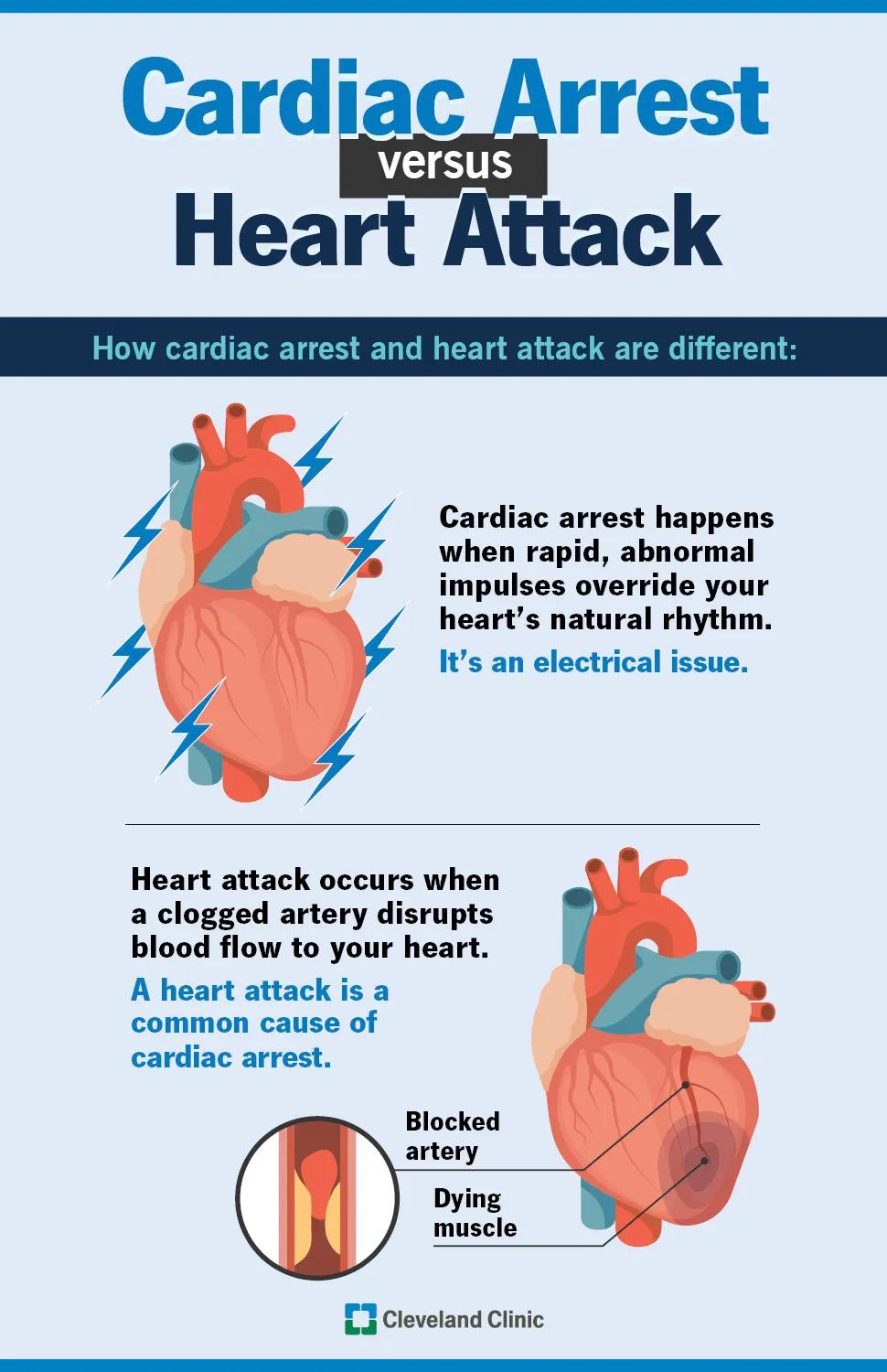
Image content: This image is available to view online.
View image online (https://assets.clevelandclinic.org/transform/89e08835-ac3d-4e6d-a587-c9ff70dee020/cardiac-arrest-vs-heart-attack-infographic)
An illustrated infographic listing the differences between cardiac arrest and a heart attack.
In the most basic of explanations:
Let’s break it down more with cardiologist Andrew Higgins, MD.
Video content: This video is available to watch online.
View video online (https://cdnapisec.kaltura.com/p/2207941/sp/220794100/playManifest/entryId/1_5ntsibkv/flavorId/1_5f3sgelj/format/url/protocol/https/a.mp4)
Cardiologist Jacqueline Tamis-Holland, MD, explains the difference between a heart attack and cardiac arrest.
Cardiac arrest and heart attack are both medical emergencies involving your heart. Both can be very, very bad — even life-threatening.
But there are often key differences in how they look in the moment.
During a cardiac arrest, when the heart stops beating and shuts down, expect someone to:
“Cardiac arrest symptoms typically start without warning,” says Dr. Higgins. “You may or may not experience chest pain before you faint and become unconscious.”
During a heart attack, when blood flow slows or stops, symptoms tend to be less dramatic and can range from mild to severe. How a heart attack feels can vary widely based on your sex, age and underlying medical conditions, too.
Common symptoms include:
Advertisement
“What may seem minor — like slight chest discomfort or shortness of breath — could be a warning sign of something much more serious,” says Dr. Higgins. “Never just dismiss what your body is trying to tell you.”
Cardiac arrest itself does not directly cause a heart attack. But a heart attack can lead to cardiac arrest if your heart’s electrical system is disrupted due to the lack of blood flow.
“A heart attack can create chaos in the heart’s electrical system to trigger cardiac arrest,” explains Dr. Higgins. “That’s why it’s so important to recognize and respond to any symptoms so you can get treatment.”
If you’re in a situation dealing with either cardiac arrest or a heart attack, your first move is the same: Dial 911 or whatever number brings emergency workers to your location.
“Getting immediate medical treatment should be your No. 1 priority,” emphasizes Dr. Higgins.
After calling for help, here’s what else you can do in each situation.
Immediate action is critical. Cardiac arrest can be fatal if CPR (cardiopulmonary resuscitation) isn’t started within eight minutes to help your heart begin pumping again.
If an automated external defibrillator (AED) is available, use it to jumpstart the heart.
“Timely defibrillation could mean the difference between walking out of the hospital or dying,” stresses Dr. Higgins.
Unless a heart rhythm is restored as soon as possible, your brain starts to die from a lack of oxygen and blood flow. The results can be fatal.
“If you’re reading this and are unsure how to perform CPR or use an AED, organizations like the American Heart Association, local schools, libraries and fire departments offer courses,” shares Dr. Higgins. “You could save a life by preparing yourself now.”
A heart attack may not be as intense a situation as a cardiac arrest, but that doesn’t mean you can relax. Action is needed, as a lack of blood flow to your heart can permanently damage or kill muscle within it.
So, while you wait for emergency crews to begin treatment, you can:
Advertisement
While cardiac arrest and heart attack are different, both are emergencies that deserve immediate attention.
“Whether it’s sudden collapse from cardiac arrest or subtle chest discomfort from a heart attack, your best chance for a positive outcome starts with a fast response,” reiterates Dr. Higgins. “Every second counts.”
Advertisement

Sign up for our Health Essentials emails for expert guidance on nutrition, fitness, sleep, skin care and more.
Learn more about our editorial process.
Advertisement

These conditions involve inflammation in different areas of your heart, leading to differences in symptoms and treatments

Exerting yourself in cold temperatures increases your risk of a cardiac event
Strokes affect your brain, while heart attacks affect your heart — both can be life-threatening emergencies
There’s no way to stop a heart attack on your own — call for help immediately

Healthy choices involving food, exercise and more can help reduce your risk

Hypertension strains your heart and blood vessels, causing damage that can contribute to heart attacks
Recognizing subtle signs, like unusual fatigue or fleeting episodes of chest pain, could be key to survival

Making a health plan with your doctor before you leave will make it easier to sit back and enjoy your flight

Managing your weight through physical activity may lower your chances of getting this common cancer

It typically starts in October and winds down in early spring, with cases at their highest in the middle of winter

Anxiety disorders, health conditions and past trauma can make driving nerve-wracking — help is available
 Search










