Locations:





Tips include cutting back on sugar, focusing on exercise and managing stress
Triglycerides are fatty types of lipids found in your blood that can be dangerous for your health. Similar to LDL (the “bad” form of cholesterol), high levels can increase your risk of heart disease and stroke, even when LDL levels are healthy. That means you want to try to keep your triglyceride levels as low as possible to avoid potential health issues.
Advertisement
Cleveland Clinic is a non-profit academic medical center. Advertising on our site helps support our mission. We do not endorse non-Cleveland Clinic products or services. Policy
The U.S. national guidelines for fasting triglyceride levels in healthy adults are:
Cardiologist Ashish Sarraju, MD, shares tips on how you can lower your triglycerides.
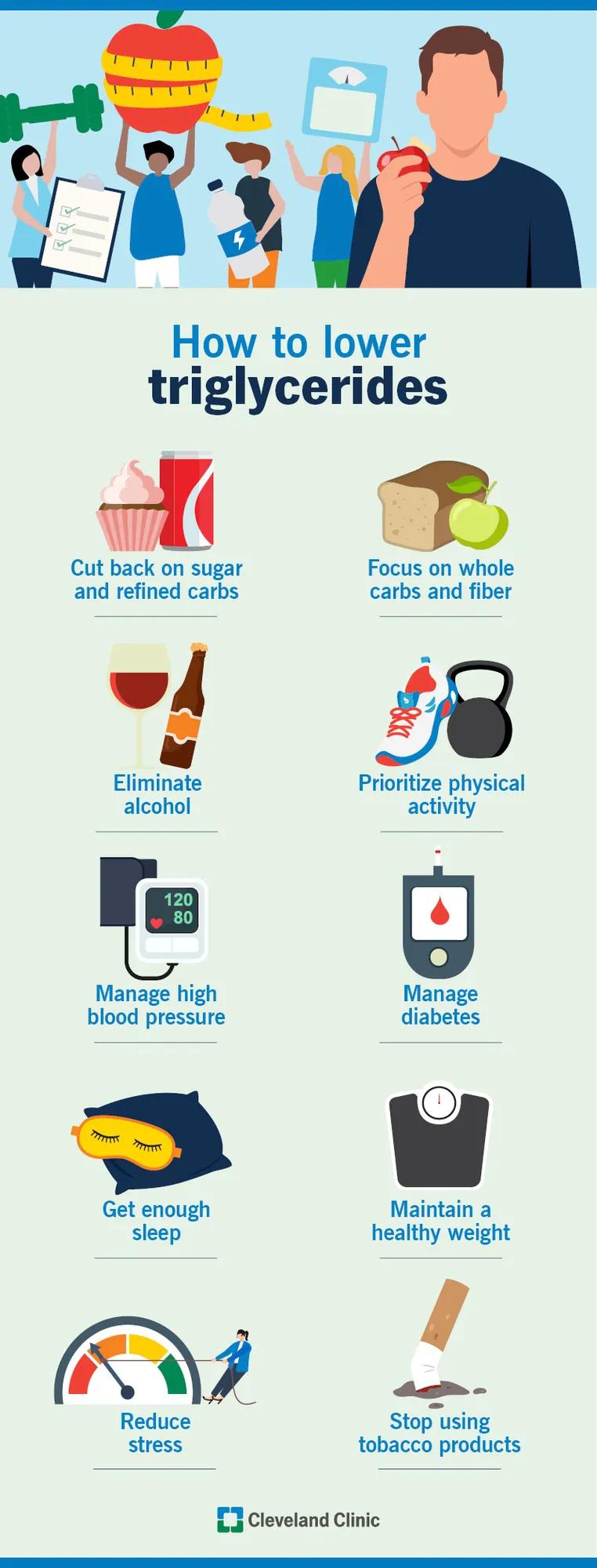
Image content: This image is available to view online.
View image online (https://assets.clevelandclinic.org/transform/7f3babd2-39fb-4e42-b531-2ff5ff61b18b/lowering-triglycerides-infographic)
Triglycerides come from our liver and the foods we eat. When levels are normal, these lipids are used for energy. The problems arise when levels are high. When we make more than we use, the rest is stored as fat.
Here’s how to reduce triglycerides.
Dr. Sarraju recommends scaling back on or eliminating:
“It’s particularly important to reduce the consumption of sugar and foods with high-fructose corn syrup,” says Dr. Sarraju. “These foods are converted to triglycerides in your body.”
Think about how you’re building your meals. Eat certain foods to lower triglycerides — typically those that are good sources of whole carbs and fiber — like:
Dr. Sarraju advises that increasing your fiber intake may lower lipid levels.
“If you have high lipid levels, there’s a good chance you don’t ingest close to the recommended 25 to 30 grams of fiber a day,” he says.
Advertisement
High triglyceride levels can be caused by excessive alcohol consumption as well. Once alcohol makes its way to your liver, it breaks down into cholesterol and fat.
So, if your levels are higher than normal, it might be a good idea to eliminate alcohol completely.
Exercising regularly can also play a huge part in managing lipid levels. During physical activity, your body uses fat as energy. So, any exercise helps improve insulin sensitivity, as well as reduce the amount of triglycerides in your liver.
Aim to get the recommended 150 minutes of moderate-intensity exercise each week, unless your doctor advises otherwise.
If your lipid levels are high, there’s a good possibility that it will cause your blood pressure to rise.
Your healthcare provider may suggest managing your high blood pressure with medication and lifestyle changes like exercise and diet.
“Certain blood pressure medications, like thiazides and beta-blockers, may raise the triglycerides,” clarifies Dr. Sarraju, “but sometimes, the benefits outweigh the risks, so discuss this with your healthcare provider.”
If you have diabetes, Dr. Sarraju stresses the importance of watching your overall carb consumption, which can raise your blood sugar levels.
“Poor diabetes control is a major factor in causing high triglyceride levels,” he notes.
This is important because diabetes tends to lower your HDL “good” cholesterol levels, while increasing harmful lipid levels.
So, what can you do? Focus on eating foods with fiber or healthy fats while limiting unhealthy fats. And talk to your healthcare provider about other ways to manage your diabetes.
By now, you know that getting quality sleep is important for a variety of reasons. And you can add “lowering triglycerides” to the list.
Higher levels have been linked to too much or not enough sleep, says Dr. Sarraju. When you sleep, your body has a chance to repair and restore itself. And if your sleep is poor, it can impact hormones like cortisol and ghrelin, which in turn, negatively affect lipid production.
“Disrupted sleep may be associated with disrupted diet and lifestyle, and may lead to unhealthy eating habits which, in turn, can increase triglyceride levels,” says Dr. Sarraju.
The goal? Aim to get about seven to nine hours of sleep each night.
If you have obesity, your healthcare provider may recommend working toward a healthier weight. Focusing on a heart-healthy diet and physical activity are just a couple of ways to reach your weight loss goals.
Advertisement
“Weight has a profound impact on triglycerides,” says Dr. Sarraju. “If you lose as little as 5% to 10% of your body weight, your triglycerides can drop as much as 20%.”
In addition to having a positive effect on lipids, being at a healthy weight improves your overall heart health.
When you’re stressed, your cortisol levels rise. More cortisol means higher blood sugar levels and more triglycerides. And when you’re stressed out, it’s more likely you’ll indulge in unhealthy foods.
Consider ways to reduce stress in your life. You can try meditation, yoga and deep breathing. But even carving out time in your busy day for a walk around the block or snuggling with your pet can help you relax and destress.
If you use tobacco, it may be time to form a plan to quit.
While we don’t fully understand the connection between tobacco and triglycerides, research shows that people who smoke tend to have higher amounts of triglycerides.
On average, it can take several weeks to see those numbers improve. But sometimes, you can see changes rapidly. It all depends on a few different factors, like:
If your triglyceride levels are high, your healthcare provider can help you create an effective management plan. This may include medications like statins.
Advertisement
“By improving your existing routine and making certain lifestyle changes, you could see changes in your triglyceride levels within a few weeks to months,” encourages Dr. Sarraju.
Advertisement

Sign up for our Health Essentials emails for expert guidance on nutrition, fitness, sleep, skin care and more.
Learn more about our editorial process.
Advertisement

By boosting your ‘good’ cholesterol, exercise can indirectly lower your ‘bad’ cholesterol — but it’s most helpful when paired with dietary changes
Despite earlier concerns, recent research suggests statins don’t raise dementia risk — and they may lower it

High cholesterol can be genetic, but testing and treatment can lower your heart disease risk

Limiting saturated fat, upping your fiber intake and moving around more can help reduce your ‘bad’ cholesterol

There isn’t enough research to recommend the supplement as a solution for lowering LDL levels

You may notice a decrease in your LDL ‘bad’ cholesterol in about four weeks

This plant-based eating plan focuses on lowering cholesterol, making it a great companion to the Mediterranean diet
In the world of cholesterol, HDL particles are ‘good’ and LDL particles are ‘bad’ for your heart health

Most breast pain isn’t a sign of cancer, but certain symptoms deserve a closer look

It’s a myth that you should avoid sleep (or have someone wake up throughout the night) after a head injury

The color and shade of your urine offer a window to your health
 Search










