Locations:





When these tiny particles of calcium carbonate come loose, it throws your sense of balance out of whack

Image content: This image is available to view online.
View image online (https://assets.clevelandclinic.org/transform/04a2de53-384b-44c0-a77d-eed54ab22d2e/vertigo-dizziness-1445422889)
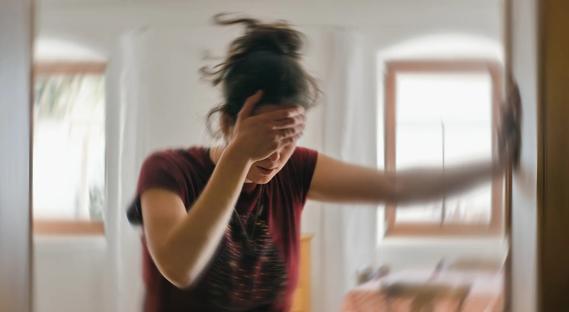
Person with hand on their head, leaning against wall, with the room spinning
You roll over to your right side in bed … and suddenly, the room starts rolling over, too. For a couple of days afterward, the world spins each time you turn to the right.
Advertisement
Cleveland Clinic is a non-profit academic medical center. Advertising on our site helps support our mission. We do not endorse non-Cleveland Clinic products or services. Policy
This condition, called benign paroxysmal positional vertigo (BPPV), can be downright scary. And when it happens repeatedly, it can become hard for you to work and do other everyday activities.
If you’ve heard that these bouts of vertigo and dizziness are related to something called “ear crystals,” you probably have a few questions.
Neurologist Neil Cherian, MD, an expert on dizziness, has the answers you’re looking for about loose ear crystals, including what causes them and how to fix them.
Otoconia, commonly called “ear crystals,” are tiny calcium carbonate particles in the chambers of your inner ear. You may also hear them called “ear rocks” or “ear stones.” And you can think of them as gravity sensors.
“Imagine a hill with blades of grass, and on top of each blade is a crystal,” Dr. Cherian illustrates. “Together, these crystals form an interconnected matrix. Whenever the blades of grass move, so do the crystals.”
In this analogy, the blades of grass represent cilia, tiny hair-like structures attached to nerves in your inner ear. When the crystals on top of the cilia move, it stimulates the nerves to fire. That tells your brain that your head is moving.
Usually, this elaborate crystal matrix is a reliable motion-sensing map. But if some of those crystals break free and drift into parts of your ear where they don’t belong, symptoms like dizziness and vertigo can set in quickly.
Advertisement
So, what’s the connection between crystals and dizziness? It all has to do with three fluid-filled semicircular canals in your inner ear.
“When the crystals are connected, that fluid only moves when your head moves, and it settles down when your head stops moving,” Dr. Cherian explains. “If the crystals are disconnected, though, they keep moving in the fluid for up to a few seconds afterward.
“Your brain has to figure out, ‘Why is there movement when I don’t see it?’ That’s what causes dizziness and vertigo, the feeling that you’re moving when you’re not.”
You’re at higher risk of developing loose ear crystals if you:
The main symptoms of loose ear crystals are:
But BPPV can cause other symptoms, too, like:
Healthcare providers can diagnose BPPV based on your symptoms and a medical evaluation. And they’ll specifically look for those rapid eye movements that are often a telltale sign of BPPV.
“If your eyes continue to move in response to false movement cues, that gives your doctor another way to confirm that you have BPPV,” Dr. Cherian says.
BPPV exercises, called canalith repositioning procedures (CRP), can help move your ear crystals back where they belong. The most well-known procedure is the Epley maneuver, and it’s easy to do on a bed or the floor. But it’s important to learn the right way to do it, or you risk making BPPV worse.
“When these exercises are done in a medical setting, the success rate for these exercises is up to 90%,” says Dr. Cherian. “So, learning to do them properly on your own can be quite effective for BPPV.”
But he adds that you should stop doing these exercises once your BPPV clears.
If you find that doing the Epley maneuver isn’t helping you, it may be because:
Advertisement
In these cases, seek help from an otolaryngologist, aka an ear, nose and throat (ENT) specialist. Or go straight to a vestibular physical therapist, who can diagnose and treat BPPV. They can help with additional exercises to move ear crystals back into place.
One more thing: If your dizziness and vertigo have you so nauseated that you can’t hold down liquids — or if you experience weakness, numbness, tingling or changes in vision — it’s important to get emergency medical care.
“Seek help sooner rather than later,” Dr. Cherian stresses. “These could signal a more serious problem, like a stroke.”
Having BPPV is sort of like coming down with the common cold: “We can identify it, and we can help you get through it sooner than you could on your own,” Dr. Cherian says. “But unfortunately, we can’t fully prevent it.”
If your symptoms are related to a head trauma, he adds that you may notice that you have fewer problems with loose ear crystals as you heal. But for the most part, it’s hard to predict the outlook for BPPV from one person to the next.
“Episodes of BPPV can last for a few seconds, a few days, a few weeks or a few months,” Dr. Cherian clarifies. “But because BPPV is so common and so fleeting, it’s hard to get good data on its incidence.”
Advertisement
If you’re experiencing BPPV, it’s important to work with your healthcare provider to master the Epley maneuver. This will allow you to put a quick stop to the spinning sensations and lightheadedness you feel when crystals get loose — so you can get back to feeling like you’re on steady ground.
Advertisement

Sign up for our Health Essentials emails for expert guidance on nutrition, fitness, sleep, skin care and more.
Learn more about our editorial process.
Advertisement
This spinning sensation is a symptom, not a condition, so you need to know what’s causing it before you can treat it

Building lower body strength is key to staying upright, particularly as you age
A study found that you might live longer if you can stand on one leg — but it’s far from a perfect indication of longevity
Staying active and doing what you love may increase both your confidence and your balance
Fainting, heart palpitations and shortness of breath are just a few signs your heart may need help

While similar, one may make you feel lightheaded, while the other can cause a spinning sensation
Staying active can help increase strength and flexibility, help maintain balance and coordination, and improve overall heart health

As the degenerative disease progresses, different mobility aids like a walker or wheelchair may be needed

Most breast pain isn’t a sign of cancer, but certain symptoms deserve a closer look

It’s a myth that you should avoid sleep (or have someone wake up throughout the night) after a head injury

The color and shade of your urine offer a window to your health
 Search










