Locations:





This spinning sensation is a symptom, not a condition, so you need to know what’s causing it before you can treat it
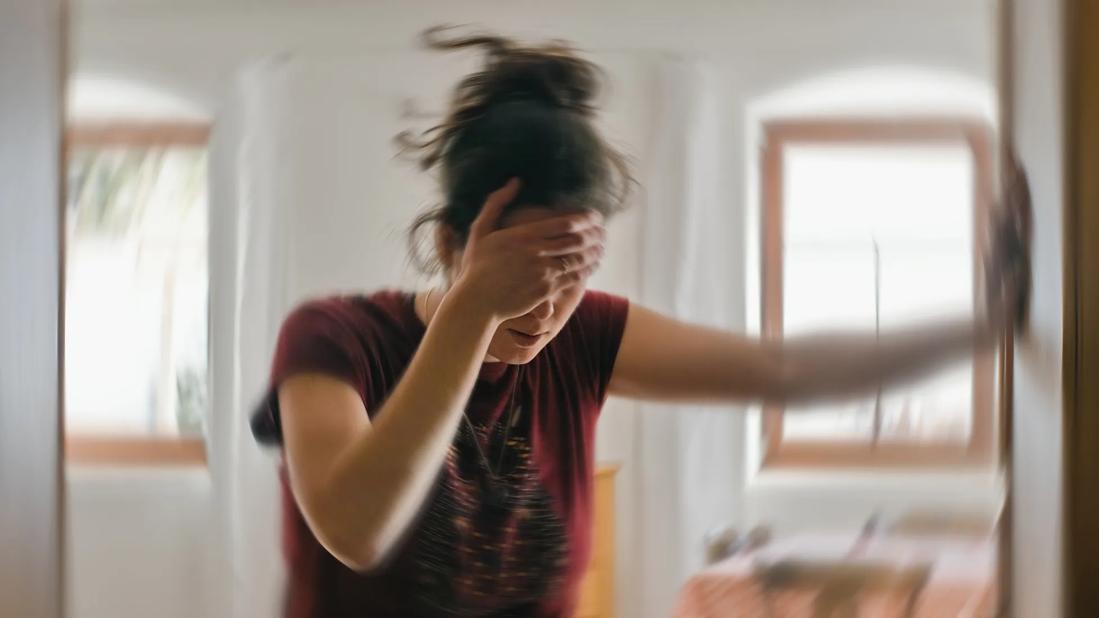
Image content: This image is available to view online.
View image online (https://assets.clevelandclinic.org/transform/23be9506-02f0-4895-ae0e-79009a1dcd30/person-dizzy-home-1366196062)
Person with hand on forehead, leaning on doorway jamb, room spinning
When you’re dealing with vertigo, the phrase “making your head spin” isn’t just an idiom.
Advertisement
Cleveland Clinic is a non-profit academic medical center. Advertising on our site helps support our mission. We do not endorse non-Cleveland Clinic products or services. Policy
“Vertigo is a spinning sensation — the feeling that you’re moving or your surroundings are moving, even when you know they’re not,” says audiologist Julie Honaker, PhD.
What can you do about it? Let’s take a look.
Vertigo can have lots of causes, which means it can also have a variety of remedies. So, the most important thing you can do for vertigo is talk to a healthcare provider to figure out why it’s happening.
Here are some vertigo home remedies your provider may advise you to try.
If you have a condition like benign paroxysmal positional vertigo (BPPV), you may be able to find vertigo relief by learning to do the Epley maneuver. A healthcare provider can show you how to do this series of specific movements, which can help change the position of tiny calcium particles called otoconia, aka “ear crystals.”
“Otoconia help give us a sense of where we are in space,” Dr. Honaker explains. “When they become dislodged, moving your head and body in certain positions can help migrate them back where they’re supposed to go.”
Ear crystals normally sit atop tiny hair cells within your head, and they’re key to your sense of balance. If they move out of place, vertigo can come on quickly — but the Epley maneuver is a type of canalith repositioning procedure (CRP) that can move them back where they belong.
Advertisement
Doing the Epley maneuver involves a series of specific position changes (including turning your head, lying down and rolling over) to move ear crystals back into place. It’s been shown to help up to 95% of people with BPPV, relieving vertigo within days or even minutes.
But you should never do it without first talking to a healthcare provider.
“Doing the Epley maneuver incorrectly can actually make vertigo worse,” Dr. Honaker warns. “So, before you try it on your own, it’s important to learn how to do it from a trained provider.”
If you’ve been diagnosed with Ménière’s disease, a chronic inner ear disorder that causes recurring vertigo, your provider may recommend switching to a low-sodium diet.
“A build-up of inner ear fluid called endolymph is thought to play a role in this condition,” Dr. Honaker explains. “And because salt causes your body to retain fluid, cutting back on salty foods may help prevent endolymph from building up.”
Aim for no more than 1,500 milligrams of salt each day, or about three-quarters of a teaspoon. But it can be difficult to make big changes to your diet and reduce salt intake on your own, so don’t hesitate to ask your healthcare provider for help figuring it out.
OK, OK, this isn’t a home remedy — at least, not initially. But a physical therapist can teach you things you can do at home to help relieve your vertigo.
Vestibular rehabilitation therapy is a specific type of physical therapy (PT) where you’ll learn personalized strategies to help manage your vertigo and any related concerns, like dizziness or balance issues.
“Physical therapy can really get you feeling rebalanced and help correct common conditions like BPPV,” Dr. Honaker shares.
Dr. Honaker describes our sense of balance as a sixth sense — one that we don’t really appreciate until something goes wrong. One of the best ways to foster a better sense of balance is to adopt healthy lifestyle habits.
Do your best to:
“When it comes to your balance system, if you don’t use it, you lose it,” Dr. Honaker cautions. “So, it’s important to keep it active and keep up with our overall health. That keeps your body as a whole working in its prime, which can ward off symptoms like dizziness and vertigo.”
Taking good care of your ears won’t stop vertigo as it’s happening. But proactive hearing protection may help limit your risk of experiencing it.
Advertisement
“Exposure to loud noises damages your inner ear, which is related to vertigo,” Dr. Honaker says. “It can cause irreversible damage to the hair receptor cells in your inner ear, which can lead to problems with your vestibular system and, ultimately, hearing loss.”
To protect your ears from loud sounds:
If your vertigo is sudden and severe, seek immediate medical care. This is especially true if it comes with other symptoms, like:
It’s worth saying again: Vertigo is a symptom, not a condition. So, before you try to treat it on your own, it’s important to figure out what’s causing it.
“There are so many causes of vertigo that we need to be sure we’re treating the correct thing,” Dr. Honaker reiterates. “Because otherwise, there’s a chance that self-treatment can cause more harm than good.”
If you’re experiencing vertigo or other balance issues, make an appointment with a healthcare provider. As you share your concerns, be prepared to answer questions like when your symptoms started, how often you have them and what activities trigger them.
Advertisement
From there, your provider may refer you to a vestibular audiologist, an expert who specializes in vertigo, dizziness and balance disorders.
“We’re kind of like detectives for vestibular disorders, helping decipher the many potential causes,” Dr. Honaker says. “Your provider can help identify the reason for your vertigo, and you’ll determine a treatment together from there.”
Advertisement

Sign up for our Health Essentials emails for expert guidance on nutrition, fitness, sleep, skin care and more.
Learn more about our editorial process.
Advertisement
When these tiny particles of calcium carbonate come loose, it throws your sense of balance out of whack

Building lower body strength is key to staying upright, particularly as you age
A study found that you might live longer if you can stand on one leg — but it’s far from a perfect indication of longevity
Staying active and doing what you love may increase both your confidence and your balance

At-home remedies may help calm symptoms and make it easier to relax at bedtime

The safety risks outweigh any potential benefits these products may offer

A variety of OTC products and professional treatments can be effective at removing stains on teeth

Topical creams, oral antihistamines and some TLC for your skin can help relieve itchiness and boost recovery

Managing your weight through physical activity may lower your chances of getting this common cancer

It typically starts in October and winds down in early spring, with cases at their highest in the middle of winter

Anxiety disorders, health conditions and past trauma can make driving nerve-wracking — help is available
 Search










