Locations:





 Search
Here’s what to know from a sleep medicine specialist
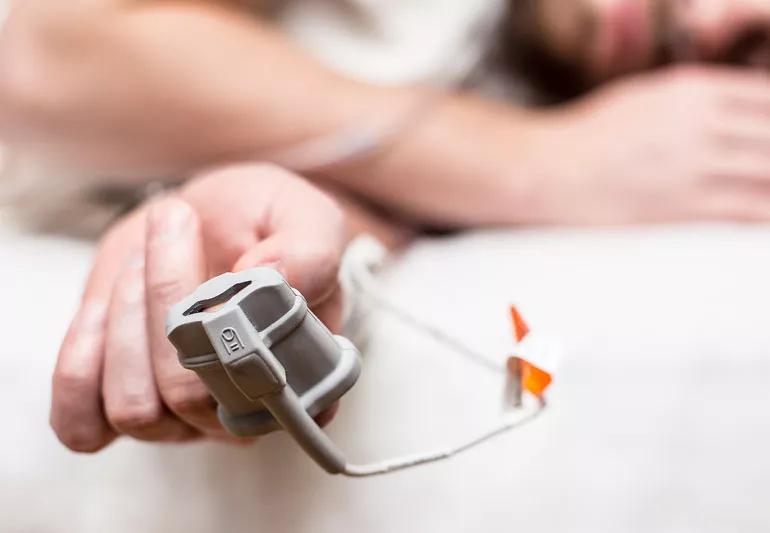
Most sleep studies are performed in a sleep laboratory. Today, these laboratories are often located in a hotel rather than a hospital.
Advertisement
Cleveland Clinic is a non-profit academic medical center. Advertising on our site helps support our mission. We do not endorse non-Cleveland Clinic products or services. Policy
But if your doctor suspects you have sleep apnea — a condition where your breathing pauses or is disrupted while you’re asleep — you might be a good candidate for an at-home sleep apnea test.
An at-home sleep apnea test has a very specific aim. “This is an abbreviated test done in your home for one reason — to confirm the diagnosis of sleep apnea,” says sleep medicine specialist Nancy Foldvary-Schaefer, DO, MS. “This test isn’t for more complicated sleep disorders. It’s not going to precisely estimate the amount of sleep apnea you have.”
An at-home sleep apnea test specifically detects the presence of high probability obstructive sleep apnea, says Dr. Foldvary-Schaefer. “If you snore, are tired during the day or have a bed partner who has witnessed apneas — meaning those breathing pauses — those are the top three symptoms of obstructive sleep apnea,” she says.
An at-home sleep apnea test measures the number of times you record either an apnea — which means you stop breathing for at least 10 seconds — or a hypopnea, or a partial airway obstruction. Doctors can use this data to calculate what’s called the apnea-hypopnea index.
“This is the number of times your upper airway experiences a significant collapse (or blockage) per hour of sleep,” explains Dr. Foldvary-Schaefer.
Advertisement
Going by this index, a number of five or above warrants a sleep apnea diagnosis. Mild sleep apnea is in the five to 15 range, moderate is 15 to 30, and severe is 30 plus.
If you’re doing an at-home sleep apnea test, you’ll generally have the test delivered to you at your house on the chosen date. The test itself comes in a sterile kit featuring the equipment you need to measure your breathing, oxygen levels and heart rate.
This equipment takes the form of four sensors, which you’ll put on and wear right before bed. These include:
All of these are connected to a recorder. “Then, you turn it on, go to sleep, wake up in the morning, take it off and ship it back to us,” says Dr. Foldvary-Schaefer. “So the home sleep test works very well.”
Yes, you can set up and use your at-home sleep apnea test by yourself. But if you need help making sure everything is set up OK, help is available. “The kit does come with instructions and a telephone number to reach out to one of our team members if there’s a challenge,” notes Dr. Foldvary-Schaefer.
Dr. Foldvary-Schaefer says at-home sleep apnea tests have a failure rate of around 7% or 8%. “Sometimes, the device won’t work or you may forget to turn it on,” she explains. “Or you might not have placed a critical sensor appropriately. In these situations, we assess whether it’s reasonable to send the device back to you to try again, or have you come for an in-lab study.”
At-home sleep apnea tests also underestimate how severe your obstructive sleep apnea is, Dr. Foldvary-Schaefer says. “That’s why it’s important to choose the right test for the right clinical question. If there is a concern about measuring the severity of sleep apnea, we may not be able to fully answer that question with a home test. An in-lab test might be preferable.”
Being treated for any sleep disorder is important. But untreated sleep apnea, especially if it’s in the moderate to severe range, puts you at risk for some serious health problems. “People in those ranges have an increased risk of cardiovascular disease, high blood pressure, heart attacks, stroke and heart failure, as well as metabolic disorders like obesity and diabetes,” says Dr. Foldvary-Schaefer. “You can even be at greater risk of cognitive impairment and even progression to Alzheimer’s disease.”
Advertisement
An at-home sleep apnea test isn’t for everyone. You’re a good candidate if you have a high probability of sleep apnea, but also no major health issues. “If we suspect you don’t have a sleep disorder that would require an in-lab test, or if you don’t have significant heart or lung disease, then you might be the perfect patient to have a home sleep apnea test,” says Dr. Foldvary-Schaefer. “It’s used when we want to confirm you have sleep apnea, so we can then start treating it.”
If you have significant lung disease, heart failure or a neurological condition — or if your doctor refers you for evaluation of sleep problems other than sleep apnea alone — you’ll definitely need to get your test done in a sleep laboratory.
“Maybe you snore but we’re not so sure how sleepy you are during the day,” says Dr. Foldvary-Schaefer. “It would be more appropriate for you to have an in-lab test so that we can measure things with more precision and measure other biological signals that are not included in the home sleep apnea test.”
Advertisement
Sign up for our Health Essentials emails for expert guidance on nutrition, fitness, sleep, skin care and more.
Learn more about our editorial process.
Advertisement
Sleep apnea is associated with sudden cardiac death and other complications that increase your risk of mortality
Manage your sleep apnea and keep your diabetes in check
To avoid sleep deprivation and shift work sleep disorder, try adopting habits that minimize light exposure and prioritize daytime sleep
Sleep disorders, mental health conditions and other health concerns can all affect the quality of your sleep
Most people fall asleep within 10 to 20 minutes, but if your experience is different, adjusting your sleep schedule may help

Tart cherry juice contains natural compounds that may support better sleep
If you’re waking up drenched, it could be menopause, stress, medications and other causes
Stick to a consistent schedule, be mindful of screen time and work on reducing your stress levels before bed
Even small moments of time outdoors can help reduce stress, boost mood and restore a sense of calm

A correct prescription helps your eyes see clearly — but as natural changes occur, you may need stronger or different eyeglasses
Both are medical emergencies, but they are very distinct events with different causes











