Locations:





 Search
Recognizing subtle symptoms, like unusual fatigue or fleeting episodes of chest pain, could be key to survival
Your body may be trying to warn you that a heart attack is coming. But are you listening? And do you know what to listen for?
Advertisement
Cleveland Clinic is a non-profit academic medical center. Advertising on our site helps support our mission. We do not endorse non-Cleveland Clinic products or services. Policy
Although some people have no early warning signs, others do. And knowing about them can be lifesaving.
We spoke with cardiologist Jacqueline Tamis-Holland, MD, to learn what you might notice before a heart attack happens and when to seek medical care.
Early warning signs of a heart attack can start hours, days or even weeks beforehand. They’re often subtle, so they might easily fly under the radar.
Dr. Tamis-Holland explains that some heart attacks occur after a period of “waxing and waning” symptoms. The symptoms come and go, and don’t last long enough to raise alarm bells. And because these sensations are fleeting, it might be easy to brush them off or assume they’re from something else, like indigestion.
The most common early signs of a heart attack are:
These may occur together or on their own. Let’s take a closer look.
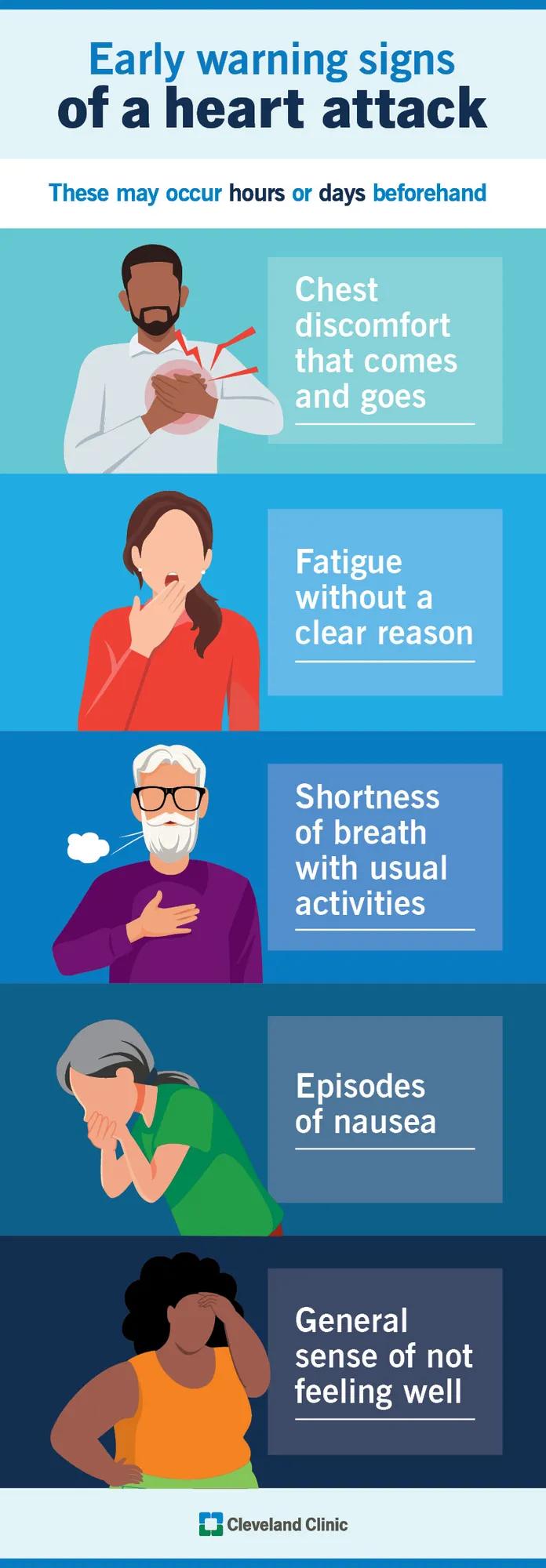
Image content: This image is available to view online.
View image online (https://assets.clevelandclinic.org/transform/7120983d-4dea-4213-bf74-2082dce79cab/early-signs-heart-attack-infographic)
“Some people have chest discomfort that goes away and then comes back,” Dr. Tamis-Holland explains. “The feeling might last five minutes or 10 minutes. But because it’s not intense or severe, and it goes away, they don’t call their provider.”
Advertisement
You might not have pain exactly, but something more like:
Such discomfort in your chest or upper body is a classic symptom of a heart attack as it’s happening. But it’s also a key early warning sign. It can mean that plaque in your coronary arteries is limiting blood flow to your heart, but not completely blocking the flow, so it’s only transient or short-lived.
The “waxing and waning” nature of this early clue affects each person a little differently. You might have one episode and then it doesn’t happen again until days later, when you have a heart attack. Or you might have isolated episodes lasting several minutes over the course of weeks.
This means you’re extremely tired to the point where it’s not typical for you. And you can’t identify a clear reason.
Maybe you normally zip up and down the stairs, no problem. But today, you’re wiped out after one slow flight. Or perhaps you can’t muster the energy to go outside to water the flowers, which you normally do without breaking a sweat. It’s that sort of thing.
“Some people just feel really tired in the weeks before,” Dr. Tamis-Holland says. “While this is less often a warning sign, some patients have described this sensation in the days prior to their event. They don’t have as much energy as they usually do.”
If you have this type of fatigue, it’s worth taking note. It might mean that your heart is having trouble sending enough blood to all the parts of your body that need it.
You may experience shortness of breath that’s not typical for you. This can occur at rest or when you’re not moving around much. You might even feel like you can’t lie down because you’re so short of breath.
Brief episodes of nausea can sometimes indicate poor blood flow to your heart muscle. If these recur, it’s best to discuss what you’re feeling with a healthcare provider.
A general sense of unwellness — where you don’t feel 100% but can’t quite describe why — can be an early warning sign of a heart attack. Aside from feeling physically unwell, you may also have a sense of impending doom, like something bad is going to happen.
“There are some people who have said after the fact, ‘I just didn’t feel well, but I can’t really explain it,’” shares Dr. Tamis-Holland. This sense might linger for days leading up to a heart attack.
This doesn’t mean that you should rush to the ER if you feel off your game. But it does mean there’s value in checking in with your body and trusting your gut. “When in doubt, err on the safe side and seek medical attention,” she advises.
Advertisement
“If you have any of these signs and are concerned, call your physician or healthcare provider,” urges Dr. Tamis-Holland. “But if you think you might be having a heart attack, call 911. It’s important to act fast.”
A heart attack can cause permanent damage to your heart muscle. But if warning signs appear, you have a chance to get help before such damage occurs. This lets providers treat the underlying causes (like coronary artery blockages) sooner and gets you on the road to recovery faster.
Listening to our bodies isn’t always easy — especially in a world that keeps getting noisier. But learning to separate red flags from background static can help you know when to seek care. And that can make all the difference in protecting yourself and those you love.
Advertisement
Sign up for our Health Essentials emails for expert guidance on nutrition, fitness, sleep, skin care and more.
Learn more about our editorial process.
Advertisement
Strokes affect your brain, while heart attacks affect your heart — both can be life-threatening emergencies

There’s no way to stop a heart attack on your own — call for help immediately

Healthy choices involving food, exercise and more can help reduce your risk

Common symptoms include chest discomfort, shortness of breath, nausea and profuse sweating

Calling 911 or emergency services should always be your first step

Mild heart attacks may cause less damage, but they can still lead to serious complications and require medical attention

Congenital heart disease, genetic conditions and unhealthy lifestyle habits can put teens at higher risk for heart attack

Absolutely! In fact, in many ways, exercise is key to recovery

The tropical fruit is a good source of antioxidants and vitamin C

Most people fall asleep within 10 to 20 minutes, but if your experience is different, adjusting your sleep schedule may help

Exploring your hidden side can lead to better understanding of what makes you tick











