Locations:





Your chronotype reflects when your body naturally wants to sleep and wake — and why your energy peaks when it does
Think of someone whose sleep habits are completely different from yours. One of you hits snooze a dozen times each morning, groggy from the get-go. The other pops awake before the sun rises, but can barely keep their eyes open past dinner.
Advertisement
Cleveland Clinic is a non-profit academic medical center. Advertising on our site helps support our mission. We do not endorse non-Cleveland Clinic products or services. Policy
Those differences aren’t about willpower or bad habits. They’re tied to your sleep chronotype — your body’s natural tendency toward certain sleep and wake times. Sleep specialist Robon Vanek, CNP, explains.
Some people feel alert early in the morning, while others hit their stride later in the day — and that’s the type of difference that chronotypes represent.
“Your chronotype is essentially your body’s natural preference for when you feel most awake and when you feel ready to sleep,” Vanek says.
The key word there is “natural.” Your chronotype isn’t about what time you have to get up for work, or when you go to bed so you can work out early the next day. It’s about when your body wants to wake and sleep, without external pressure.
So, why does your sleep chronotype matter?
“Problems can arise when your biological clock is constantly out of sync with work or school schedules,” Vanek explains. “This is a concept we call ‘social jet lag.’ And over time, that mismatch can affect your sleep quality, alertness and overall well-being.”
On the other hand, understanding your chronotype can help you make more informed choices about sleep timing, daily routines and expectations. Tailoring your sleep schedule to your chronotype can help you sleep better and longer and feel more alert during the day.
Advertisement
Here’s a quick overview of sleep chronotypes:
There’s another popular model of sleep chronotypes, too. In the late 2010s, clinical psychologist Michael Breus, PhD, ABSM, created a framework of four easy-to-understand chronotypes based on animals: bear, lion, wolf and dolphin.
“These animal labels aren’t part of any formal medical terminology,” Vanek notes. “But some people may find them helpful to better understand where they fall on the chronotype spectrum.”
Here’s a look at each of the animal chronotypes.
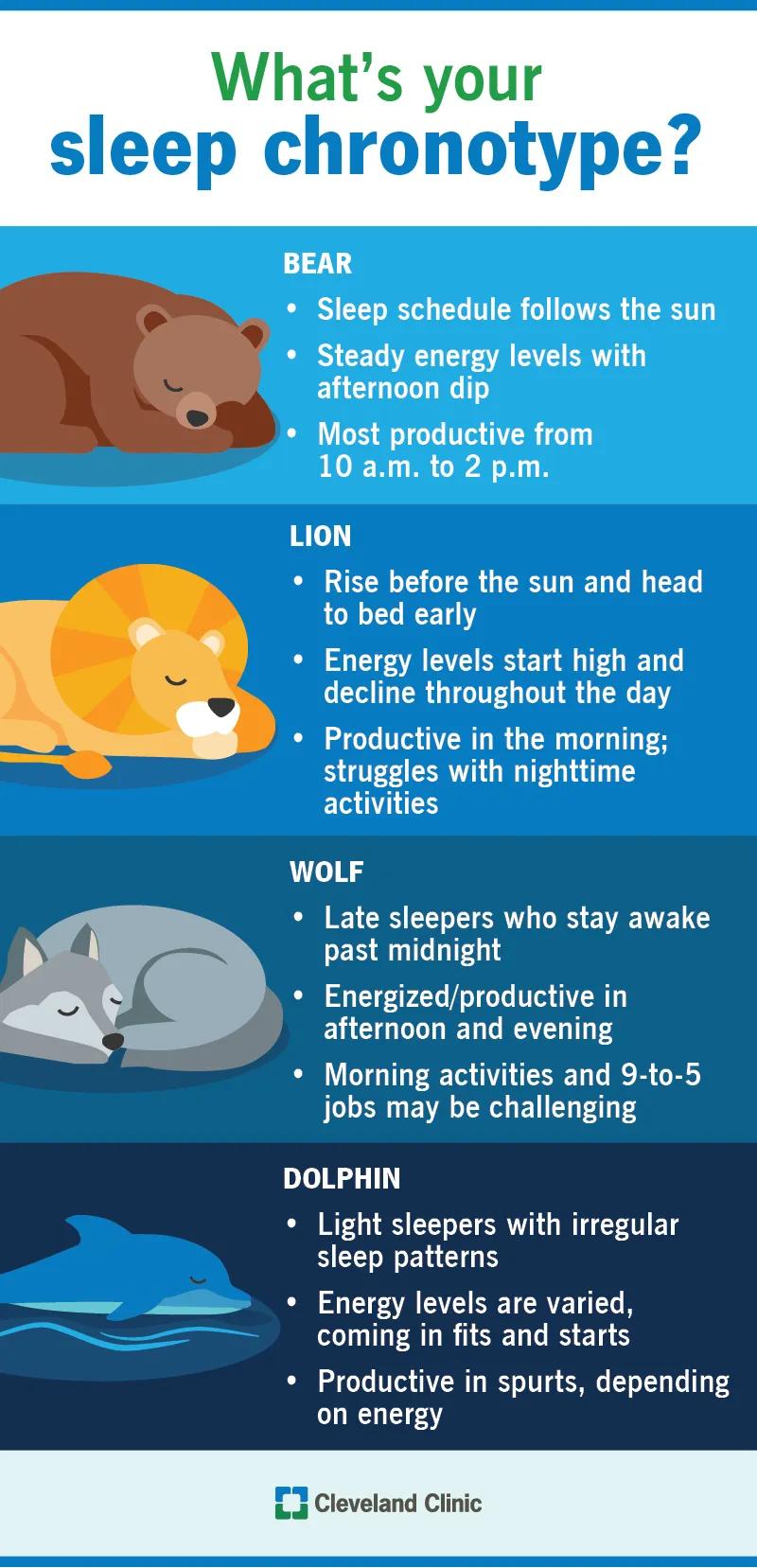
Image content: This image is available to view online.
View image online (https://assets.clevelandclinic.org/transform/a9fa75de-c871-4e73-841f-0bc08ce66a43/sleep-chronotype-infographic)
When you think of standard sleep/wake times, you’re thinking of the schedule associated with the bear chronotype. So, what does it mean to be a bear?
If you fancy yourself an early bird, you’re probably a lion. Lions are early risers who wake up ready to face the day.
Wolves come out at night, and so do you! OK, OK, that’s not totally true: People with the wolf chronotype simply feel most energized and productive later in the afternoon and evening.
Advertisement
This sleep chronotype is named after dolphins, whose unique sleep pattern means that even when half of their brain is asleep, the other half remains active.
Because the dolphin chronotype is associated with irregular sleep patterns, it’s especially important to pay attention to how rested you feel. If you struggle with sleep, talk to a healthcare provider to rule out insomnia or other sleep disorders.
Researchers think of chronotypes as a spectrum ranging from “morningness” to “eveningness.” You’re not locked into one category, but most people lean toward earlier or later, depending on factors like biology, age and environment.
Advertisement
Some of these factors are out of your control, while others are lifestyle-related and can nudge your sleep timing earlier or later and make your natural chronotype harder to recognize.
If you’ve ever tried to keep yourself awake for a late-night event or change your habits to become a morning person, you know how hard it can be. And there’s a reason for that: You’re working against your chronotype.
Advertisement
Those natural inclinations are largely built in, which can make them really tough to change.
“Chronotype isn’t set in stone, but it’s not infinitely flexible either. Biology does set some limits on how much you can change it,” Vanek says. “But there are a few strategies you can try if you want to help shift your sleep timing earlier or later.”
Here’s what she recommends:
Still, when you’re trying to adjust your chronotype, expectations matter.
“These strategies usually only lead to modest changes,” Vanek notes. “If you’ve always been an extreme night person, you’re not likely to suddenly become an extreme early bird.”
Your chronotype is rooted in biology, but it isn’t set in stone. Understanding it can help you make choices that support high-quality sleep, daytime energy and your overall quality of life.

Sign up for our Health Essentials emails for expert guidance on nutrition, fitness, sleep, skin care and more.
Learn more about our editorial process.
Advertisement

Nocturnal emissions are a natural part of growing up and nothing to worry about
There’s limited research on whether the supplement can help you snooze — adopting proven sleep habits may be a better place to start

Head to bed in a bra to reduce breast pain, nipple irritation and stretch marks

These brief episodes of sleep last only seconds, but they can have serious consequences when they happen at the wrong time

Putting on socks at night can help regulate your core body temperature to bring on ZZZs
The term refers to how long it takes you to fall asleep, which can be a key factor in overall sleep quality

A little ‘prep work’ before going to bed can help you get the quality sleep your body needs

Sleep masks can help you create total darkness so you can sleep better

Managing your weight through physical activity may lower your chances of getting this common cancer

It typically starts in October and winds down in early spring, with cases at their highest in the middle of winter

Anxiety disorders, health conditions and past trauma can make driving nerve-wracking — help is available
 Search










