Locations:





This breathing technique can help protect your heart during treatment for certain types of cancer
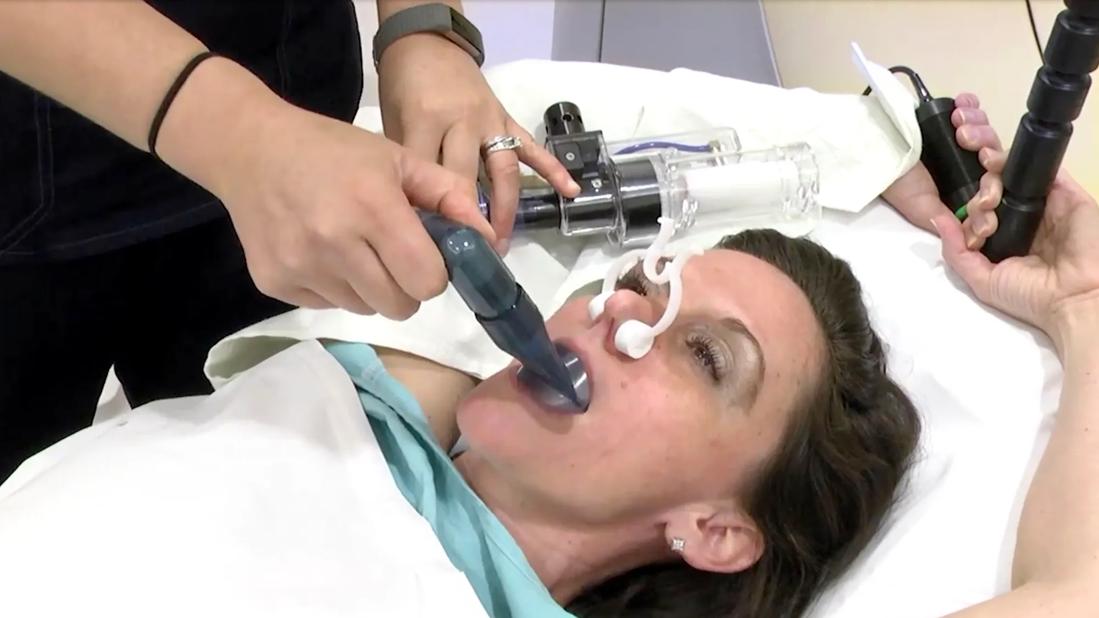
Image content: This image is available to view online.
View image online (https://assets.clevelandclinic.org/transform/3b5960fd-3c28-4799-b93c-61fb1c40bf34/Deep-Inspiration-Breath-Hold-CC)
Person being set up for the deep inspiration breath hold technique during radiation therapy
When you’re undergoing radiation therapy, you’re already dealing with a lot. You’re focused on this health concern, and the last thing you want to think about is what kind of health issues you might face down the road.
Advertisement
Cleveland Clinic is a non-profit academic medical center. Advertising on our site helps support our mission. We do not endorse non-Cleveland Clinic products or services. Policy
But it’s important to know that in some cases, radiation can raise your risk of developing heart disease later on.
“If your heart receives radiation during cancer treatment, it puts you at greater risk for a range of heart problems in the future,” explains breast radiation oncologist Rahul Tendulkar, MD.
Your care team wants to do everything they can to help lower that risk. Dr. Tendulkar explains how a technique called a deep inspiration breath hold (DIBH) can help keep your heart safe during treatment.
Radiation uses high-energy X-rays to kill cancer cells while minimizing damage to healthy cells. But if your heart directly receives radiation, it raises your risk for radiation heart disease, a range of heart problems that includes:
Radiation heart disease is most common in people who have had radiation therapy to the chest — especially the left side of the chest, where your heart is.
The American College of Cardiology warns that undergoing radiation therapy to your left breast doubles the risk of heart disease in young women, compared to right breast radiation therapy. That risk is even higher if you’re receiving chemotherapy at the same time, or if you’re at higher risk for heart disease in the first place.
Advertisement
You may also receive radiation that can affect your heart if you’re undergoing treatment for other types of cancer, including:
Deep inspiration breath hold (DIBH) is a breathing technique that helps protect your heart while you’re undergoing radiation therapy for certain types of cancer — particularly breast cancer in your left breast.
“The left breast is closer to the heart, which means it may be in the radiation field,” Dr. Tendulkar explains. “But even a small shift in your heart’s position can make a meaningful difference in how much radiation it receives.”
The idea behind a deep inspiration breath hold, then, is to shift your heart out of the “danger zone” of radiation.
When you take a deep breath and hold it, your diaphragm — a large, dome-shaped muscle at the base of your lungs — gently pulls your heart away from your chest walls and away from the radiation field. It’s been shown to significantly decrease the amount of radiation to the heart, compared to breathing normally.
There’s another use for DIBH, too.
“If you’re undergoing radiation therapy to target a tumor in your lung, liver or pancreas, holding your breath helps keep your organs from moving during treatment,” Dr. Tendulkar further explains. “This allows radiation to target the tumor while minimizing its impact on your organs.”
During DIBH, you hold your breath for up to 20 seconds while radiation is delivered. But you don’t have to do it alone: Your care team may use a device called an active breathing coordinator (ABC) to make it easier for you to hold your breath.
“The device is designed to be safe and comfortable,” Dr. Tendulkar notes, “and you’re always in control of when it starts or stops.”
An ABC looks like a snorkel with a nose clip. You’ll also hold on to a handheld element of the device, which has a button on top. It’s connected to a computer that’s monitored by a therapist from your care team.
Your therapist will teach you how to use the ABC to do a deep inspiration breath hold during your treatment. Here’s an overview of how it’s done:
Advertisement
“You’ll follow this process during each radiation treatment,” Dr. Tendulkar adds. “Your therapist will guide you and tell you how many times you’ll have to hold your breath throughout it.”
If you have any questions about the process, they’ll be there to answer them — every step of the way.
Your care team will teach you everything you need to know about how to perform the deep inspiration breath hold, and the ABC device will make it easier for you to do. But practicing on your own can help get your body comfortable with it.
Studies show that just five days of practicing at home before treatment can help reduce the amount of radiation that ultimately reaches your heart during treatment.
“You can help prepare for deep inspiration breath holds by practicing deep breathing at home,” Dr. Tendulkar shares. “Just practice taking long, slow, deep breaths and holding them for a few seconds at a time.”
There’s no need to be perfect. But even gentle practice ahead of time can help you feel more confident as you head into treatment.
Not everyone who’s going through radiation treatment needs or benefits from deep inspiration breath hold.
“It’s used only when we think it will be helpful, based on your anatomy, tumor location and breathing ability,” Dr. Tendulkar clarifies. “So, your radiation oncologist will recommend it only if it meaningfully improves your treatment plan.”
Advertisement
If your care team does recommend this technique as part of your radiation therapy, they’ll be there to teach you how to do it and to support you throughout the process. Though deep inspiration breath hold is a simple technique, it can play an important role in helping protect your heart while you focus on what matters most — healing.
Advertisement

Sign up for our Health Essentials emails for expert guidance on nutrition, fitness, sleep, skin care and more.
Learn more about our editorial process.
Advertisement

Your care team can determine if you’re a good match for this newer type of targeted treatment

Managing your weight through physical activity may lower your chances of getting this common cancer

Not all breast lumps signal cancer, and not all breast cancer causes lumps — it’s important to know the facts

BRCA1/2 gene mutations can raise your risk for breast, prostate and other cancers — genetic testing can help you take proactive steps

If you’re of Ashkenazi Jewish descent, these tests may be a reasonable starting point — but more thorough genetic testing can go much deeper

Breast cancer treatments can lower estrogen, which has a ripple effect on your bones

Breast cancer treatments can lower your fertility, but egg freezing and other preservation measures may be an option

The process can range from six months to more than a year, depending on whether you have immediate or two-stage reconstruction
Managing your weight through physical activity may lower your chances of getting this common cancer

It typically starts in October and winds down in early spring, with cases at their highest in the middle of winter

Anxiety disorders, health conditions and past trauma can make driving nerve-wracking — help is available
 Search










