Locations:





Delirium is a sudden change in mental status, while dementia is a long-term, progressive decline
It can be scary when someone you love suddenly seems confused, forgetful or “not themselves.” What could be going on?
Advertisement
Cleveland Clinic is a non-profit academic medical center. Advertising on our site helps support our mission. We do not endorse non-Cleveland Clinic products or services. Policy
Both delirium and dementia affect how the brain works, including thinking, memory and attention. They sometimes look similar, but they’re actually very different conditions with different causes, timelines and treatments. And one of them — delirium — requires prompt medical attention because it can be a signal that something serious is going on.
Intensive care unit pharmacist Heather Torbic, PharmD, explains the difference between delirium and dementia and how knowing the difference can help you get the right care at the right time.
At a basic level, both delirium and dementia affect how the brain works. But they’re not the same thing.
“The clearest difference between the two is that dementia develops slowly and is usually permanent, while delirium is a sudden change in mental activity that is often reversible,” Dr. Torbic explains.
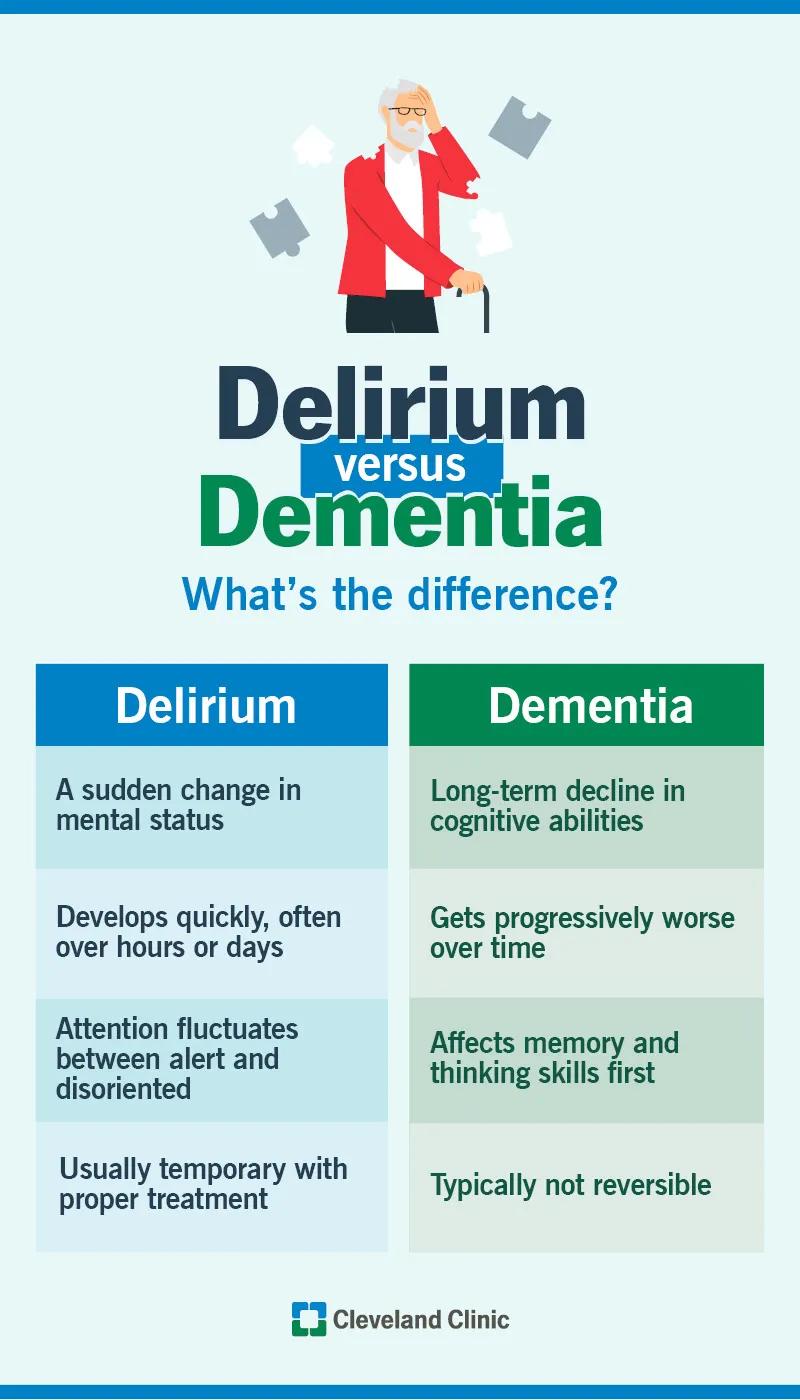
Image content: This image is available to view online.
View image online (https://assets.clevelandclinic.org/transform/dad0e451-d760-454c-b087-ca5bb84fceb1/delirium-versus-dementia-infographic)
While the symptoms of delirium and dementia may overlap, several key differences help healthcare providers tell them apart.
The speed at which symptoms appear is one of the clearest differences between delirium and dementia.
Advertisement
“Delirium can appear within hours or a day or two, and symptoms can come and go throughout the day,” Dr. Torbic explains.
Dementia, on the other hand, develops gradually, usually over months or years. Symptoms slowly get worse over time and interfere with daily life as the condition progresses.
Delirium almost always has a specific trigger — something acute or short-term that’s putting stress on the body or brain and is often multifactorial. It’s especially common among people who are already hospitalized in an intensive care unit (ICU). And the longer the hospital stay, the higher the risk.
Other common causes of delirium include:
“When someone develops delirium, we’re always asking, ‘What caused this?’” Dr. Torbic shares. “There’s usually an underlying issue we can identify and treat.”
But ongoing changes in the brain, like Alzheimer’s disease or other neurological conditions, cause dementia. These changes aren’t a result of short-term stress on the brain, and they don’t resolve with treatment.
One caveat, though: People with dementia are at higher risk for developing delirium, especially during illness or hospitalization.
Delirium and dementia both affect thinking, but in different ways. Often, one of the first signs of delirium is the way it affects a person’s ability to pay attention.
“People with delirium often seem confused about what’s going on around them and have trouble paying attention,” Dr. Torbic observes. “They may also become aggressive or withdrawn and act much differently than they normally do at their baseline.”
With delirium, alertness can fluctuate throughout the day. Your loved one may seem clear and aware one moment, but confused and disoriented the next.
With dementia, a person’s ability to pay attention is usually more stable in the early stages of the disease. Their memory and thinking skills decline first, while alertness doesn’t decline until the disease progresses.
Delirium is typically temporary. Symptoms can last for hours, days or sometimes weeks, depending on the cause and how quickly it’s recognized.
But dementia is long term and progressive. Symptoms don’t come and go quickly. Instead, a person’s cognitive ability declines steadily over time.
“Delirium is often reversible if the underlying cause is treated,” Dr. Torbic says. “The sooner it’s recognized, the better the chance of recovery.”
Advertisement
Dementia typically isn’t reversible, although symptoms can sometimes be managed or slowed.
This is one of the most critical differences between the two conditions.
Delirium is a medical emergency, while dementia usually isn’t.
“Sudden confusion or other changes in mental state are a red flag that something in the body is seriously wrong and needs immediate attention,” Dr. Torbic emphasizes.
Dementia requires medical evaluation, too, but it’s typically not an emergency unless symptoms change suddenly — which could signal delirium on top of dementia. (More on that in a moment.)
Delirium and dementia can look similar at first, which is why it’s easy to confuse them. Both conditions can involve:
Older adults are at higher risk for both delirium and dementia. And delirium is frequently missed or mistaken for dementia, especially in older adults.
“When this happens, a serious underlying illness may go untreated,” Dr. Torbic says.
Delirium and dementia can (and often do) coexist. People with dementia are 3 to 4 times more likely to experience delirium than people without dementia. And when they do, their symptoms are often more severe.
Advertisement
Experiencing delirium also raises your risk of developing dementia in the future. Research shows that people who’ve experienced delirium are almost 9 times more likely to develop dementia one year after experiencing delirium. And that risk goes up with each episode of delirium.
If you notice that a loved one’s memory or thinking skills are slowly declining, encourage them to schedule a medical evaluation to explore possible causes. But delirium requires more urgent medical attention.
Seek medical care right away if you notice:
If your loved one is already hospitalized or in a care facility, don’t hesitate to raise any new concerns about their mental state with their healthcare providers.
“Delirium is a sign that something is wrong elsewhere in the body,” Dr. Torbic reiterates. “Recognizing it early can prevent complications and, in some cases, save lives.”
Advertisement

Sign up for our Health Essentials emails for expert guidance on nutrition, fitness, sleep, skin care and more.
Learn more about our editorial process.
Advertisement

If you’re frequently dealing with short-term memory loss, confusion or issues around spatial awareness, you may need to see a neurologist

Alzheimer’s is just one common cause of cognitive decline categorized as ‘dementia’

Changes to your vision may have an impact on the way your brain processes information

Your risk for familial Alzheimer’s disease and other forms of hereditary dementia increases if an immediate family member has it

Difficulty staying asleep at night or sleeping too much during the day are common issues

A Q&A to help you understand the research — and how to protect you and your loved ones

Socializing is linked to a healthier and more resilient brain, while loneliness can lead to an increase in dementia symptoms

Everything you see, hear, taste, touch and smell impacts your ability to think, feel and process information

Managing your weight through physical activity may lower your chances of getting this common cancer

It typically starts in October and winds down in early spring, with cases at their highest in the middle of winter

Anxiety disorders, health conditions and past trauma can make driving nerve-wracking — help is available
 Search










