Locations:





Unless you have other symptoms, green urine is probably a souvenir from food, dyes or medicine
Your lawn. Your child’s plate. Your bank account. There are plenty of things you’d probably like to see get a little greener. Your pee probably isn’t on that list. But is it something to worry about?
Advertisement
Cleveland Clinic is a non-profit academic medical center. Advertising on our site helps support our mission. We do not endorse non-Cleveland Clinic products or services. Policy
We asked urologist Howard Goldman, MD. Dr. Goldman explains why green pee happens, why it’s rarely cause for concern and what to do about it.
It can be shocking to see in your toilet bowl, but green or yellow-green pee is usually a result of something you ate, a medication you took or dye used as part of a medical procedure. Not an underlying health issue.
Let’s dive into the most common causes of a green stream.
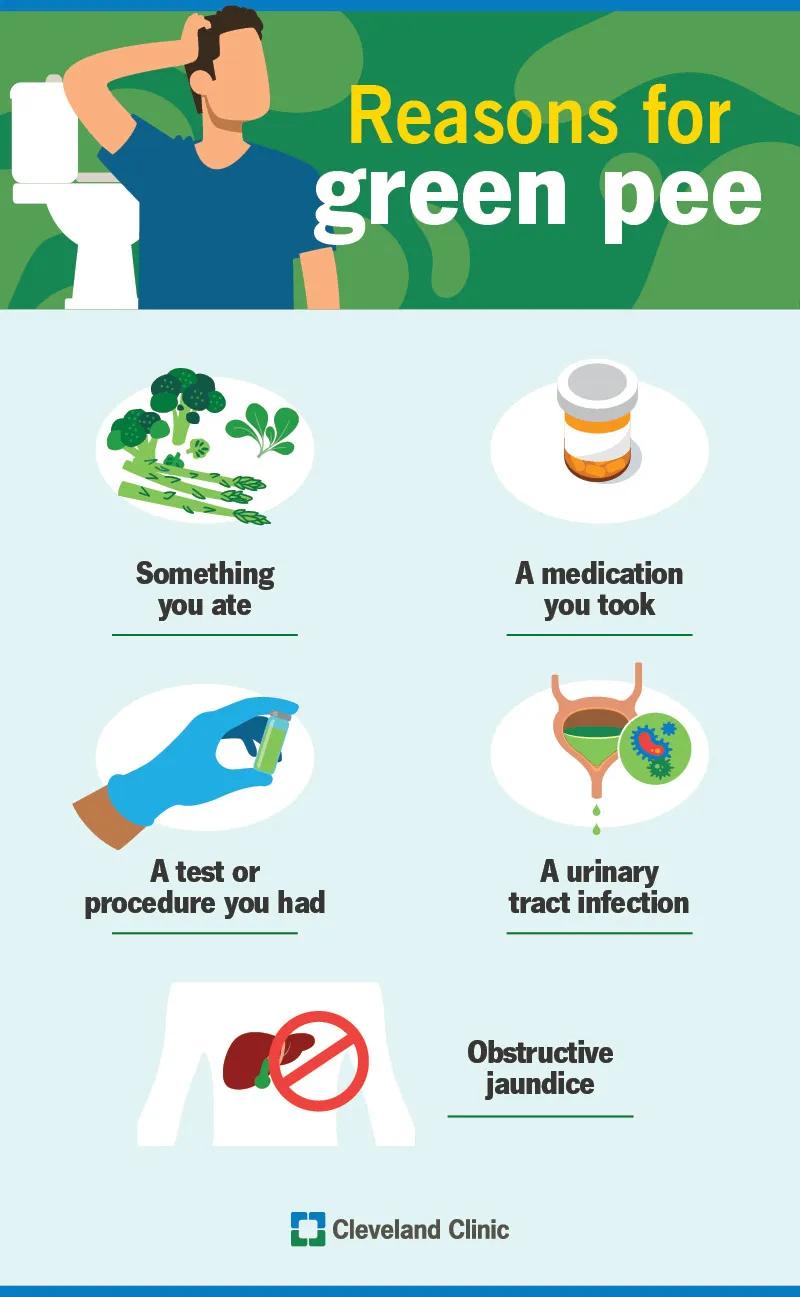
Image content: This image is available to view online.
View image online (https://assets.clevelandclinic.org/transform/f75cc0ad-8eb6-4811-ae0b-203c5a7f9d1a/WhyMyPeeGreen-infographic-800x1297)
More often than not, green pee means you ate something dyed green or blue — or one of the few foods known to give urine a greenish, verdant tint, like:
Advertisement
If something you ate is tinting your pee, rest assured: Things will go back to normal as soon as your body’s done processing it. How long that takes varies from person to person, but Dr. Goldman predicts you’ll be golden (yellow, that is) within 24 to 48 hours.
If the source of your green pee isn’t lurking in the pantry, it may be hiding in your medicine cabinet.
“A number of medications, some of them common, can occasionally turn urine green, though it’s not a typical side effect,” Dr. Goldman reports. They include:
Vitamin B supplements are known for turning urine bright yellow. But in the right light, or after eating the right food, it may give the impression that you’re producing light greenish pee.
If a medication is changing the color of your urine, but it isn’t causing any other symptoms, the change is often harmless. Still, contact your healthcare provider if you have concerns. Stopping a medication suddenly can be dangerous, so only do so under your doctor’s guidance.
If you’ve recently had surgery or undergone a medical test, that could be why your pee is green.
“Doctors sometimes use brightly colored dyes when they’re evaluating things,” Dr. Goldman explains. “Urologists, for example, might use dye to check how your urinary tract is working. When it gets processed, it can come out as a bright, fluorescent green.”
He describes the effect as “pretty cool.” But if you’re not a fan, you’re in luck: It typically fades within hours.
Though rare, propofol — a medication used to put you to sleep during surgery — can also leave you sporting swampy-green pee for a few hours.
Green urine can point to an underlying health condition, but it’s usually not the only indication that something’s off. Other, more noticeable symptoms (yes, more noticeable than green pee) are likely to take center stage.
Dr. Goldman reviews the medical causes of green urine.
If you have a urinary tract infection (UTI), green pee typically means a specific bacterium is causing it.
“Pseudomonas infections can cause urine to change color, including turning green,” Dr. Goldman says. In addition to the shade change, your pee may take on a cloudy appearance.
A UTI is more likely if you also notice:
Advertisement
“If you have green urine and also have symptoms of an infection, go get it checked out,” he advises.
In rare, serious cases, green pee may be the result of a blockage that’s preventing bile from flowing properly. This can lead to obstructive jaundice, a serious condition in which bilirubin — a pigment found in bile — builds up in your body. It often turns urine dark and may, in some cases, make it appear green.
If you have obstructive jaundice, the color of your pee will be just one of many signs that something is wrong with your:
But jaundice affects more than just your pee. Your skin and the whites of your eyes change color, too. Bile also helps give poop its color. So, in cases of obstructive jaundice, Dr. Goldman says that your stool may be pale or clay colored.
Obstructive jaundice doesn’t just change how you look. You feel it, too. Symptoms include fever, abdominal pain, itching and nausea. It’s a serious situation.
“At that point, green urine is the least of your problems,” Dr. Goldman adds. “Get immediate medical attention.”
If you have green pee that isn’t due to a medical issue, the fix is simple: Wait it out. Once the offending food, medicine or dye has passed through your system, your urine will return to normal.
Advertisement
If it doesn’t get better with time or if you have other concerning symptoms, see a healthcare provider.
Dr. Goldman says there’s never a time when green pee, absent any other symptoms, is an emergency.
“If you have green urine, there’s no clear cause and it’s not getting better after a couple of days, then that’s something to talk to your doctor about,” he advises. “But I can’t think of any reason you’d need to be seen immediately.”
So, do your best to go with the flow. Chances are, you’ll be back to a mellow yellow in no time.
Advertisement

Sign up for our Health Essentials emails for expert guidance on nutrition, fitness, sleep, skin care and more.
Learn more about our editorial process.
Advertisement

The color and shade of your urine offer a window to your health

These moisture sensors can help kids’ brains and bladders make the connection needed to end overnight accidents
Most kids grow out of bedwetting over time, but certain strategies can help — including having them evaluated for other medical conditions
Dehydration, diet and diabetes are a few possible reasons
Urine can contain bacteria, viruses and more — don’t drink it or use it to clean wounds
Don’t ‘go with the flow’ if you have issues with urge incontinence or a contagious infection

Going seven times a day is average, but more or less can be OK, too, as long as you’re not experiencing drastic changes

An enlarged prostate, diuretics and bladder irritants can all contribute

Hormonal changes, a slower metabolism and muscle loss can make weight gain more common around menopause — healthy habits can help you manage it

Life-threatening complications include sepsis, stroke, pneumonia and more
Fruity-smelling breath can happen when your body burns fat for energy, and in some cases, can signal a medical emergency
 Search










