Locations:





A low-vision occupational therapist can help you learn new ways of doing things so you can maintain your independence
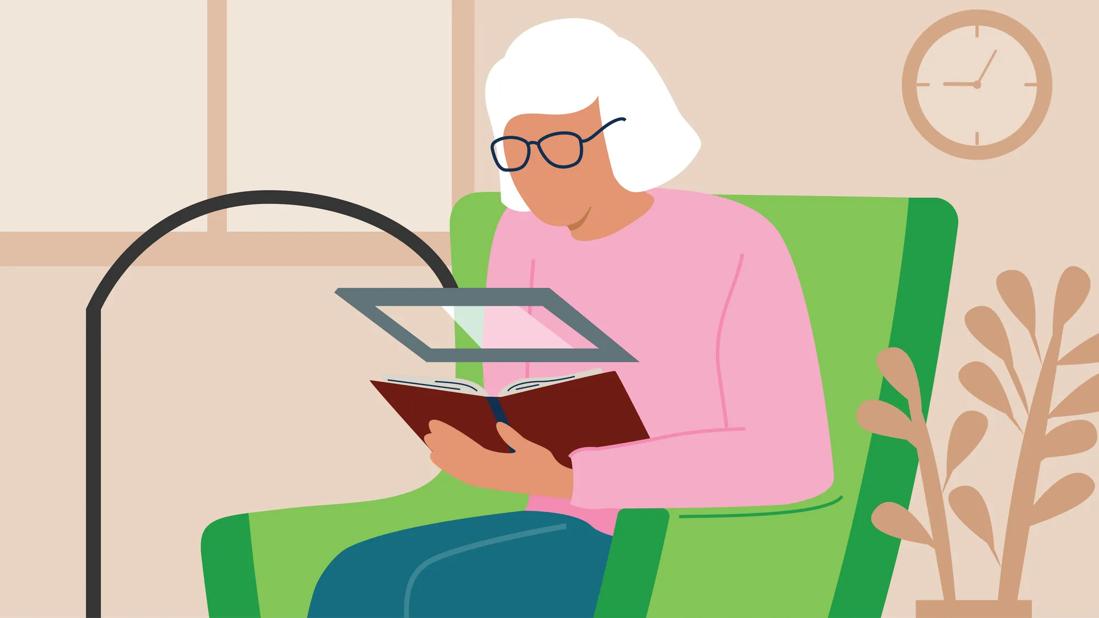
Image content: This image is available to view online.
View image online (https://assets.clevelandclinic.org/transform/bcdd1969-320b-484b-8223-a9cc1e87cbf8/elder-person-reading-chair-magnifying-assist-1415647404)
Older person reading using a magnifying reader
When you’re living with geographic atrophy (GA), or advanced dry macular degeneration, once-simple actions take a lot more work than they used to. Everything from making coffee and checking your phone to recognizing someone across the room requires more effort and patience than ever before.
Advertisement
Cleveland Clinic is a non-profit academic medical center. Advertising on our site helps support our mission. We do not endorse non-Cleveland Clinic products or services. Policy
It can feel like you’re losing parts of your life in slow motion, especially when you add in fears about your vision continuing to decline. But low vision rehabilitation may be able to help you feel more in control of your condition — and your life.
Low vision rehabilitation is a type of occupational therapy that can help you learn to use your remaining vision more effectively and maintain independence.
“It won’t treat your geographic atrophy or restore the vision you’ve lost,” says low-vision occupational therapist Christina Duncan, OTR/L. “But you’ll learn to use techniques and devices that can help you function as independently as possible.”
In low vision rehab, you’ll learn to adapt tasks and make changes to environments to make everyday life easier. This often means learning to use assistive devices and other tools that help compensate for central vision loss.
“Our goal is to help you use your remaining vision to adapt to your environment,” Duncan says. “We want you to be able to maintain independence and continue to do the things you enjoy.”
Your low-vision occupational therapist will develop personalized therapy focused on your daily activities and vision needs. And if your needs change as your disease progresses, your personalized therapy plan will evolve, too.
Advertisement
“We’re trained to evaluate the things you’re having trouble doing and figure out how you can do them with the vision you have left,” Duncan says.
That means there’s no one-size-fits-all version of low vision rehabilitation. But you may learn to address challenges like:
Here’s a look at what you may learn to do at low vision rehab.
When you have GA, lighting can make the difference between seeing something and struggling with it. So, your low-vision occupational therapist will likely talk to you about how to use different types of light and contrasting colors to make things easier to see.
“For example, we often discuss adding task lighting to reading places and increasing contrast of items to make them easier to see — like using white cups on a black countertop,” Duncan illustrates.
When you’re living with vision loss, staying organized at home can help you maintain your independence on a day-to-day basis. Your occupational therapist can recommend organizational techniques that can help.
“We talk about, for example, placing frequently used items in a specific area so you always know where they are,” Duncan says. Your therapist can also recommend:
A variety of low-vision aids for geographic atrophy can help you better navigate the world around you.
“It’s not just about introducing new tools or equipment either,” Duncan notes. “We also talk about tools you may already have and how to look at them in a new light — like using your cell phone camera or a magnifier application to help with quick reading.”
When you’re struggling to read your texts or see photos of your grandkids, adjusting your smartphone’s accessibility options can help. Your low-vision therapist can help you learn to adjust your setting to provide:
Advertisement
“Driving — or the inability to do so — is one of the biggest challenges people with GA face, and it can really affect your sense of independence,” Duncan acknowledges.
In the early stages of macular degeneration, you may still be able to drive under certain circumstances. But you may need a driving evaluation from a certified driving rehabilitation specialist. And eventually, as your geographic atrophy progresses, you won’t be able to drive anymore.
“In low-vision occupational therapy, we’ll help you navigate alternative transportation options,” Duncan reassures. “We can also help you figure out how to manage those logistics when driving is no longer an option.”
In low vision rehab, you may learn specific techniques to help you maximize your remaining vision.
For example, a technique called steady eye strategy (SES) can help make reading easier. You’ll learn to keep your eyes fixed in one location while moving the text in front of the parts of your eyes with the clearest vision.
Another technique, eccentric viewing, teaches you to look slightly away from the person or thing you actually want to see. This allows you to see with the undamaged parts of your eye.
Advertisement
But there’s not enough research to say whether eccentric viewing is beneficial to people with vision loss from geographic atrophy. Though some people find it helpful, studies suggest it may not be worthwhile for macular disease that continues to progress.
You don’t have to wait until you’re seriously struggling to start low vision rehabilitation for geographic atrophy — and in fact, you shouldn’t. You can seek a referral whenever your visual function starts to affect your everyday life.
Your healthcare provider may suggest low vision rehab if you:
The sooner you can start low vision rehab, the better. Duncan says: “The earlier you’re referred to us, the earlier you can learn helpful strategies — before your vision loss becomes severe.”
So, if your healthcare provider doesn’t bring up the possibility of low vision rehabilitation, don’t hesitate to ask if it’s an option for you.
Advertisement
“As low-vision occupational therapists, we want you to be able to keep doing the things that you enjoy,” Duncan reiterates. “And we’re here to help you learn different ways of doing them.”

Sign up for our Health Essentials emails for expert guidance on nutrition, fitness, sleep, skin care and more.
Learn more about our editorial process.
Advertisement
Izervay and Syfovre are long-term medications that can slow down the disease
Progress can be slowed with the help of supplements, injections and close monitoring

Tools like CCTV, voice commands and magnifiers can help improve quality of life when you’ve lost vision
Preserving your social life and protecting your mental health are key to living well with vision loss
Start low-vision rehabilitation as soon as possible and see your retina specialist at least every six months

Over-the-counter reading glasses can work well for many people, but they’re not the best choice for everyone

A correct prescription helps your eyes see clearly — but as natural changes occur, you may need stronger or different eyeglasses

The benefits of these drugs typically outweigh potential risks — but talking about your eye health and GLP-1s with your provider is advised
Eyes typically increase to full size during two growth spurts in childhood

To start, opt for calorie-dense foods that are rich in protein and healthy fats

Pre-birth injections and monoclonal antibodies can help prevent serious complications
 Search










