Locations:





Challenging negative thoughts and making a game plan for future events can help
Social anxiety is more than just feeling a little bit nervous in social settings. When you have this anxiety disorder, you may feel like other people will laugh at you or judge you — even if you know that’s probably not the case. And those worries can be so distracting and distressing that you may have trouble engaging in social situations.
Advertisement
Cleveland Clinic is a non-profit academic medical center. Advertising on our site helps support our mission. We do not endorse non-Cleveland Clinic products or services. Policy
“People with social anxiety disorder have frequent anxiety, panic or significant discomfort in certain social situations,” says psychologist Dawn Potter, PsyD. “You may enter into these situations with a lot of distress or even try to avoid them entirely.”
Now for the good news: There are steps you can take to manage and lessen your social anxiety. Dr. Potter explains.
There are different kinds of social anxiety — and to figure out how to address yours, it helps to take a step back and understand what you’re dealing with.
“Maybe your concerns are performance-based, like when it comes to public speaking,” Dr. Potter illustrates. “Maybe you feel uncomfortable in new scenarios. Or maybe your anxiety keeps you from doing things like going to parties, ordering at restaurants or talking on the phone.”
From there, strategies for overcoming social anxiety depend both on your individual personality and how much the disorder is affecting your life. But these tips can offer a starting point.
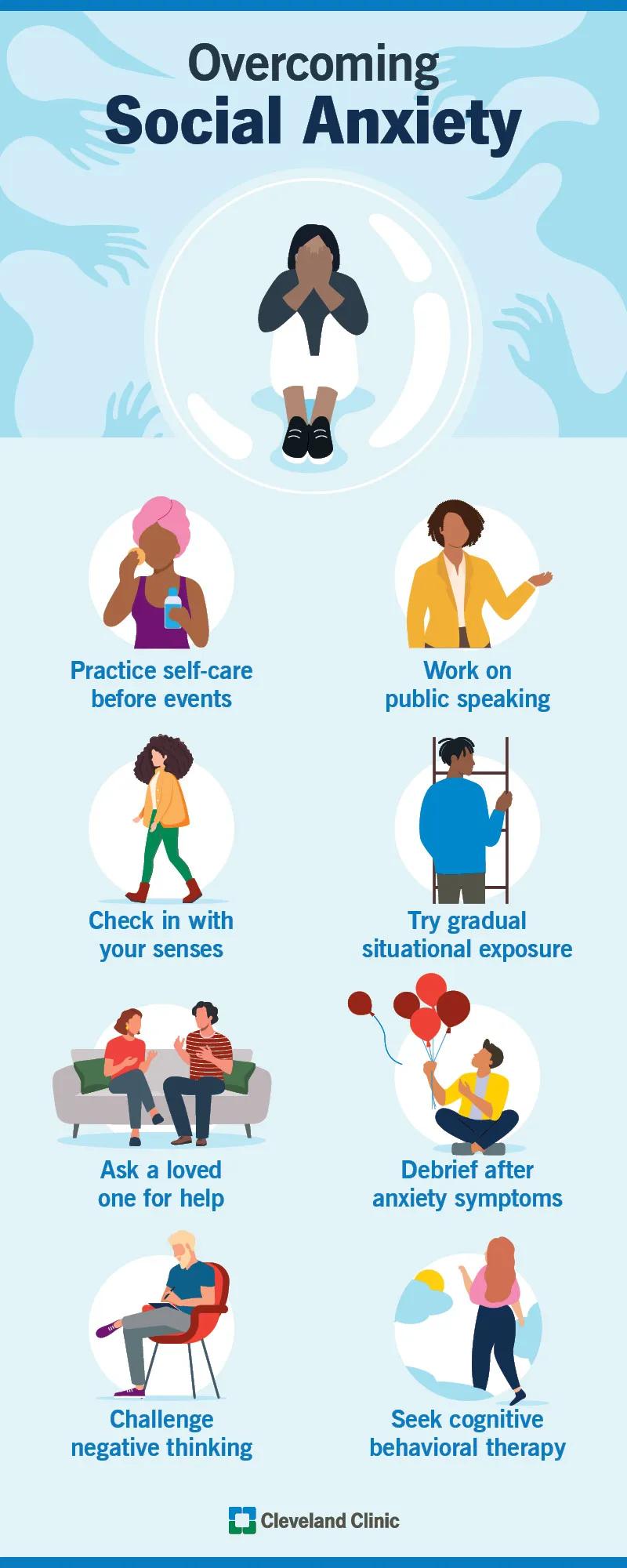
Image content: This image is available to view online.
View image online (https://assets.clevelandclinic.org/transform/e0f9190d-2128-477e-bf7d-20beb14d93ce/social-anxiety-infographic)
Sometimes, anticipating social interactions can be worse than actually experiencing them. So, practice coping before you need to.
“Try to take it easy the day before something you’re especially anxious about,” Dr. Potter recommends. “Get enough sleep the night beforehand, eat a healthy meal and avoid alcohol or anything else that might negatively impact how you feel.”
Advertisement
When you’re in public and start to feel anxious, it’s easy to spiral. Suddenly, you’re fixated on everything that feels like it’s going wrong. Did I say something weird? Do I look weird? Is everyone judging me?
“Anxiety often magnifies the negative and minimizes the positive,” Dr. Potter points out. “But the things you’re acutely aware of may not be noticeable to others.”
When you learn to notice those thoughts as they occur, you can better acknowledge the reality: That other people are likely to be more focused on themselves than on you.
“Most people aren’t likely to be scrutinizing your behavior in social situations because they’re too busy thinking about what they’re going to say or do next,” she continues.
When negative thoughts kick in, take a moment to remind yourself that you can’t read anyone else’s mind, and you can’t know what they’re actually thinking — about you or anything else. So, that little voice in your head telling you to be afraid? Try not to listen to it and assume positive intent.
If your social anxiety is related to public speaking, Dr. Potter recommends finding ways to get more comfortable with those skills.
“This can be helpful for people with mild to moderate social anxiety — the kind that’s not causing full-blown panic attacks but still affecting your ability to live your life the way you want to,” she says.
Dr. Potter suggests joining a group or taking a class to practice public speaking and learn communication skills.
When you’re internalizing everything and starting to panic, try to take a breather and refocus.
“In the moment, you need to focus outside of yourself and remind yourself, ‘This is probably related to my anxiety,’” Dr. Potter encourages.
To do that, she recommends a technique that she calls “five senses” (also called a 5-4-3-2-1 grounding exercise), which can help you regain perspective and stay in the moment. Try to identify:
“Checking in with your senses can help distract you from unpleasant internal sensations and get you more externally focused,” she explains. “Then, you can try to refocus on what’s really happening.”
If you can identify the types of social situations that cause you anxiety, you can start to gradually and intentionally expose yourself to anxiety-inducing situations.
To do it, you work your way up to social situations that cause you anxiety by starting with lower-stakes versions of them. Throughout the process, you can practice relaxation and breathing techniques to help you tolerate any anxiety you experience.
Advertisement
What, exactly, might that look like?
“Let’s say you’re afraid of being social in large groups. You might start by going out with a friend one-on-one,” Dr. Potter suggests. “You’d work your way up to going out with a small group of friends — and repeat as needed until you feel comfortable attempting to go to a restaurant, bar or party where there would be more people.”
You can also work on situational exposure in a professional setting. Exposure therapy is a specific type of cognitive behavioral therapy that many therapists offer.
It can be embarrassing or humbling to admit to others that you’re anxious in social situations and might need their help. But letting someone else know that you need extra support can be a major morale boost.
“Most people feel more comfortable in social situations with somebody they’re close to,” Dr. Potter notes. “When you have social anxiety, it can be especially helpful to have a buddy with you as you navigate it.”
Your loved one’s support and presence can help you gain more confidence in social settings. Just remember: The goal is to learn to become more independent over time — not to become dependent on the buddy system.
Social outing didn’t go as you’d hoped? Debrief with yourself afterward to figure out what triggered your reaction, whether it was a panic attack or a general sense of jitteriness.
Advertisement
“Break down what happened, then look for ways you might be able to change the situation next time,” Dr. Potter says.
Let’s say you went to a concert but had a panic attack because you were surrounded by so many people. Next time, plan to stand in the back of the room or sit in an aisle seat so there’s an exit route if you feel anxious or closed in.
Social anxiety can have a major impact on your life — which makes addressing it all the more important. If it’s affecting your relationships, career, social life or other aspects of your life, a therapist can help.
Among the different kinds of psychotherapy available, cognitive behavioral therapy (CBT) can be a helpful way to tackle social anxiety. CBT teaches you to change the ways you think and feel about a situation, which, in turn, helps you modify your behavior.
“CBT can help you identify patterns of thinking that cause you to avoid social situations,” Dr. Potter explains. “For example, maybe you’re always expecting the worst outcome, or you’re fixated on the fact that someone might see you blushing or sweating. A therapist can help you learn to challenge those expectations and adopt more positive self-talk, rather than negative self-talk.”
Advertisement
Talk to a healthcare provider if your social anxiety is impacting your ability to live your life the way you want.
“Not all social anxiety is managed the same way,” Dr. Potter clarifies. “For example, if you have panic attacks when you go out in public, a healthcare provider might recommend medication, therapy or a combination of both. But less severe anxiety might be better served by different treatment options.”
Talk to a provider if you experience symptoms associated with panic, whether or not you have panic attacks. These may include:
Social anxiety can cause other physical symptoms, too — ones that don’t rise to the level of panic but are still unpleasant and unwanted. These may include:
Sometimes, Dr. Potter adds that it can be hard to tell whether physical symptoms are from anxiety or another medical condition.
“If they go away quickly after the anxiety-provoking situation has ended — like after you leave a social event — then it’s more likely to be anxiety-related,” she says. “If you’re in doubt, though, it’s important to talk to your healthcare provider.”
It’s even more important to touch base with your provider if you have a known heart condition. They’ll help you learn to differentiate between symptoms of cardiac conditions and anxiety.
Social anxiety may not fade as quickly as you’d like it to. And that’s normal.
“Maybe you moved too fast and need more practice before you’re ready to tackle a certain social situation,” Dr. Potter encourages. “Or you may need to work more on relaxation and distraction techniques so you can tolerate that situation next time.”
Whatever the case, try to be kind to yourself.
“Keep reminding yourself that even with social anxiety, anticipating an event is often much worse than the actual event itself,” she reiterates. “So, be brave and continue to put yourself out there.”

Sign up for our Health Essentials emails for expert guidance on nutrition, fitness, sleep, skin care and more.
Learn more about our editorial process.
Advertisement

Anxiety disorders, health conditions and past trauma can make driving nerve-wracking — help is available

This simple mindfulness exercise can help interrupt anxious thoughts by bringing your attention to your five senses

The terms are often used to describe intense feelings of fear and anxiety

Going home isn’t always easy, but there are ways to ease any stress you might feel

This fast-acting anxiety medication should never be taken with alcohol, despite what you may see on The White Lotus

Deep breathing, positive mantras and tackling negative thoughts can help get you out of your head and cool down your anxiety

Focusing on what you can see, feel, touch and hear can help you feel more present in the moment
Performance anxiety and stage fright are outsized stress responses that can creep up when you’re put on the spot

Managing your weight through physical activity may lower your chances of getting this common cancer

It typically starts in October and winds down in early spring, with cases at their highest in the middle of winter
Anxiety disorders, health conditions and past trauma can make driving nerve-wracking — help is available
 Search










