Locations:





Most babies will crawl between 7 and 10 months old, but later can be normal, too
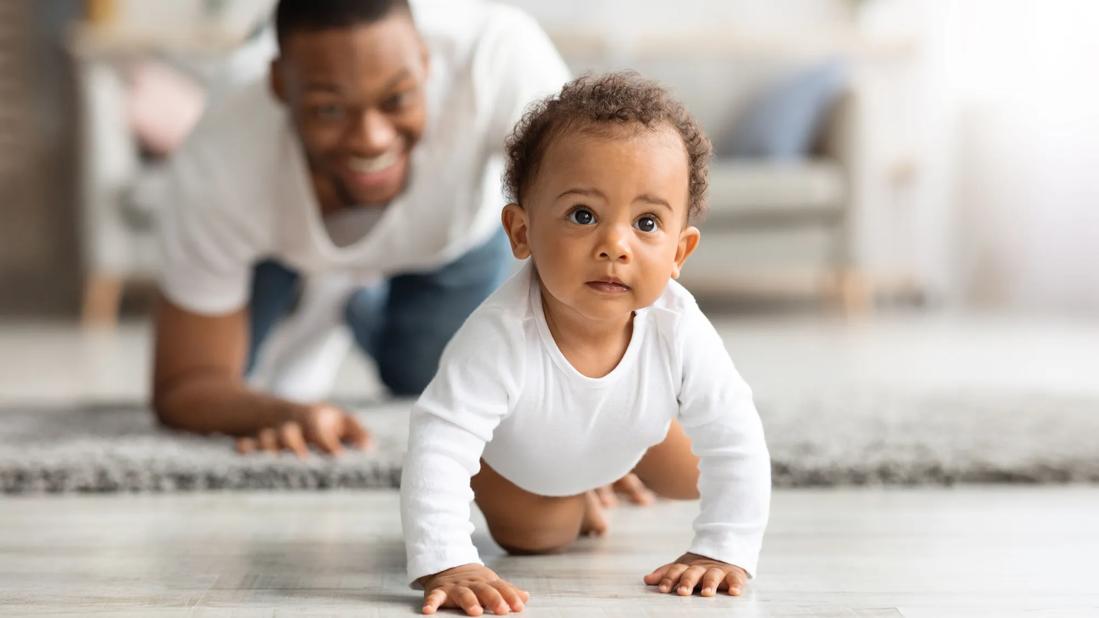
Image content: This image is available to view online.
View image online (https://assets.clevelandclinic.org/transform/c991c14a-d80e-41c6-98a2-f067984006ee/baby-crawling-1337850728)
Baby crawling across floor, with caregiver smiling on all fours behind them
Crawling isn’t just a milestone — it’s a turning point. When babies get mobile, they interact with the world in a whole new way and develop skills for upcoming milestones.
Advertisement
Cleveland Clinic is a non-profit academic medical center. Advertising on our site helps support our mission. We do not endorse non-Cleveland Clinic products or services. Policy
But when do babies start crawling? What counts as crawling? And should you worry if they don’t start “on time”?
“Crawling” can look different for every baby — from belly scoots to rolling and even bear crawls.
Board-certified pediatric physical therapist Christin Close, DPT, breaks down what to expect and how to encourage your baby to crawl.
Most babies start crawling between 7 and 10 months old. But that’s not true of every infant. So, resist the urge to panic if Junior’s taking their time.
“There’s a wide range of what’s considered ‘normal,’” Dr. Close reassures. “Development doesn’t follow a strict timeline. One baby may crawl at 7 months, and another might not crawl until closer to 11 months. Both are OK.”
Crawling is more than just a way for children to explore their surroundings. It helps prepare them for future developmental milestones.
“Crawling provides a full-body workout that strengthens the hands, arms, legs, core, hips and shoulders for later skills like walking and running,” Dr. Close explains.
Crawling on hands and knees helps strengthen the small muscles of the hands, which support activities like writing and fastening clothing later on. It also promotes hand-eye coordination for activities like ball play and coloring.
Advertisement
We all think we know what crawling is. But it’s a pretty complicated set of motions if you think about it. So, your baby might try out some variations of movement before (or instead of) moving to the standard hands-and-knees position.
Here’s what your baby might look like when they’re first getting in the groove of being on the move.
Babies often start rolling from their tummies to their backs around 6 months old. And sometimes, they’ll build on that new skill not just to flip over, but also to get around — log-rolling as they travel from room to room.
Sounds dizzying. But it’s a sign of progress, even if it’s not technically crawling.
Some babies prefer to sit on their bottom and push themselves forward using one or both legs. “Booty scooting” isn’t considered crawling, but it still counts as independent movement.
Belly crawling is commonly a baby’s first attempt at truly crawling. It’s when babies drag their belly across the floor, using their arms to pull and legs to push — like a mini commando on a mission. It’s a good sign they’re building the strength they’ll need for more advanced movement.
Belly crawling commonly starts when babies are about 7 or 8 months.
This is a traditional crawl: Both hands and knees are on the ground, with opposite hands and knees moving forward together. It takes coordination and core strength — and it’s a big milestone. It often follows belly crawling, and typically starts when babies are between 9 and 10 months old.
In this style, babies keep their arms and legs straight, push their tush up in the air, and move on their hands and feet, rather than on their knees. It’s less common than a classic crawl and can be seen as babies move from crawling to walking.
When your baby starts to crawl isn’t just about their age. It’s also about opportunity, motivation, their physical development and more.
For example, if your baby spends long periods of time in swings, seats or carriers, they spend less time building crawling skills.
“Babies need daily opportunities to explore on the floor,” Dr. Close advises.
Additionally, your baby’s development plays a big role when they reach milestones like crawling. That includes things like muscle tone, coordination and underlying conditions. Preterm infants and babies with certain medical conditions may develop on a different timeline.
You don’t need special gear to support your baby’s development. Just a safe, open space and time to explore. Here are some of Dr. Close’s top tips.
Spending some time on their tummies every day helps babies strengthen their neck, shoulders and core muscles — all of which are needed for crawling.
Start with short sessions a few times a day and build from there. Aim for 10 minutes per day for each month old. For example, a 3-month-old baby should be getting close to 30 minutes of tummy time spread out throughout the day.
Advertisement
“Tummy time and time playing on a firm, flat surface are really important,” Dr. Close recommends.
Importantly, tummy time is for when babies are awake, supervised and on the floor — not on an elevated surface like a couch or bed. Always put your baby to sleep on their back, too.
Sometimes, a little encouragement can go a long way. You can help your baby learn to crawl by giving them a reason to want to crawl.
Place favorite toys just out of reach during tummy time to encourage your baby to stretch, pivot and scoot toward them.
Join your baby at their level. Babies love interaction — and your face might be the motivation they need to move. Stay just out of arm’s reach to encourage them to move to you.
Busy households and fast-paced schedules can make it harder to fit in floor play. We get it. But babies learn through repetition. Allow them to have some supervised floor time multiple times throughout the day to help them learn to move and explore.
Limit time spent in baby seats and strollers to give them more opportunities to try out some moves. Staying in confined spaces can cause flattening on the back of the head, restrict baby’s movement and delay motor skills, like crawling.
It’s natural to be concerned if your baby isn’t hitting milestones like clockwork. Add on the pressure of well-meaning friends and family (So ... are they crawling yet?!), and it’s easy to worry that something is wrong.
Advertisement
If your baby isn’t crawling by 10 months, it could be no big deal. But Dr. Close advises talking with a pediatrician or pediatric physical therapist if:
“There’s often no need to worry if your baby hasn’t mastered crawling on the expected timeline,” Dr. Close encourages. “But if you’re concerned about overall motor development, it’s always worth a conversation with a healthcare provider.”
Advertisement

Sign up for our Health Essentials emails for expert guidance on nutrition, fitness, sleep, skin care and more.
Learn more about our editorial process.
Advertisement
Massage, teething rings, chilled items and pain relievers can help dull the discomfort when baby teeth erupt
Clean their bottom using plain water and a soft washcloth, then apply an ointment — and let them go diaperless when possible

Stay calm and validate your child’s feelings, but don’t give in to their demands

Big feelings, growing independence and lots of meltdowns are all typical parts of toddlerhood
Check for common causes, try soothing strategies and know when it’s time to take a break

Thumb sucking is a normal part of early development, but over time, it can affect teeth, speech and habits
From coos and babbles to first words and short sentences, there’s a wide range of what’s considered ‘normal’
Most teething symptoms are mild — fevers and other major symptoms are likely something else

Hormonal changes, a slower metabolism and muscle loss can make weight gain more common around menopause — healthy habits can help you manage it

Life-threatening complications include sepsis, stroke, pneumonia and more

Fruity-smelling breath can happen when your body burns fat for energy, and in some cases, can signal a medical emergency
 Search










