Locations:





Teaching your baby to sign may help ease frustrations before they can talk, but it’s not a must-do
You’ve probably heard the not-so-humble brags from parents who gush about their baby knowing sign language. Imagine your tot telling you that they’re sleepy or hungry long before they can form the words. It’s kind of magic.
Advertisement
Cleveland Clinic is a non-profit academic medical center. Advertising on our site helps support our mission. We do not endorse non-Cleveland Clinic products or services. Policy
Baby sign language can have its benefits. But is it a must? And how do you get started? Pediatrician Shannon Thompson, DO, offers advice.
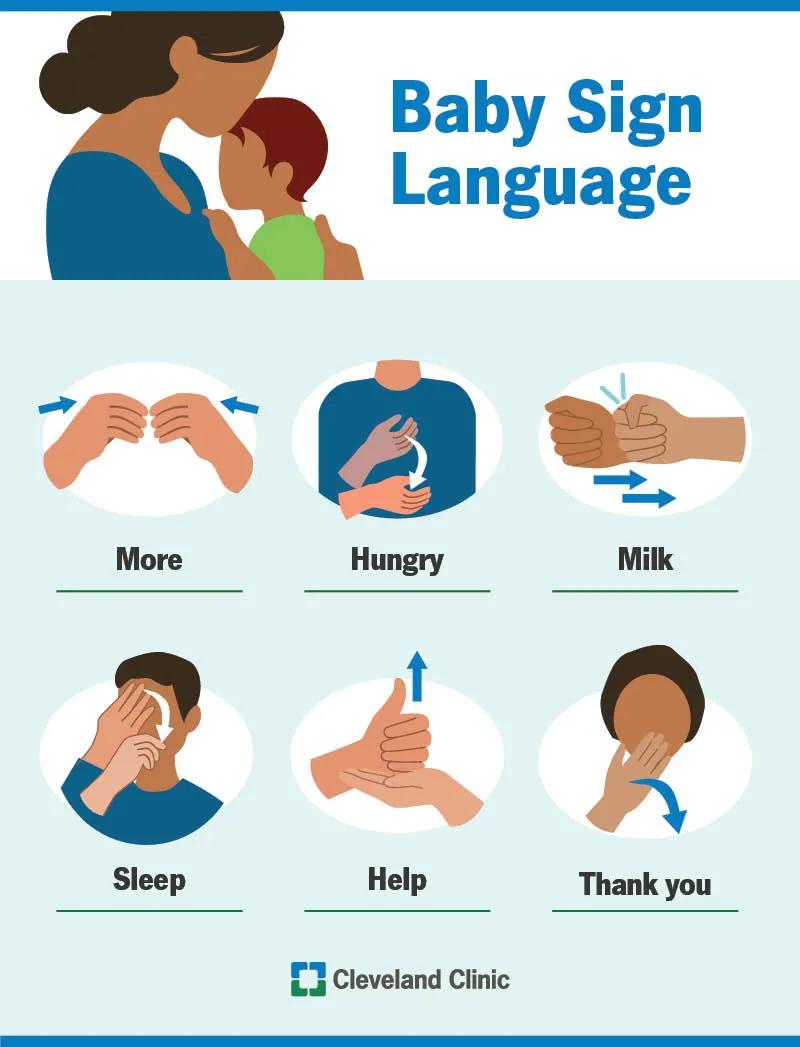
Image content: This image is available to view online.
View image online (https://assets.clevelandclinic.org/transform/161e6b73-6d94-4838-8bd6-bbba4272dd2c/Baby-Sign-Language-infographic-icons-800x1047)
Baby sign language is a way parents and caregivers can communicate early with infants using a small set of simple hand gestures.
“Babies start cooing and babbling early on, but they often develop more words closer to a year,” Dr. Thompson says. “Even then, it can take a while before they can effectively tell you what they want.”
But motor skills, like using your hands to share your thoughts, develop earlier than verbal speech skills. So, learning a few signs can allow babies to share their needs earlier.
It’s not the same as using American Sign Language (ASL) or other sign languages used by people who are Deaf or hard-of-hearing. Those are complete, complex languages with grammar, structure, syntax and histories.
But increasingly, many families are choosing to teach their babies a few signs, often borrowed from select words in ASL. Common baby signs include hungry, more and thank you.
Research on baby sign language for hearing children is limited, but the American Academy of Pediatrics says it can be a positive tool for improving early communication and building connections with your baby.
Advertisement
“It can help babies and parents understand each other better,” Dr. Thompson adds. “None of the research suggests that teaching baby sign language has negative effects, so it’s worth a try if you’re interested in it.”
In fact, teaching your baby to sign may:
Dr. Thompson suggests starting to introduce baby sign language when your baby is around 6 to 8 months old. That’s also about when you can expect your baby to start mimicking gestures, like waving and clapping.
“When they start repeating your hand movements, that’s a good sign they might be ready to start using some signs,” she says.
Of course, you can begin modeling signs earlier than that to get into the habit. But don’t expect them to start signing back until they’ve developed the proper hand coordination.
The two most important things to remember about teaching baby sign language to babies are to be consistent and use spoken language as well.
Dr. Thompson offers these tips:
Advertisement
Choosing to teach your baby how to sign can be a fun and rewarding way to connect with them. But consider it optional, not essential.
“It’s a nice cherry on top, and it might be helpful if you want to do it,” Dr. Thompson reiterates. “But more important is just to talk with them and interact with them.”
Whether you teach your baby sign language or not, the best thing for developing language in your child is simply to talk, read and sing to them.
“Babies love to hear your voice,” she emphasizes. “Even if they don’t understand yet, it’s comforting and helps them learn.”
Advertisement

Sign up for our Health Essentials emails for expert guidance on nutrition, fitness, sleep, skin care and more.
Learn more about our editorial process.
Advertisement
Massage, teething rings, chilled items and pain relievers can help dull the discomfort when baby teeth erupt

Clean their bottom using plain water and a soft washcloth, then apply an ointment — and let them go diaperless when possible

Stay calm and validate your child’s feelings, but don’t give in to their demands

Big feelings, growing independence and lots of meltdowns are all typical parts of toddlerhood
Check for common causes, try soothing strategies and know when it’s time to take a break

Thumb sucking is a normal part of early development, but over time, it can affect teeth, speech and habits

From coos and babbles to first words and short sentences, there’s a wide range of what’s considered ‘normal’
Most teething symptoms are mild — fevers and other major symptoms are likely something else

Managing your weight through physical activity may lower your chances of getting this common cancer

It typically starts in October and winds down in early spring, with cases at their highest in the middle of winter

Anxiety disorders, health conditions and past trauma can make driving nerve-wracking — help is available
 Search










