Locations:





Doctors look at stage, biology, genetic risk and more to recommend your treatment plan
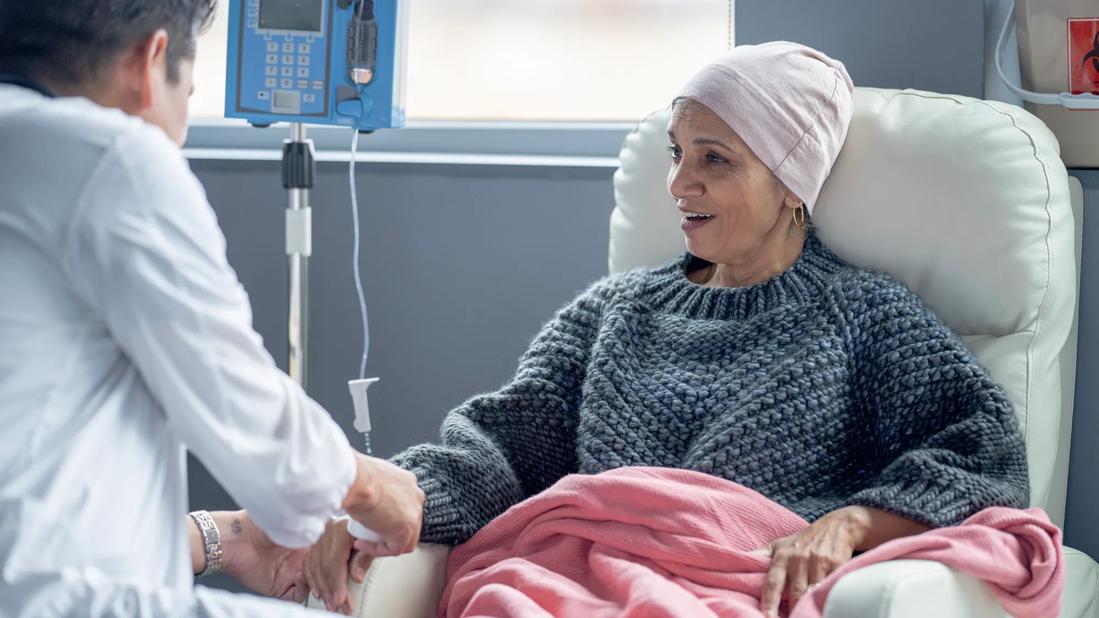
Image content: This image is available to view online.
View image online (https://assets.clevelandclinic.org/transform/07427810-04a3-44fc-8776-d261902394c7/chemo-patient-breast-cancer-2187784913)
Healthcare provider setting up cancer patient to receive chemotherapy
If you’re diagnosed with breast cancer, one of the first questions on your mind may be: Do I need chemo?
Advertisement
Cleveland Clinic is a non-profit academic medical center. Advertising on our site helps support our mission. We do not endorse non-Cleveland Clinic products or services. Policy
Many people assume the answer is yes. After all, chemotherapy is almost synonymous with cancer treatment in a lot of people’s minds.
But it’s not the right route for everyone.
Breast cancer treatment is highly personalized. Your team will carefully analyze the specific characteristics of your cancer and your risk of the cancer returning (recurrence) to understand whether you’d benefit from chemotherapy and other treatments.
Breast oncologist Azka Ali, MD, shares some of the factors your team will consider when deciding whether to recommend chemo.
Doctors tailor their recommendation for breast cancer treatments, including chemotherapy, to your needs.
The goal is to balance the benefits of treatment with the risks. They’ll recommend chemo if they expect it to be helpful in treating your cancer and keep it from coming back.
That can mean that two people with similarly sized tumors can have two very different treatment plans.
“No two breast cancers are the same,” Dr. Ali emphasizes. “Your treatment plan can look very different from others’ with a similar size of cancer.”
To make decisions about chemo and other treatments, your team will look at a few key factors.
“I tell all my patients that we look primarily at two things: stage and biology,” Dr. Ali explains. “These features help us understand the risk of cancer recurrence and whether chemotherapy will provide benefit.”
Advertisement
One major factor doctors consider is the stage of the cancer. Cancer stage is a measure of whether the cancer has spread and how far.
Breast cancer stage is determined using what doctors call the TNM system:
Together, these factors help determine how advanced the cancer is, on a scale of 0 to IV (4):
Higher-stage cancers are typically more likely to benefit from chemotherapy than earlier stages.
In addition to the stage, your providers will consider the biological features of the cancer — meaning how the cancer cells look under a microscope.
Why? Because those microscopic differences in cancer cells can say a lot about how aggressive the cancer may be and how likely it is to respond to chemo and other treatments.
“Breast cancer cells are graded from 1 to 3,” Dr. Ali further explains. “The more ‘funky’ they look, the higher the grade.”
Higher-grade cancers are often considered higher risk and may be more likely to warrant chemotherapy.
Doctors also analyze certain proteins called “receptors” on breast cancer cells. If these receptors are present, they can act like switches that help fuel cancer growth.
The main ones include:
Your team may be more likely to recommend chemotherapy as part of your treatment plan if your cancer is negative for all three markers (triple-negative breast cancer) or if you have HER2-positive breast cancer.
For some breast cancers (ER positive, HER2 negative), doctors may also recommend additional testing on the tumor tissue, like Oncotype DX or MammaPrint.
The results of these tests will also be considered as your care team plans treatment.
“These tests look at genes within the tumor and generate a risk score,” Dr. Ali says. “The results help us understand the likelihood of recurrence and whether chemotherapy will provide benefit.”
It’s different from genetic testing, which your team may recommend depending on your individual risk, age at diagnosis, family history and type of cancer.
Advertisement
Genetic tests determine if you inherited high-risk genes from your biological parents that you could pass on. Oncotype DX or MammaPrint tests predict the risk of cancer recurrence.
Beyond stage and biology, several additional factors can influence chemotherapy recommendations, including:
Pre-menopausal women, for example, are statistically more likely to develop aggressive breast cancers and may be more likely to receive chemotherapy recommendations.
Chemotherapy is an important part of treatment for many breast cancers — but it isn’t automatic. Your treatment plan will be tailored to your needs. It may include chemotherapy, as well as other treatments, like
Your team will carefully evaluate multiple factors to arrive at a plan for you. And they’ll talk with you about their reasoning, including why chemo is, or isn’t, appropriate for you.
Advertisement
The goal is to create a treatment plan tailored to your specific cancer and your overall health. And reaching that conclusion is a complex process.
“Those recommendations are based on your specific cancer and what will give you the best outcome long term,” Dr. Ali encourages. “Ask your team any questions you have about your treatment. You deserve to be knowledgeable about what your team is advising and why.”
Advertisement

Sign up for our Health Essentials emails for expert guidance on nutrition, fitness, sleep, skin care and more.
Learn more about our editorial process.
Advertisement

Managing your weight through physical activity may lower your chances of getting this common cancer

Not all breast lumps signal cancer, and not all breast cancer causes lumps — it’s important to know the facts

If you’re of Ashkenazi Jewish descent, these tests may be a reasonable starting point — but more thorough genetic testing can go much deeper

Breast cancer treatments can lower estrogen, which has a ripple effect on your bones

Breast cancer treatments can lower your fertility, but egg freezing and other preservation measures may be an option
Practical help and honest conversations can make a meaningful difference

Your path lab report contains detailed information about your tumor — your care team can work with you to turn it into a care plan
While you can’t change risk factors, like age or genetics, lifestyle choices and regular screenings can help lower your overall risk

Hormonal changes, a slower metabolism and muscle loss can make weight gain more common around menopause — healthy habits can help you manage it

Life-threatening complications include sepsis, stroke, pneumonia and more

Fruity-smelling breath can happen when your body burns fat for energy, and in some cases, can signal a medical emergency
 Search










