Your core is at the center of almost anything you do — from standing up and bending over to lifting heavy objects and carrying a child. In fact, you probably use your core so often that you may not even give it a second thought. And that’s exactly why you should.
Advertisement
Cleveland Clinic is a non-profit academic medical center. Advertising on our site helps support our mission. We do not endorse non-Cleveland Clinic products or services. Policy
A strong core supports your entire body through:
- Balance and stability
- Flexibility
- Better posture
- Less back pain and spinal support
By focusing on core exercises, you can reduce the risk of injury while making everyday tasks more manageable.
Physical therapist Brittany Smith, DPT, shares core workouts for every fitness level and explains why they’re a useful addition to your fitness routine.
Best core workouts
Your core is made up of more than just your abs. It also includes muscles in your:
- Back (like the erector spinae and multifidi)
- Pelvis
- Hips
- Glutes
“Everything starts with your core,” says Dr. Smith. “The more you work on these muscles, the more it becomes second nature to hold them tight when you’re lifting grocery bags, doing yard work or performing any other kind of physical activity.”
A strong core offers support to other areas of your body during exercise, too. By “tightening your core” — pulling your belly button in toward your spine — you can deepen a stretch or move more smoothly.
As you engage your core in each of the exercises here, be sure to listen to your body. If you feel sharp pain (beyond mild or moderate muscle burn), that’s a sign to reduce the number of reps, the weight or the duration of the exercise. If pain persists, make an appointment with a healthcare provider, like a physical therapist.
“Let pain be your guide as you’re exercising,” advises Dr. Smith. “It often takes four to six weeks of consistent exercise to notice an actual change. So, don’t get discouraged.”
Beginner exercises
The best core workouts for beginners are focused on quality, not quantity, Dr. Smith says.
“For the most part, you’ll want to move through each exercise slowly,” she advises. “Work your way up to doing one to two sets of 10 to 15 repetitions two or three times a week.”
If you’re just getting started, consider seeking guidance from a physical therapist or an athletic trainer to be sure you’re doing the moves correctly.
Supine march with pelvic tilt
- Lie on your back with your knees bent, feet flat on the floor and arms at your side.
- Tighten your abdominal muscles, pulling your belly button toward your spine and pressing your back down toward the floor.
- Slowly raise one leg off the floor, keeping your knee bent and back flat on the floor.
- Hold for five to 10 seconds, then lower back to the starting position.
- Repeat the process with your other leg.
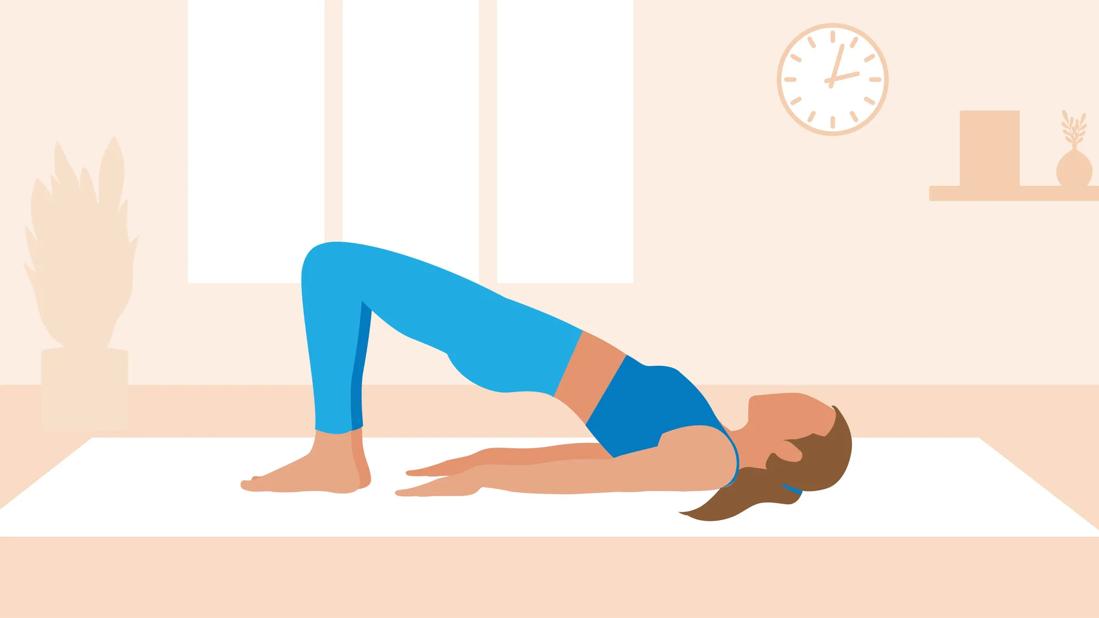
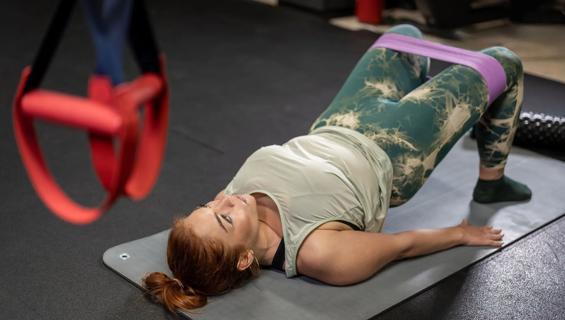
Bridge
- Lie on your back with your knees bent, feet flat on the floor and arms at your sides.
- Squeeze your abdominal and buttocks muscles and slowly push your heels into the floor, lifting your hips toward the ceiling.
- Keeping your back straight, hold this position for five to 10 seconds before returning to the floor.
Clamshell with resistance band
- Lie on your side with your knees bent, feet in line with your hips and back, and a resistance band looped around your legs just above your knees.
- Tighten your abdominal muscles and open your legs, lifting your top knee upward while keeping your feet together. Make sure you don’t let your hips roll forward or backward.
- Hold for five seconds, then slowly return to the starting position and repeat. After 10 to 15 reps, switch sides.
Quadruped hip hike
- Begin on all fours with one knee on the ground and the other knee resting on a foam pad, rolled towel or yoga mat.
- Keeping your movements small and controlled, engage your back and butt muscles to gently raise your pelvis and lift your knee off the ground until your hips are level.
- Hold for five to 10 seconds before returning to the starting position. After 10 to 15 reps, switch sides.
Squat with chair touch and resistance band
- Start in a standing position in front of a chair, with a resistance band around your knees.
- Slowly lower your body by bending your knees, pressing slightly outward against the resistance band, until your butt lightly touches the chair. Don’t let your knees bend past your toes.
- Slowly rise to stand and repeat.
Intermediate exercises
“If you’re doing these exercises and you’re not feeling fatigued or challenged after doing a full set, then you can move on to more intermediate exercises,” says Dr. Smith. “You want to increase the challenge as you get stronger so you can continue making progress.”
Supine leg extension
- Lie in the supine march position, with your knees bent, feet flat on the floor and fingers resting on your stomach (just above your hip bones).
- Tighten your abdominal muscles by pulling your belly button in toward your spine and up.
- Feel your muscles contract under your fingers, and continue to breathe as you straighten one leg a few inches off the ground.
- Hold your leg straight for three to five seconds before returning to the starting position. Repeat with your other leg, alternating for 10 to 15 reps.
Marching bridge
- Lie on your back with your knees bent, feet flat on the floor and arms straight at your sides,
- Tighten your abdominals and slowly lift your hips off the floor into a bridge position.
- Lift one leg off the ground, keeping your knee bent, back straight and arms flat on the floor.
- Lower your leg back down and repeat with the other leg for 10 to 15 reps, before returning your hips back down to the ground.
Hip abduction with resistance band
- Begin on all fours, with your arms directly under your shoulders and a resistance band around your legs.
- Keeping your back straight and knee bent, lift one leg out to the side until your thigh is parallel to the floor. While lifting your leg, keep your abs tight and avoid twisting your torso.
- Slowly bring your knee back to the starting position. Repeat for 10 to 15 reps, then switch sides.
Pallof press
- Start by wrapping a resistance band around a door handle. Close the door so you’re on the inside, with the door opening away from you.
- Hold onto both ends of the resistance band with each hand, and take a few side steps to the right until you feel some resistance.
- Tighten your abdominal muscles and slowly push your arms straight out in front of you. Avoid twisting your torso or letting your arms get pulled toward the door.
- Hold for three to five seconds, then bring your arms back toward your chest and repeat for 10 to 15 reps. When you’re done, turn to face the other direction and repeat for another 10 to 15 reps on your left side.
Planks
To do a low plank:
- Lie flat on your stomach.
- Prop yourself up on your elbows, tighten your abdominal muscles, and lift your hips and legs off the ground. Keep your elbows directly under your shoulders.
- Hold this position for 20 to 30 seconds before slowly lowering back to the floor.
Advanced exercises
These core exercises provide an extra challenge.
Dead bugs
- Lie on your back with your knees bent and feet flat on the floor.
- Tighten your abs. Keeping your back flat, lift both legs up to a 90-degree angle and your arms up toward the ceiling.
- Slowly lower your right arm over your head and straighten your left leg at the same time. Return to the starting position and repeat with your left arm and right leg to complete the rep. Continue alternating for 10 to 15 reps.
For a harder challenge, add a resistance band around one foot and the opposite hand.
Bird dogs
- Begin on all fours, keeping your arms in line with your shoulders.
- Straighten one arm in front of you and the opposite leg behind you at the same time until they’re parallel to the floor.
- Keep your back straight, abs tight and hips level as you hold this position for three to five seconds.
- Return to the starting position and repeat with the opposite arm and leg. Do 10 to 15 reps on both sides.
High plank with shoulder taps
- Begin on all fours, then straighten your legs and arms to bring yourself up to a high-plank position, as if you’re about to lower down into a push-up.
- Tighten your abdominals and hold this position while lifting one hand off the ground to tap your opposite shoulder. Keep your back straight, and don’t twist your torso.
- Return to the starting position and repeat with your other hand for a total of 10 to 15 reps on both sides.
Kettlebell deadlift
- Start in a standing position, with your feet slightly wider than shoulder-width apart and a kettlebell in front of you on the floor.
- Tighten your abs and bend at your hips to reach down and grab the kettlebell with both hands.
- Lift the kettlebell off the ground and engage your back and thigh muscles to return to a standing position.
- Gently lower the kettlebell back down and repeat for 10 to 15 reps.
Single-leg Romanian deadlift
- Stand upright with a dumbbell in one hand and the other hand on your waist.
- Balancing on the leg opposite the dumbbell, bend at your hips and slowly tilt your body forward while extending your other leg behind you.
- Keep your back straight and your elbow relaxed as you lower the dumbbell toward the floor.
- Return to the starting position and repeat on both sides for 10 to 15 reps.









 Search










