Locations:





Stay slow and controlled as you work your way up past the bar
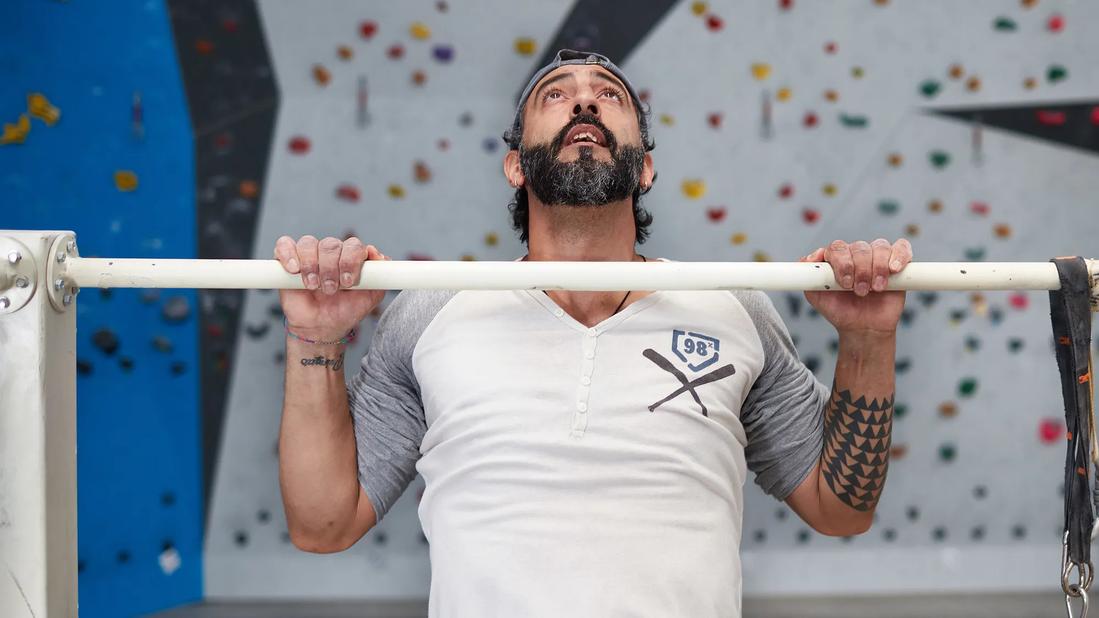
Image content: This image is available to view online.
View image online (https://assets.clevelandclinic.org/transform/70abe4f2-f4b5-4ce3-be9d-96c8667176f7/overhand-pull-ups-987729658)
Person doing overhand pull up at gym
When it comes to building upper body strength, pull-ups are often overlooked. That’s because other exercises like rowing and lat pull-downs prove to be less challenging.
Advertisement
Cleveland Clinic is a non-profit academic medical center. Advertising on our site helps support our mission. We do not endorse non-Cleveland Clinic products or services. Policy
But if you’ve aced those other exercises and you’re ready for a new challenge, pull-ups could be the next addition to your physical fitness routine.
Physical therapist Scott Malik, DPT, shares how to do them and avoid injury.
Traditional pull-ups are an upper-body exercise that involves pulling your body up off the ground while holding onto an overhead horizontal bar. Depending on your setup, the bar could be fixed. Or you can use an adjustable power rack.
Pull-ups work your:
Different muscles also take on more stress than others depending on how you grip the bar:
“If you’re not doing a good job of controlling the socket, you’ll end up with pinching in your shoulder,” cautions Dr. Malik. “You want to pull your shoulder blades down and in.”
Advertisement
Good core stability is key to doing a pull-up. You want to focus on building your strength instead of building momentum. So, let your muscles do the heavy lifting instead of swinging your body into position as you pull yourself up.
“You want to keep everything slow and controlled,” advises Dr. Malik. “Try not to arch your back or move your trunk and torso, and keep some tension throughout your body. If you’re not able to do that, you could end up with pinching in your shoulders.”
Here’s how to do a basic pull-up:
You can do pull-ups in a couple of different ways.
For example, you might have heard about a kipping pull-up, where you rapidly swing your lower body to kick yourself up and push your chin past the bar with momentum. But Dr. Malik warns against doing these, unless you learn how to do the correct form from an athletic trainer or other qualified professional.
“Kipping pull-ups can be a common cause of arm and shoulder injury, so I wouldn’t advise trying them unless you’ve perfected your pull-up form first,” he adds.
Other variations involve:
Advertisement
Pull-ups aren’t for everyone. They require enough upper-body strength to lift your bodyweight above the bar.
If you’re not quite there yet or you’re not ready to tackle a pull-up, you can get there by focusing on increasing your strength in other ways.
“You really have to approach it gradually and strengthen your muscles first, keeping your arm below shoulder height,” says Dr. Malik. “As you start doing things above your shoulders, you increase the likelihood of pinching. So, it helps to work on your form with other exercises that teach you to stabilize your shoulders first.”
Here are some alternatives to a traditional pull-up that will get you geared up for the overhead bar:
Advertisement
“Once you’re able to do these exercises and you’re upping your resistance without issues, then I would just hang from the bar without trying to pull yourself up,” he continues. “These are all ways to increase your strength so that you can pull yourself up above the bar effectively.”
Like any exercise, pull-ups take patience, persistence and strength. It’s OK if you can’t do a pull-up right now. But if that’s your goal, you can get there the more you work on strength training and technique.
Advertisement

Sign up for our Health Essentials emails for expert guidance on nutrition, fitness, sleep, skin care and more.
Learn more about our editorial process.
Advertisement
It helps to build up your strength and balance before tackling these more resistance-heavy TRX exercises
Glute bridges are simple bodyweight exercises worth adding to any workout

Stay afloat with bicycle kicks, alternating punches and water jogging

Plyometric training uses explosive movements to improve speed, power and agility
Circuit training combines strength and cardio exercises into one efficient workout

One helps with quick, intense bursts, while the other helps carry you for the long haul

It depends on your symptoms and where you feel them in your body, but you may want to sit this one out

This 75-day challenge provides a balanced approach to physical fitness, mental health and healthy habits

Managing your weight through physical activity may lower your chances of getting this common cancer

It typically starts in October and winds down in early spring, with cases at their highest in the middle of winter

Anxiety disorders, health conditions and past trauma can make driving nerve-wracking — help is available
 Search










