Locations:





Rash color may be harder to spot, but there are other telltale signs, like types of bumps and severity of itch
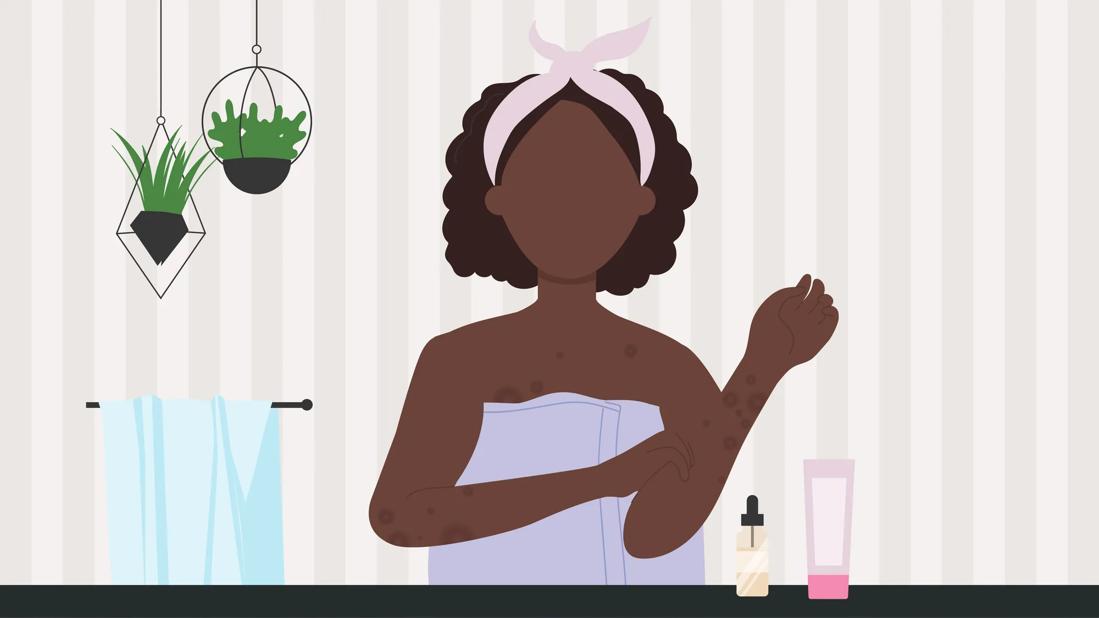
Image content: This image is available to view online.
View image online (https://assets.clevelandclinic.org/transform/e9ff60a1-1508-44c8-9e3a-404d3c22c007/eczema-black-skin)
Person with darker skin tone, wearing a towel in their bathroom, with eczema rash on their skin
Atopic dermatitis is often described as causing a rash that’s red or pink. And that’s often true … on people who have fair skin. But if you have a darker skin tone, atopic dermatitis may show up differently.
Advertisement
Cleveland Clinic is a non-profit academic medical center. Advertising on our site helps support our mission. We do not endorse non-Cleveland Clinic products or services. Policy
Dermatologist G. Cheyana Ranasinghe, MD, explains how symptoms of atopic dermatitis may appear on skin of color.
Atopic dermatitis looks a little different on everyone. No two people have exactly the same symptoms. And symptoms can vary widely depending on the color of your skin.
“Some signs of atopic dermatitis, like redness, may be harder to identify on darker skin,” Dr. Ranasinghe says.
The problem is that, historically, not enough research has focused on how atopic dermatitis appears on darker skin colors or how it can specifically affect people depending on their background. That means healthcare providers haven’t always known exactly what to look for or how to diagnose this condition.
“We now know that atopic dermatitis is actually more common among people of Black, Asian and Pacific Islander descent than people of white European descent,” Dr. Ranasinghe reports.
“Fortunately, research continues to uncover the differences into how this condition can affect people with a variety of skin tones and types. That’s allowing us to better diagnose and treat it.”
It’s also important to acknowledge that “skin of color” isn’t a monolith. One large research study notes that this research term is used to describe skin tones that are generally darker than those typically classified as white. That includes many racial, ethnic and cultural backgrounds.
Advertisement
Here are some ways atopic dermatitis may show up on skin of color.
Video content: This video is available to watch online.
View video online (https://cdnapisec.kaltura.com/p/2207941/sp/220794100/playManifest/entryId/1_5u6y2al6/flavorId/1_5f3sgelj/format/url/protocol/https/a.mp4)
Worried about a future flare? Here are 7 tips for preventing eczema and reducing the severity of your symptoms.
Instead of red or pink, areas of your skin affected by eczema may look:
“The skin discoloration that’s often associated with atopic dermatitis can be difficult to identify on darker skin,” Dr. Ranasinghe says. “In contrast, a red or pink eczema rash is often very easy for healthcare providers to observe on lighter skin tones.”
Instead of relying on color changes, your healthcare provider will lean on identifying other symptoms of atopic dermatitis — like oozing, crusting and warmth at affected areas of your skin.
After an eczema flare, people with darker skin are especially likely to experience changes in pigmentation.
“The areas of your skin where you had atopic dermatitis symptoms may be a different tone than the skin that surrounds them,” Dr. Ranasinghe explains.
Hyperpigmentation is when you have darker-than-usual spots on your skin, while hypopigmentation means the affected areas are lighter than usual.
These pigment changes aren’t typically permanent. Once your atopic dermatitis is managed, the spots usually fade away. But that can sometimes take months.
Studies show that people who have atopic dermatitis are more likely to experience severely dry skin (xeroderma), which can lead to intense itching (pruritus). There may be several reasons for that:
Atopic dermatitis can cause various types of bumps on the skin, some of which are more common or easier to see on darker skin tones.
Advertisement
Scratching or rubbing at eczema lesions can lead to patches of skin that become:
“This is called lichenification,” Dr. Ranasinghe explains. “It’s more common on darker skin tones, and it may be more pronounced in Asian people with atopic dermatitis.”
If you’re of Eastern Asian descent and have atopic dermatitis, you may be more likely to have symptoms that resemble psoriasis — like parakeratosis, a skin reaction that can make eczema patches look shiny and scaly.
Deep, prominent creases in the palms of your hands are more common among people with atopic dermatitis who have darker skin tones.
“This is called hyperlinearity, and it’s often a sign of a compromised skin barrier,” Dr. Ranasinghe says.
Another possible symptom of atopic dermatitis is Dennie-Morgan lines — horizontal creases beneath your lower eyelashes. A study out of India found that Dennie-Morgan lines were one of the most common atopic dermatitis symptoms in kids under age 16.
Atopic dermatitis can affect any part of your body. But your skin tone may play a role in where you’re most likely to experience its effects.
“People with darker skin tones are prone to having eczema rash on the extensor surfaces — the outside of joints like the elbows and knees,” Dr. Ranasinghe points out. “People with light skin are more likely to see eczema lesions on flexor surfaces, which means they’re inside the bend of those same joints.”
Advertisement
Black people in particular are also more likely to have eczema lesions on their:
There’s no way to prevent atopic dermatitis. But knowing how this condition may look and feel on your skin can help you better identify flare-ups and take steps to manage them — and know when to ask a healthcare provider for help.
“Atopic dermatitis can be a really difficult condition to deal with,” Dr. Ranasinghe empathizes. “But you don’t have to try to do it on your own. There are a lot of treatments we can try, both prescription and nonprescription, that can make a real difference.”
If you’re living with atopic dermatitis, talk to a provider about treatment options. They can help you figure out what works best for your skin.
Advertisement

Sign up for our Health Essentials emails for expert guidance on nutrition, fitness, sleep, skin care and more.
Learn more about our editorial process.
Advertisement

Your symptoms can be affected by hormones, medical conditions and other factors that can change with age and time

Sex hormones, stress hormones and pregnancy hormones can all trigger eczema flares

From hyperactive immune response to disordered nerve connections, the itch is real
Steroids, self-injections and medications can be game changers
Changing your wardrobe or environment won’t eliminate eczema, but it can help reduce flares
Look for emollients, humectants and occlusives to hydrate, soothe and protect your skin

Address your nighttime itching with moisturizers, topical anti-inflammatories, and changes to your bedtime routine and environment

If you’re dealing with intense itching and red or swollen skin, it might be eczema

Managing your weight through physical activity may lower your chances of getting this common cancer

It typically starts in October and winds down in early spring, with cases at their highest in the middle of winter

Anxiety disorders, health conditions and past trauma can make driving nerve-wracking — help is available
 Search










