Locations:





 Search
It’s important to angle it toward your rectum or back, along the natural curve of your vaginal canal
Putting a tampon in wrong can cause discomfort and leakage. But when you put it in correctly, it’s able to do its job and let you go about your day without period-related worries.
Advertisement
Cleveland Clinic is a non-profit academic medical center. Advertising on our site helps support our mission. We do not endorse non-Cleveland Clinic products or services. Policy
If you haven’t yet tried tampons because you’re just not sure how to use them, help has arrived. Women’s health specialist Sara Youngblood, CNP, walks us through the steps to insert a tampon properly, while also answering some of your most pressing questions.
If you’re nervous about inserting a tampon for the first time, that’s understandable. But you’re in luck. Because once you get the hang of it, it’s easy to do, as well as convenient.
“Tampons are a great option because they’re discreet and easy to use,” Youngblood reiterates.
Before you insert a tampon, it helps to know the components:
Advertisement
Not all tampons have applicators. But if this is your first time, it may be best to use one that does, as they’re a little bit easier to insert. “And plastic applicators are more comfortable to insert than cardboard ones,” Youngblood advises.
Here’s a step-by-step look at inserting a tampon correctly, including some essential things to know along the way.
Before you insert a tampon, there are a few steps you need to take to get ready.
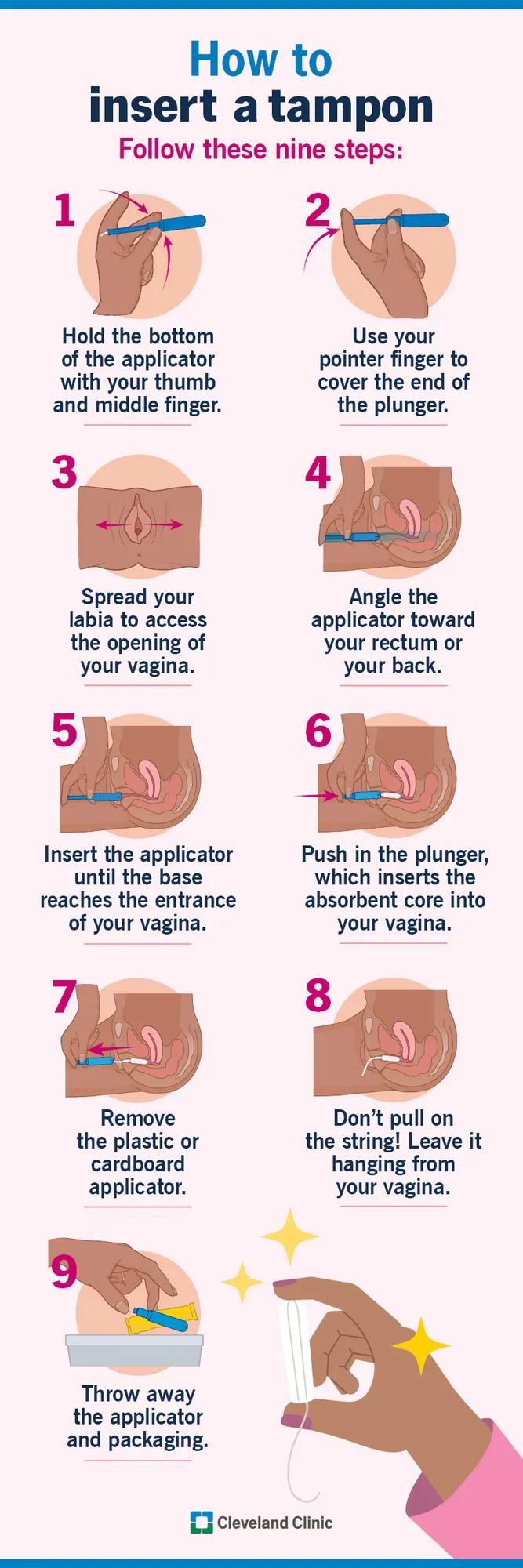
Image content: This image is available to view online.
View image online (https://assets.clevelandclinic.org/transform/e4901a32-e9cc-432f-b19d-21135918df0e/how-to-insert-tampon-infographic)
It’s go-time. Here’s how to put in a tampon.
Advertisement
“You might feel a little discomfort when you first put in a tampon, especially if your period isn’t heavy,” Youngblood notes. “Your vaginal walls aren’t as lubricated as they are during a heavy period, which causes a little more friction in your vagina.”
With your tampon safely inserted, you’re just about done. Here’s what’s next.
Congrats, you’ve done it! Enjoy the next few hours without a period-related care in the world.
“When it comes time to take out your tampon, just tug gently on the string to remove it from your vagina,” Youngblood advises. Simple as that.
But wait, let’s back up: How do you know when it’s time to remove a tampon? There are two ways to tell:
Advertisement
Once you’ve removed the tampon, be sure to throw it in a trash can. Never put the applicator, wrapper or used cotton tampons into the toilet, which can lead to serious plumbing issues.
It’s understandable to have questions about tampons, especially because there are a lot of misconceptions about them. Youngblood answers a few frequently asked questions about wearing tampons.
Tampons are categorized by how absorbent they are, meaning how much blood they’re able to soak up. You should always use the lightest absorbency tampon that will manage your flow — and you might need to use different absorbency levels for different days of your period.
Advertisement
Unfortunately, there’s no way to tell how heavy your flow will be. But over time, you may start to notice patterns about your period, including when it’s likely to be heaviest and lightest.
“If you notice that your tampon is heavily saturated with blood within a short period of time, you may need to go up in absorbency,” Youngblood says. “And vice versa: If your period isn’t very heavy and you see empty, white, unsaturated areas on the tampon when you take it out, switch to a lower-absorbency tampon or a sanitary pad instead.”
Once a tampon is in position, it shouldn’t cause any pain or discomfort.
“Tampons should definitely not hurt,” Youngblood confirms. “If it hurts after you’ve put it in, there could be a few things at play.”
Discomfort may be a sign that:
You can insert a tampon while sitting on the toilet or in a squatting position. But if you’re new to the process and want a little more space, you can stand up with one foot up on the toilet or bathtub.
“This might help you to better insert the tampon at an angle,” Youngblood suggests. “Then, once you’ve gotten the hang of it, it will become easier to do while sitting down.”
If you can’t get the tampon in, try these tips:
But if you still can’t seem to do it, don’t force it. In rare cases, you could be dealing with a medical condition that makes inserting a tampon difficult. So, make an appointment with a healthcare provider. They can help figure out what’s causing the problem. And if the issue is user error, they can provide in-person guidance to get you on the right track.
Learn more about our editorial process.
Advertisement
Yes, you can pee with a tampon in; no, they won’t stretch out your vagina or make cramps worse!
Nothing scented should go in or around your vagina!

It depends on your menstrual flow, and a little trial and error

Yes, with the right absorbency level and maximum time-frame
Homemade doesn't always mean safe
From using one at night to how often you should change them
Use them within five years and store them someplace cool and dry
In addition to toxic shock syndrome, you risk other vaginal infections

Wearing a scarf, adjusting your outdoor activities and following your asthma treatment plan can help limit breathing problems

Your diet in the weeks, days and hours ahead of your race can power you to the finish line

When someone guilt trips you, they’re using emotionally manipulative behavior to try to get you to act a certain way











