Locations:





This imaging can help your care team see where the cancer has spread and determine the best treatment for you
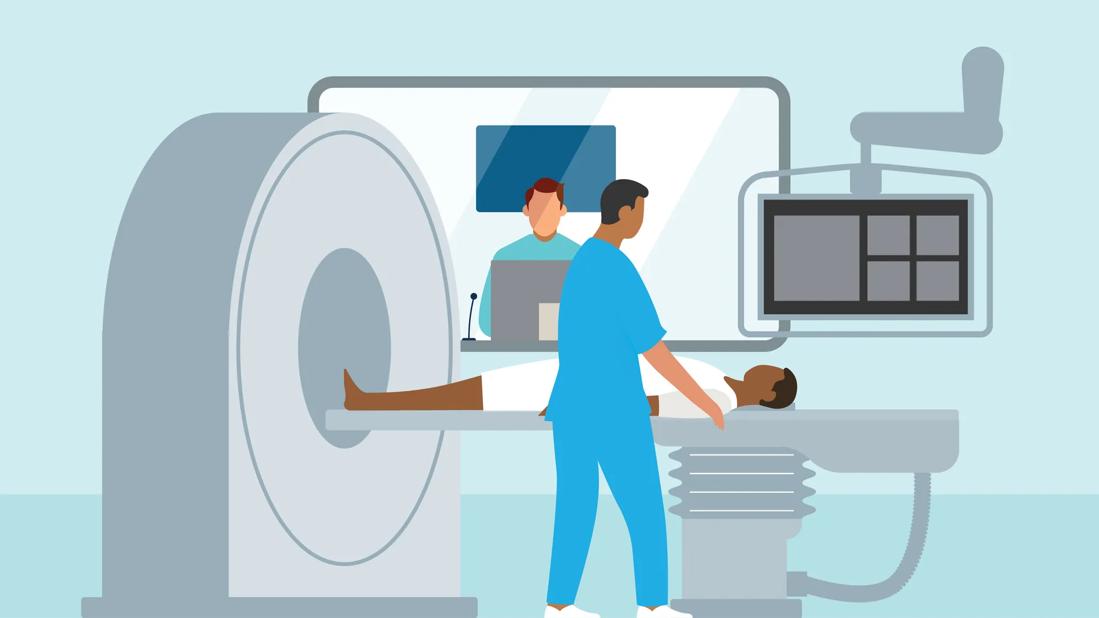
Image content: This image is available to view online.
View image online (https://assets.clevelandclinic.org/transform/c53d26d6-562d-432b-b2a1-0f1e0d796db8/PET-scan-prostate-1937115819)
Patient on PET scan table, being prepping by healthcare provider to undergo a scan
When you’re living with advanced prostate cancer, every new test can bring a mix of worry and hope. How might the results affect what comes next?
Advertisement
Cleveland Clinic is a non-profit academic medical center. Advertising on our site helps support our mission. We do not endorse non-Cleveland Clinic products or services. Policy
A PSMA PET scan can help your care team better understand if and where the cancer has spread. Radiation oncologist Rahul Tendulkar, MD, explains how this information can make a meaningful difference in the decisions you make together about your treatment.
You’ve already been diagnosed and are undergoing treatment for advanced prostate cancer. So, why would your doctor order a PSMA PET scan now?
This type of scan is designed to find prostate cancer cells throughout your body — even in very small amounts. Ultimately, a PSMA PET scan helps answer one major question: Where is the cancer now?
Dr. Tendulkar says there are two key reasons your provider might order this scan:
“PSMA PET imaging has been able to find smaller metastases than other types of imaging, and it exposes people to much lower levels of radiation,” he adds. “It can often achieve a very high level of detection, even identifying some of the smallest lesions.”
Advertisement
That’s really important. Because the earlier your care team can detect recurrence, the sooner they can try to treat it.
In the past, providers often couldn’t detect cancer until it had grown large enough to be picked up by traditional imaging, like CT scans and bone scans. But PSMA PET scans have been shown to be 27% more accurate.
That’s because PSMA PET scans work differently. They target a specific protein found on prostate cancer cells, which causes them to “light up” on imaging. That often allows doctors to detect the return (recurrence) of prostate cancer earlier, even when PSA levels are very low.
Earlier detection can give you and your care team more options — and more time to act thoughtfully and precisely.
One of the biggest benefits of having a PSMA PET scan for advanced prostate cancer is that it can help pinpoint where cancer has come back or spread. And that allows your care team to better target your treatment.
Dr. Tendulkar explains that there are generally three places where prostate cancer comes back:
“With a PSMA PET scan, we can provide a more accurate assessment of where the source of the cancer might be coming from,” he explains. “And if we can identify recurrence before it’s widespread, we may be able to intervene earlier.”
Importantly, the results of your PSMA PET scan allow your care team to better tailor your treatment to what’s actually happening within your body. The results guide decisions about what comes next, like:
“I sometimes tell people that the results of the PSMA PET scan allow us to take a ‘whac-a-mole’ approach — in a good way,” Dr. Tendulkar illustrates. “We can treat what we find now, and we can often do the same thing again in the future, if we need to. The goal is to provide long periods of being disease-free.”
If your doctor ordered a PSMA PET scan because your PSA levels are rising, it can feel confusing and even unsettling if the results come back negative. But that information still helps your care team guide your treatment plan.
“A negative PSMA PET scan is helpful because it tells us that whatever is making your PSA rise is still microscopic at this stage,” Dr. Tendulkar explains. “That can affect how we move forward with treatment planning.”
Advertisement
In these cases, your doctors may recommend monitoring rather than rushing into treatment. That can help you avoid unnecessary side effects while still keeping a close eye on your health.
Understanding why you need a PSMA PET scan can help give you a clearer sense of what’s to come. Consider asking questions like:
Your care team can also help you understand what to expect during the scan itself, which usually takes fewer than two hours to complete.
About 1 in 8 men will be diagnosed with prostate cancer during their lifetime — and cases of advanced prostate cancer are on the rise. But science is also evolving quickly in an effort to keep up.
“In recent years, we’ve seen really remarkable improvements in our ability to identify and treat prostate cancer,” Dr. Tendulkar reports. “PSMA PET scans are an important evolution in our ability to find recurrence at an earlier stage than ever before.”
It’s one of many tools helping healthcare providers catch recurrence earlier and tailor treatments better. And all of that, he says, offers hope for the future.
Advertisement
“Even if we can’t cure advanced prostate cancer up front, our goal is to turn it into a disease people can live with for a long time,” Dr. Tendulkar says. “We want you to be able to have a good, healthy quality of life going forward.”
Advertisement

Sign up for our Health Essentials emails for expert guidance on nutrition, fitness, sleep, skin care and more.
Learn more about our editorial process.
Advertisement

Your care team can determine if you’re a good match for this newer type of targeted treatment

Your PSA numbers matter for diagnosing and monitoring advanced prostate cancer — but they may not tell the whole story

Cancer that’s spread beyond the prostate is considered ‘advanced’

Anxiety, grief and anger are common after an advanced prostate cancer diagnosis — support and healthy coping strategies can help

Possible signs include slow urine flow and loss of bladder control — but if this common cancer is caught before it spreads, the prognosis is good

You don’t have to cope in silence with issues like urinary incontinence and sexual dysfunction

Family history and genetics may heighten your risk for prostate cancer

Check-in with your care team, and focus on low-impact exercises and walking for good gains

Eyes typically increase to full size during two growth spurts in childhood

To start, opt for calorie-dense foods that are rich in protein and healthy fats

Pre-birth injections and monoclonal antibodies can help prevent serious complications
 Search










