Locations:





This fermented cabbage is full of probiotics and fiber, and can help your gut, heart and brain health
If you’ve ever eaten a Reuben sandwich, your taste buds may have delighted in the tangy, sour flavor of sauerkraut.
Advertisement
Cleveland Clinic is a non-profit academic medical center. Advertising on our site helps support our mission. We do not endorse non-Cleveland Clinic products or services. Policy
But is sauerkraut good for you?
Yes! Made of fermented cabbage, it’s a good source of probiotics. Plus, it’s low in calories and high in fiber.
Registered dietitian Alexis Supan, RD, LD, shares the other potential health benefits of sauerkraut.
Sauerkraut is a fermented cabbage dish that’s often associated with Eastern European cuisine (it’s a classic side to bratwurst and kielbasa). But it originated in China thousands of years ago as a way to keep cabbage from spoiling.
“Traditional sauerkraut is typically made with cabbage and salt that’s been fermented,” explains Supan. “The fermentation process turns it into a really good probiotic, which is a great thing for your gut health.”
One cup (or 142 grams) of sauerkraut has approximately:
It also provides these nutrients:
“If you were to eat a cup of sauerkraut, that would give you roughly a quarter of the vitamin C you need for the day,” says Supan.
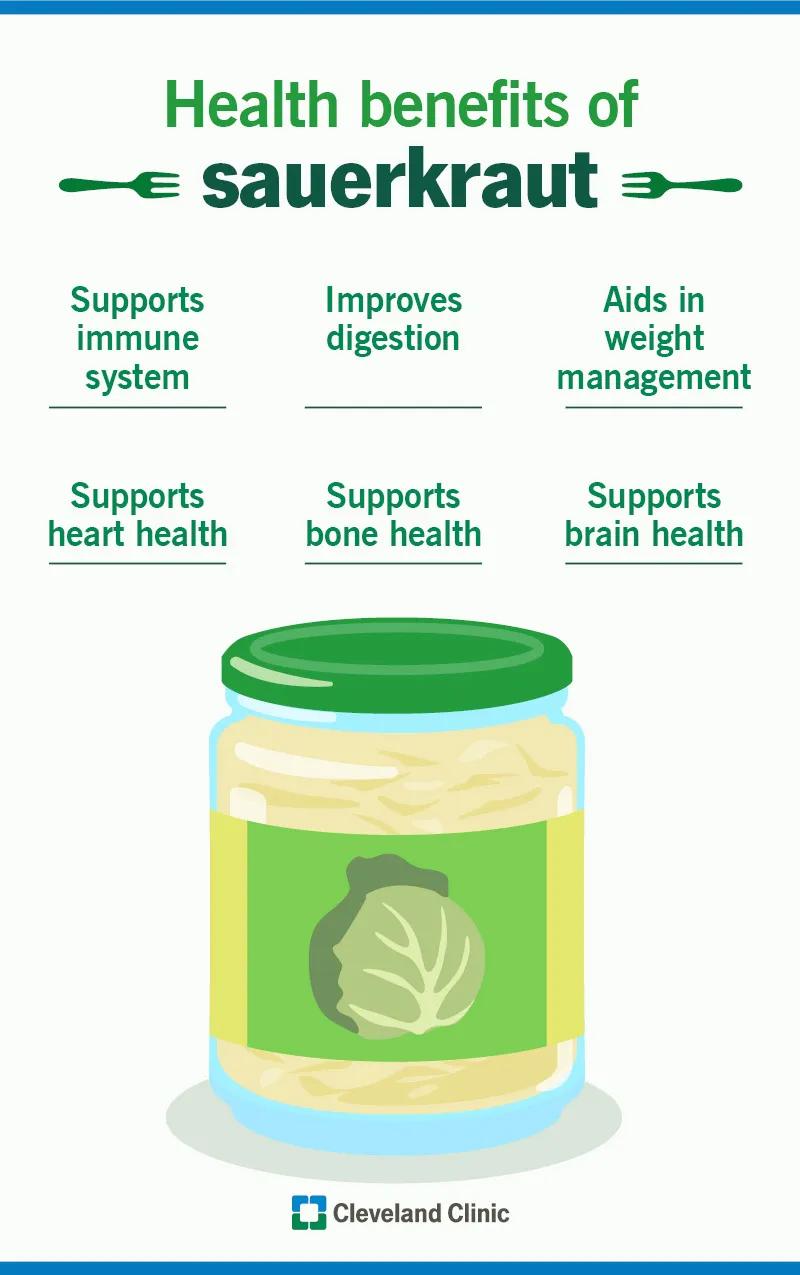
Image content: This image is available to view online.
View image online (https://assets.clevelandclinic.org/transform/590df86e-e80d-4482-8ab6-d39b3ccc74fa/sauerkraut-infographic)
How else can this fermented food help your health? Supan explains.
Your gut health plays a major role in how you feel. Supan even calls your gut “your second brain.”
Advertisement
“Fermented foods like sauerkraut actually supply your gut with good bacteria,” she says. “Research shows fermented foods improve your gut lining and reduce inflammation. Good gut health also improves your absorption of other minerals and nutrients.”
There’s also limited research that probiotics may help reduce diarrhea or symptoms of inflammatory bowel disease.
Those probiotics found in sauerkraut can also support your immune system by preventing the growth of harmful bacteria and aiding in the production of antibodies.
Additionally, the amount of vitamin C and iron found in most kinds of sauerkraut can help keep your immune system strong.
Remember when we mentioned that sauerkraut is low in calories and high in fiber? Those factors come into play when talking about weight loss management.
“A cup of sauerkraut is around 30 calories, which is very low. That’s on par with any other non-starchy vegetable,” shares Supan. “It’s a great way to help fill yourself up, especially if you’re someone who’s trying to eat in a way where you’re being weight-conscious.”
The fiber and probiotics from sauerkraut may help lower blood pressure and cholesterol. But according to research, the real story here may be the vitamin K2 found in the fermented food.
“Vitamin K2 may improve your heart health and reduce your risk of heart disease because it helps with the absorption of calcium in your bones and not your arteries,” says Supan.
Another way the vitamin K2 in sauerkraut can benefit your health? It aids in stronger bones. Vitamin K2 activates a protein that binds to calcium and makes sure it’s absorbed by your bones.
There’s a connection between your gut health and your brain health. While there haven’t been any studies specifically on sauerkraut and brain health, Supan says that probiotic foods may help reduce stress and improve memory.
“We’re just connecting the dots of what we know,” she explains. “First, sauerkraut improves your gut health. And secondly, your gut health has an impact on your stress, mood and memory.”
Yes. Ideally, you want to use unpasteurized versions.
“You want to avoid pasteurization,” stresses Supan. “During pasteurization, sauerkraut is heated, which kills all its probiotic properties.”
But if you’re using store-bought sauerkraut, whether it’s pasteurized or not isn’t usually on the label.
“The easiest way to know is to buy sauerkraut that’s refrigerated,” she recommends. “If it’s shelf-stable, it’s pasteurized.”
Advertisement
Another reason to steer clear of the pasteurized version? Those shelf-stable varieties also tend to be loaded with added preservatives and sugar, which you want to avoid, as those extra ingredients don’t provide any nutritional benefit.
“If you’re unsure, peek at the ingredient list. It should just say cabbage and salt. Some types may have a specific ingredient like garlic or fennel seeds to add flavor. And those are OK,” clarifies Supan. “But if it has some ingredients that you don’t recognize, I would choose another brand.”
While sauerkraut is safe for most people to eat, talk to your doctor first if you take monoamine oxidase inhibitors (MAOIs).
It’s believed that some of the compounds in sauerkraut may interact with the absorption of this medication, which is commonly used to treat depression, anxiety and Parkinson’s disease.
Another consideration for some people? Supan says that sauerkraut can be high in sodium.
“The amount will vary from brand to brand, but it’s probably close to 1,000 milligrams of sodium per cup,” she warns.
The upside? You don’t need to eat sauerkraut every day to get its probiotic benefits.
“Even just eating a couple of forkfuls once or twice a week will deliver that healthy bacteria to your body,” she says.
Advertisement
Sauerkraut comes with plenty of good-for-you benefits, like helping your digestive system and supporting your heart and brain health.
And it can be fun to try out new ways to incorporate sauerkraut into your meals. For Supan, she likes to add sauerkraut to pierogies to make the Eastern European dish a little bit healthier (she also subs in Greek yogurt for sour cream).
“It’s one of my top ways of eating sauerkraut, and it’s a very Cleveland-centric thing to do,” she shares. “But now, you’re getting some veggies from the sauerkraut and some protein from the Greek yogurt.”
Advertisement

Sign up for our Health Essentials emails for expert guidance on nutrition, fitness, sleep, skin care and more.
Learn more about our editorial process.
Advertisement

Don’t underestimate the power of a pause
From sauerkraut to kimchi, these foods can help keep your gut healthy

This famously funky-smelling fruit is packed with fiber, vitamins and minerals
Choosing snacks with protein can help curb hunger, support muscle health and keep your energy steady between meals
Fish packs plenty of protein, heart-healthy fats and other body-boosting nutrients into every bite

The best choices are high in omega-3s and protein and low in mercury

Look for foods with a variety of nutrients that last a long time and work in multiple meals — like legumes, whole grains and frozen or canned produce
Prepping ingredients ahead of time, rethinking your snacks and making smart protein swaps can up your daily intake

Managing your weight through physical activity may lower your chances of getting this common cancer

It typically starts in October and winds down in early spring, with cases at their highest in the middle of winter

Anxiety disorders, health conditions and past trauma can make driving nerve-wracking — help is available
 Search










