Locations:





While outdated, these subtypes highlight the many signs of schizophrenia
Schizophrenia is a complex mental health condition — and an often misunderstood one.
Advertisement
Cleveland Clinic is a non-profit academic medical center. Advertising on our site helps support our mission. We do not endorse non-Cleveland Clinic products or services. Policy
Some of that confusion comes from long-standing stigma. And some of it stems from how quickly medical understanding has evolved. Research has come a long way, which is a good thing. But it can also make it harder to keep up.
You may have heard of schizophrenia types, like “paranoid” or “catatonic.” That’s because in the past, a schizophrenia diagnosis was divided into five subtypes. Since 2013, experts have seen schizophrenia as a spectrum rather than separate subtypes with distinct symptoms.
Psychiatrist Travis Krew, MD, explains what changed and what the different symptoms can look like.
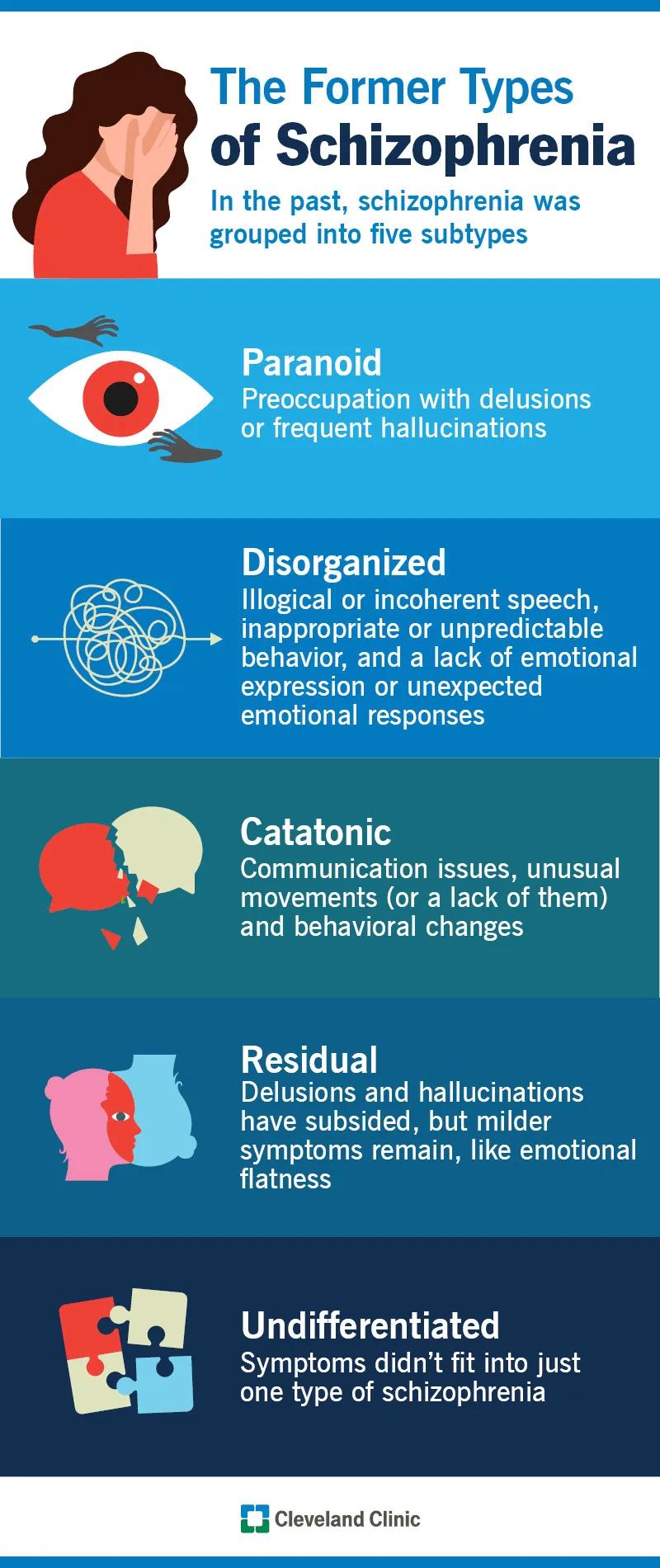
Image content: This image is available to view online.
View image online (https://assets.clevelandclinic.org/transform/cc7ed6f5-d7be-457c-b846-c8f02f84df71/types-of-schizophrenia-infographic)
In the past, schizophrenia was grouped into five subtypes:
In 2013, the American Psychiatric Association (APA) removed these categories from the DSM, the manual that healthcare providers use to diagnose mental health conditions.
Why the shift?
Researchers found that the stand-out symptoms of schizophrenia can change over time and so can their intensity. So, instead of putting people into strict groups, experts now think of schizophrenia as a spectrum — more like a sliding scale than a set of boxes.
“The APA updates the DSM to reflect new research and improve how we diagnose and treat mental health conditions,” says Dr. Krew. “These changes help providers speak the same language and offer better care.”
Advertisement
But although the subtypes are no longer used for diagnosis, they can still help understand the range of symptoms you or your loved one may experience. Here’s a closer look at each type.
In the past, a diagnosis of paranoid schizophrenia required preoccupation with delusions (firmly held false beliefs) or frequent hallucinations (perceptions of things that don’t exist), like hearing voices. But there was a catch. Other symptoms of schizophrenia, like disorganized speech and bizarre behavior, couldn’t be the main features.
“Paranoia, delusions and hallucinations are common symptoms of schizophrenia, but they don’t have to be present in every case,” clarifies Dr. Krew. “You can also have these symptoms along with behavioral and cognitive challenges — it’s not one or the other.”
Schizophrenia can affect how you think, speak, behave and express emotions.
A disorganized (hebephrenic) schizophrenia diagnosis focused on those changes. Being diagnosed with disorganized schizophrenia used to require all of the following:
“These are still important symptoms of schizophrenia,” Dr. Krew notes. “We just don’t use this specific label anymore.”
Catatonia disrupts how your brain works. Communication issues, unusual movements (or a lack of movement) and behavioral changes are the most striking features of it.
A catatonic schizophrenia diagnosis used to require at least two of the following:
“Catatonia can occur with many other mental health conditions, but it’s often associated with schizophrenia,” says Dr. Krew. “Up to a quarter of people with schizophrenia have catatonic episodes.”
Schizophrenia symptoms can come and go. “Residual schizophrenia” used to be how healthcare providers categorized people whose symptoms fluctuated.
In the past, residual schizophrenia meant that symptoms like delusions and hallucinations subsided. But milder symptoms remained, like emotional flatness.
“Schizophrenia can involve milder symptoms,” says Dr. Krew. “But it’s still a lifelong condition that benefits from ongoing treatment.”
Healthcare providers used to diagnose undifferentiated schizophrenia when someone’s symptoms didn’t fit into just one type of schizophrenia.
Advertisement
“We don’t use this classification anymore,” shares Dr. Krew, “but it reflects how we now understand schizophrenia — as a condition with a range of symptoms that can shift over time.”
Schizophrenia itself is a spectrum. But it’s also part of a broader group of conditions known as schizophrenia spectrum disorders that the DSM recognizes.
“Our understanding of psychosis continues to build and evolve,” says Dr. Krew. “Different diagnoses help us describe it and provide the best treatment to each patient.”
Related disorders include:
Advertisement
While the “old types” of schizophrenia are no longer used, they can still provide helpful context (understanding) for the wide range of symptoms you may see.
And if you or a loved one seems to be experiencing symptoms of schizophrenia, it’s important to get medical help, advises Dr. Krew.
“Given the number of potential causes of that symptom, it may take time to get an accurate diagnosis. But it’s essential to get the correct one so you can get the most effective treatment.”
Advertisement

Sign up for our Health Essentials emails for expert guidance on nutrition, fitness, sleep, skin care and more.
Learn more about our editorial process.
Advertisement

Negative symptoms refer to a lack of emotional expression and motivation
The first symptoms of schizophrenia can be subtle, but recognizing them may help you get treatment sooner

Certain B vitamins, omega-3 fatty acids and a healthy diet can serve as complementary treatments for schizophrenia

Following your treatment plan, finding a community, staying active and maintaining a healthy diet can help manage this psychiatric condition

People with schizoaffective disorder have additional mood symptoms

Boys are more likely to exhibit easily noticed hyperactive symptoms, while girls often show subtler, quieter signs of the condition

Mood stabilizers promote long-term mood stability, while antipsychotic medications work faster to manage acute episodes

Different medications can help manage different aspects of this condition

Managing your weight through physical activity may lower your chances of getting this common cancer

It typically starts in October and winds down in early spring, with cases at their highest in the middle of winter

Anxiety disorders, health conditions and past trauma can make driving nerve-wracking — help is available
 Search










