Locations:





From coos and babbles to first words and short sentences, there’s a wide range of what’s considered ‘normal’
If you’re wondering when babies should start talking, you’re not alone. It’s one of the most common questions pediatricians hear. But pediatric speech-language pathologist Meghan Mingee, SLP, says there’s a wide range of what’s considered normal.
Advertisement
Cleveland Clinic is a non-profit academic medical center. Advertising on our site helps support our mission. We do not endorse non-Cleveland Clinic products or services. Policy
“A lot of children say their first word around 12 months,” Mingee says. “Some are a little earlier, though, and some are a little later. And even if a child is a little delayed at a young age, that doesn’t mean they’ll be delayed forever.”
Mingee and pediatrician Kimberly Churbock, MD, offer a look at how kids’ language skills typically unfold.
“Speech and language development is a huge spectrum,” Dr. Churbock says. “Kids tend to follow a predictable pattern of skill progression, but the timing can vary a lot.”
Here’s how babies’ language skills typically develop — and when to check in with your child’s provider.
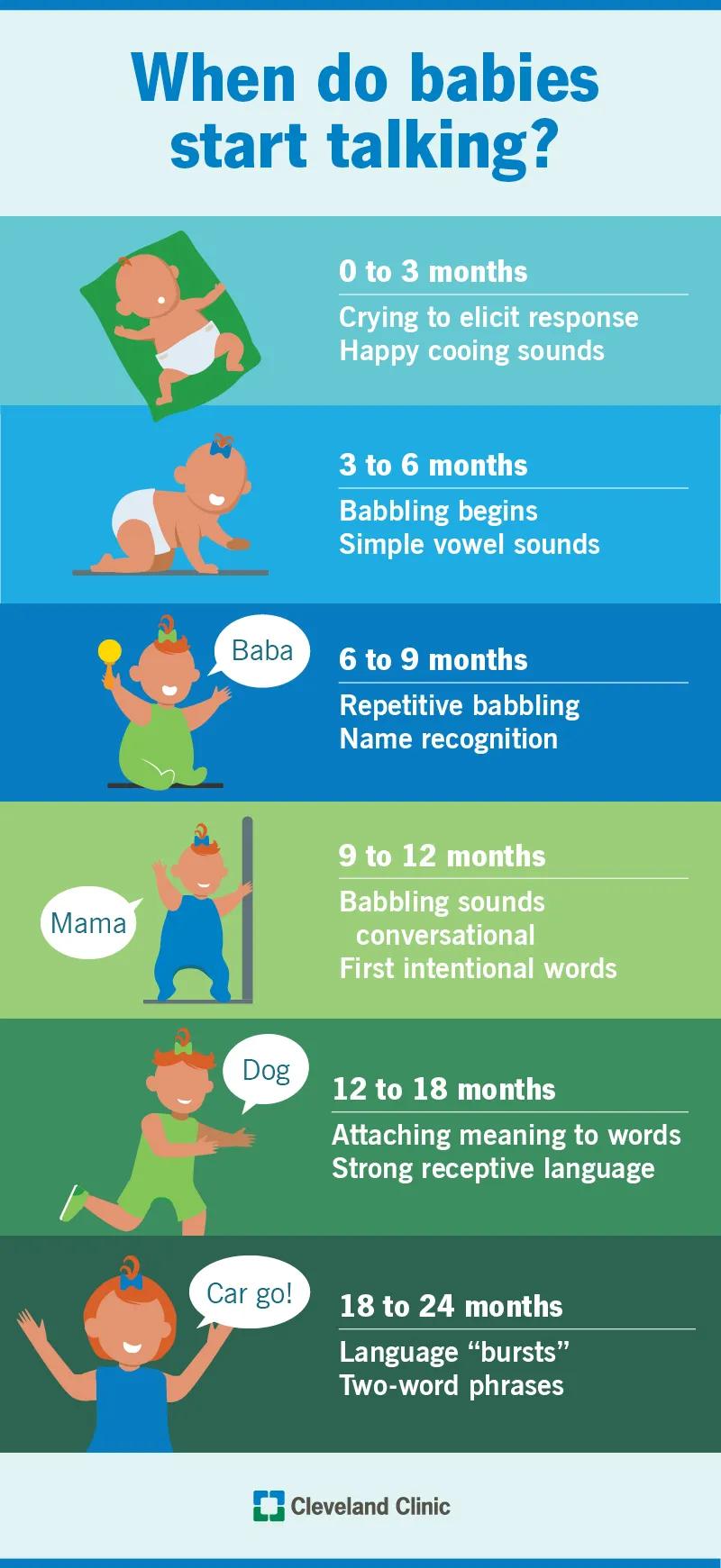
Image content: This image is available to view online.
View image online (https://assets.clevelandclinic.org/transform/0bb4ac2b-7890-4038-9d59-e11934500c45/BabiesStartTalking-infographic-800x1744)
Even though newborns can’t talk, they’re learning to communicate.
Advertisement
Around 4 to 6 months, babies should also start turning to search for sounds and music when they hear it.
When to talk to a provider: “I’d recommend checking in with your child’s doctor if they’re not babbling by about 6 months,” Mingee says.
By their first birthday, most babies say their first real word (like “mama” or “dada”) and use it with meaning. This often happens around 10 to 11 months, though for some babies, it can happen earlier, and others won’t do it until later.
But before that first word arrives, you’ll start to hear more variety in your child’s babbles. Instead of repeating the same sound, they start to mix them up.
“In the earlier months of this phase, it’s still about just imitating sounds like ‘ma-ma-ma’ and ‘ba-ba-ba,’ but without real meaning,” Minghee says. “Around 9 or 10 months is when they usually start to switch up their babbling to become more speech-like.”
At this point, it may sound like they’re having a conversation, even if it doesn’t yet make sense.
At this stage, babies should also:
When to talk to a provider: If your baby isn’t hitting these responsiveness milestones, that could be a sign of hearing-related issues, which can affect speech and language development. “If you have any concern whatsoever about your child’s hearing, we want to evaluate that earlier rather than later,” Dr. Churbock emphasizes.
Many babies start talking in a more meaningful way around their first birthday. This is the stage when they really start attaching meaning to their words. And they may use a few specific words for people or favorite things.
By 18 months, many toddlers can say 10 or more words. Some have many more, while others are just getting started.
“New words should be heard each week at this age,” Minghee says.
But what matters just as much is your child’s ability to understand words. Receptive language (what your child comprehends) often develops before expressive language (what your child is able to say).
“Some children have fewer words but still seem very engaged, try to communicate and clearly understand what’s being said to them,” Dr. Churbock says. “When it comes to language development, all of those things are reassuring.”
Mingee agrees.
“The most important thing is that they understand what you’re saying,” she emphasizes. “If they can follow simple directions like ‘get the ball’ or point to something you name, those are great signs of language development.”
Advertisement
When to talk to a provider: Dr. Churbock says 18 months is a common age for referrals to a speech-language pathologist. “Look for a milestone of 10 or more words,” she recommends. “If you don’t see many specific words or attempts to make specific words, that’s when we’d think about extra support.”
Between 18 and 24 months, toddlers often experience a language “burst.”
“This is often when it seems like the rate of new word acquisition really starts to speed up,” Dr. Churbock explains. “For some kids, it almost seems like a switch flips, and suddenly, they have more and more words.”
By age 2, most children are starting to combine two words to make short phrases, like:
These phrases don’t need to be grammatically correct, and your child’s pronunciation doesn’t need to be perfect. What matters is that they’re putting together two separate ideas.
“At this point, we’re looking for enough of a vocabulary that it includes some nouns, some verbs and maybe some adjectives,” Dr. Churbock says.
You may even start to hear three-word phrases emerging, especially closer to 2 and a half years.
When to talk to a provider: If your child isn’t putting together two- to three-word phrases by age 2, bring it up at their next appointment.
Advertisement
Babies’ individual personalities and preferences can account for a lot of the differences between them — including when they start talking.
“Some children are early talkers,” Mingee acknowledges. “Others take their time. It’s most important that your child demonstrates an increasing understanding of words and is engaging with you throughout the day.”
But several other factors may be at play, too.
Try your best not to compare your child’s progress to others’, especially in a time of milestone checklists and social media parenting brags.
“In this day and age, there are so many factors that can fuel parental anxiety,” Dr. Churbock recognizes. “Social media can absolutely contribute (oftentimes, unnecessarily) to parental worries, especially if you feel like your kid isn’t doing something by a certain time.”
Advertisement
Don’t hesitate to talk to your pediatrician if you have questions or concerns about your child’s language development skills. If they’re found to have a speech delay, early intervention and support can make a big difference.
You don’t need flashcards or special programs to help your baby learn how to talk. Simple, everyday interactions can go a long way.
Try these strategies:
Above all, try to keep it fun.
“We want language and communication to be enjoyable,” Dr. Churbock encourages. “And your pediatrician is there to walk alongside you — both to celebrate milestones and to help if there’s an area that needs extra support.”

Sign up for our Health Essentials emails for expert guidance on nutrition, fitness, sleep, skin care and more.
Learn more about our editorial process.
Advertisement
Massage, teething rings, chilled items and pain relievers can help dull the discomfort when baby teeth erupt
Clean their bottom using plain water and a soft washcloth, then apply an ointment — and let them go diaperless when possible
Stay calm and validate your child’s feelings, but don’t give in to their demands
Big feelings, growing independence and lots of meltdowns are all typical parts of toddlerhood
Check for common causes, try soothing strategies and know when it’s time to take a break

Thumb sucking is a normal part of early development, but over time, it can affect teeth, speech and habits
Most teething symptoms are mild — fevers and other major symptoms are likely something else
This common sitting position for kids can cause problems with joint health, muscle development and motor coordination

Managing your weight through physical activity may lower your chances of getting this common cancer

It typically starts in October and winds down in early spring, with cases at their highest in the middle of winter

Anxiety disorders, health conditions and past trauma can make driving nerve-wracking — help is available
 Search










