Locations:





 Search
Your pooping habits, diet and fluid intake can all play a role in limiting painful hemorrhoid issues
When your hemorrhoids get irritated, it’s not a pleasant experience. These swollen veins that may form inside and outside your anus can become painful, uncomfortable and — in some cases — even a little bloody.
Advertisement
Cleveland Clinic is a non-profit academic medical center. Advertising on our site helps support our mission. We do not endorse non-Cleveland Clinic products or services. Policy
But despite hemorrhoid problems being extremely common, they’re relatively easy to prevent.
We asked colorectal surgeon Arielle Kanters, MD, to share how.
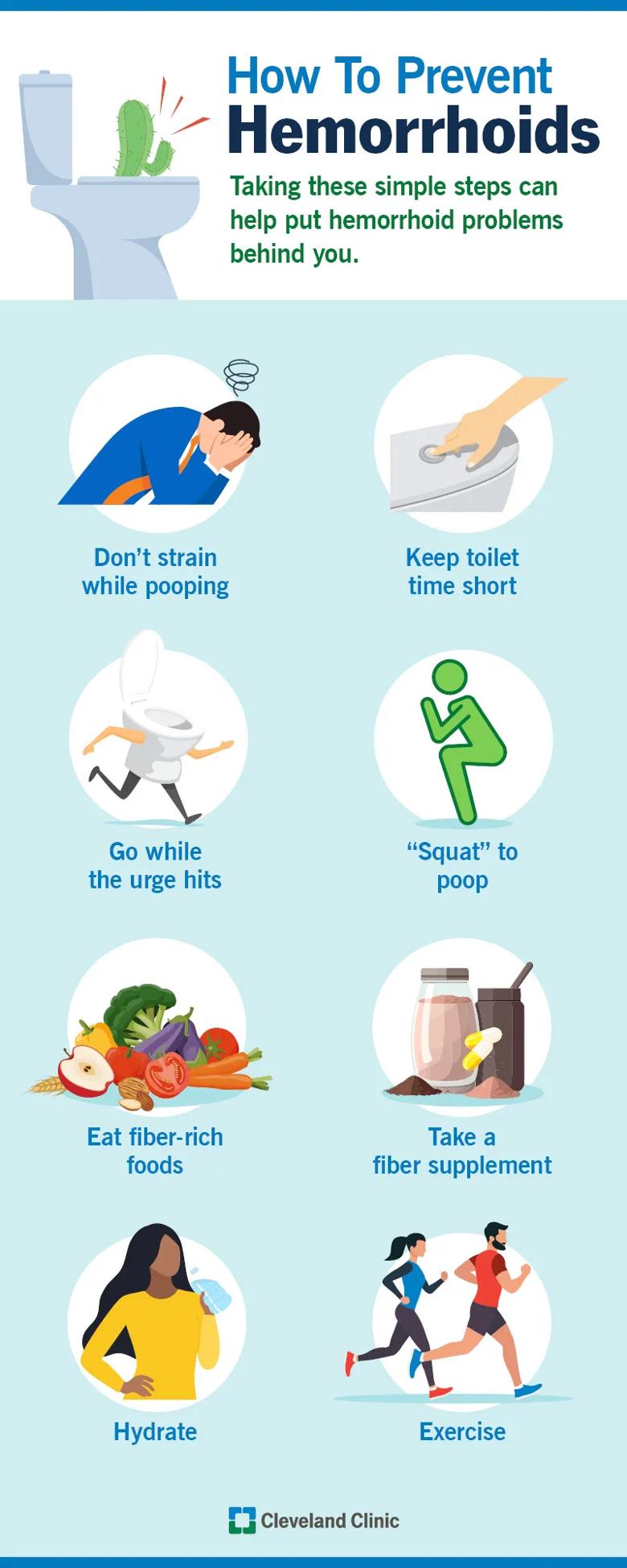
Image content: This image is available to view online.
View image online (https://assets.clevelandclinic.org/transform/33a20099-83b5-46c6-8078-5f861e438151/preventing-hemorrhoids-infographic)
Most hemorrhoid issues aren’t random. They’re closely tied to pooping habits — in particular, how you go — and lifestyle. The following eight strategies can help keep hemorrhoid problems from flaring up.
Straining to force out poop is one of the biggest contributors to hemorrhoid problems. When you bear down, you increase pressure on the sensitive veins around your anus. That force causes hemorrhoids to bulge.
“You know how you see big veins in your forehead when you strain? The same thing is happening to the veins in your bottom,” illustrates Dr. Kanter.
To keep those downstairs veins from popping out, relax your body to allow your pelvic floor muscles to let the poop pass more easily. Keep your breathing slow and steady. (Don’t hold your breath to push!)
If you consistently feel the need to strain to go No. 2, it may be a sign of constipation or another issue that needs attention, she says.
Spending too long on the toilet with your butt over the bowl can irritate hemorrhoids — even if you’re not actively straining.
“When you’re sitting on the toilet, blood pools down low and causes hemorrhoids to swell,” explains Dr. Kanters. “The position puts a lot of added stress and pressure on your blood vessels.”
Advertisement
Dr. Kanters recommends limiting toilet time to no more than five minutes. Basically, get in and get out. Focus on addressing a bodily necessity — not “escaping” from the world to play on your phone or read a book or magazine.
If poop doesn’t quickly exit after you sit down, get up and move on. “You can always come back when you’re ready,” she says. “Don’t just wait there hanging out.”
When it comes to hemorrhoids, how you sit on the toilet matters more than you might think.
Your rectum is slightly kinked when you’re sitting on a standard toilet in the traditional way, with your feet flat on the ground and your knees bent at 90-degree angles. That’s not ideal for letting poop pass.
But if you get into more of a squatting position, with your feet elevated, your rectum straightens out to let bowel movements move more freely.
“Just putting your feet on a little step stool in front of your toilet can make a big difference,” says Dr. Kanters. “It can help you go easier and faster, which both limit the possibilities of hemorrhoid problems.”
Eating fiber-rich foods can help keep your poop soft and easier to pass. When bowel movements go smoother, you’re less likely to strain — which, as we noted, helps prevent hemorrhoid troubles.
Unfortunately, most of us don’t consistently get enough fiber in our diet, notes Dr. Kanters. That’s a reality that can lead to irregular pooping patterns that eventually irritate your hemorrhoids.
The solution? Focus on filling your plate with high-fiber foods to get the recommended daily amount. Suggested fiber intake varies by age and sex, ranging from 25 grams to 34 grams per day.
You can reach that by eating more:
So, be honest here: Are you always going to load up on enough salad to hit your daily fiber target? If the answer is no, that’s where supplements may help prevent hemorrhoid problems.
“Fiber supplementation guarantees a certain amount of fiber in your diet, regardless of what you eat that day,” says Dr. Kanters. “It can help you be really consistent without the need for tracking.”
She often suggests using fiber powders, such as psyllium husk, given that they tend to be affordable and effective. Talk to your healthcare provider about whether supplementation may be an option for you.
Fiber only works well for your system if you’re also drinking enough water. Without fluid, fiber can actually make poop harder. (That is NOT the direction you want to go to avoid hemorrhoid issues!)
Advertisement
Dr. Kanters recommends drinking at least 68 ounces (2 liters) of water a day to help keep your poop soft.
If you keep moving, odds are, your poop keeps moving, too. Regular exercise helps keep waste traveling through your intestinal tract to prevent constipation and potential hemorrhoid flare-ups.
One word of caution, though: Be careful when doing squats and similar motions with heavy weights. Those activities increase abdominal strain and pressure, which can irritate hemorrhoids.
Go poop when you feel the need to poop, urges Dr. Kanters. This sounds like common-sense advice, but many people ignore it — and that can be bad news for your hemorrhoids.
If you delay using the bathroom, you increase the risk of your poop drying out and turning rock hard. That becomes tougher to poop out, which can lead to straining and more time on the toilet.
There are plenty of treatment options available if your hemorrhoids turn into a pain in the … well, you know. But the best approach may be making simple adjustments to avoid the problems in the first place.
“The majority of people will never need to worry or think about their hemorrhoids if they take some basic preventive steps,” encourages Dr. Kanters. “Most of the time, it really is that simple.”
Advertisement
Advertisement

Sign up for our Health Essentials emails for expert guidance on nutrition, fitness, sleep, skin care and more.
Learn more about our editorial process.
Advertisement
That constant itch is common, but relief starts with understanding what’s causing the irritation
Try sitting in a sitz bath or taking psyllium husk to help relieve symptoms
This TikTok trend can cause injuries, infections and inflammation
Dandruff, allergic reactions and lice can get you scratching your head
Expired toothpaste won’t make you sick, but it’s less effective for your dental health
From whitening to sensitivity toothpastes, the best choice depends on your dental needs — but fluoride should always be part of the equation
For a more efficient and pleasant bathroom routine, raise your feet onto a small stool and don't overdo the wiping

These surgeries may be recommended if your child has obstructive sleep apnea or frequent throat infections

Simplifying choices, a reassuring attitude and avoiding information overload can help you overcome indecision
Nicotine and other lingering chemicals from smoking can harm people who don’t smoke, including children
The research is mixed, but experts agree: The risks outweigh the benefits











