Locations:


One feels out of your control, while the other feels like part of who you are
With nearly identical names, obsessive-compulsive disorder (OCD) and obsessive-compulsive personality disorder (OCPD) sound like they should be closely related.
Advertisement
Cleveland Clinic is a non-profit academic medical center. Advertising on our site helps support our mission. We do not endorse non-Cleveland Clinic products or services. Policy
But they’re actually two different mental health conditions. Think of them more like cousins than siblings.
“The biggest difference is that OCD involves unwanted thoughts and repetitive behaviors that you don’t want to have,” says psychologist Dawn Potter, PsyD. “With OCPD, you’re generally obsessive about perfectionism, being in control and doing things correctly because it’s part of your personality.”
If the distinction still isn’t clear, you’re not alone. To help, Dr. Potter compares and contrasts these two conditions and how they can affect your life.
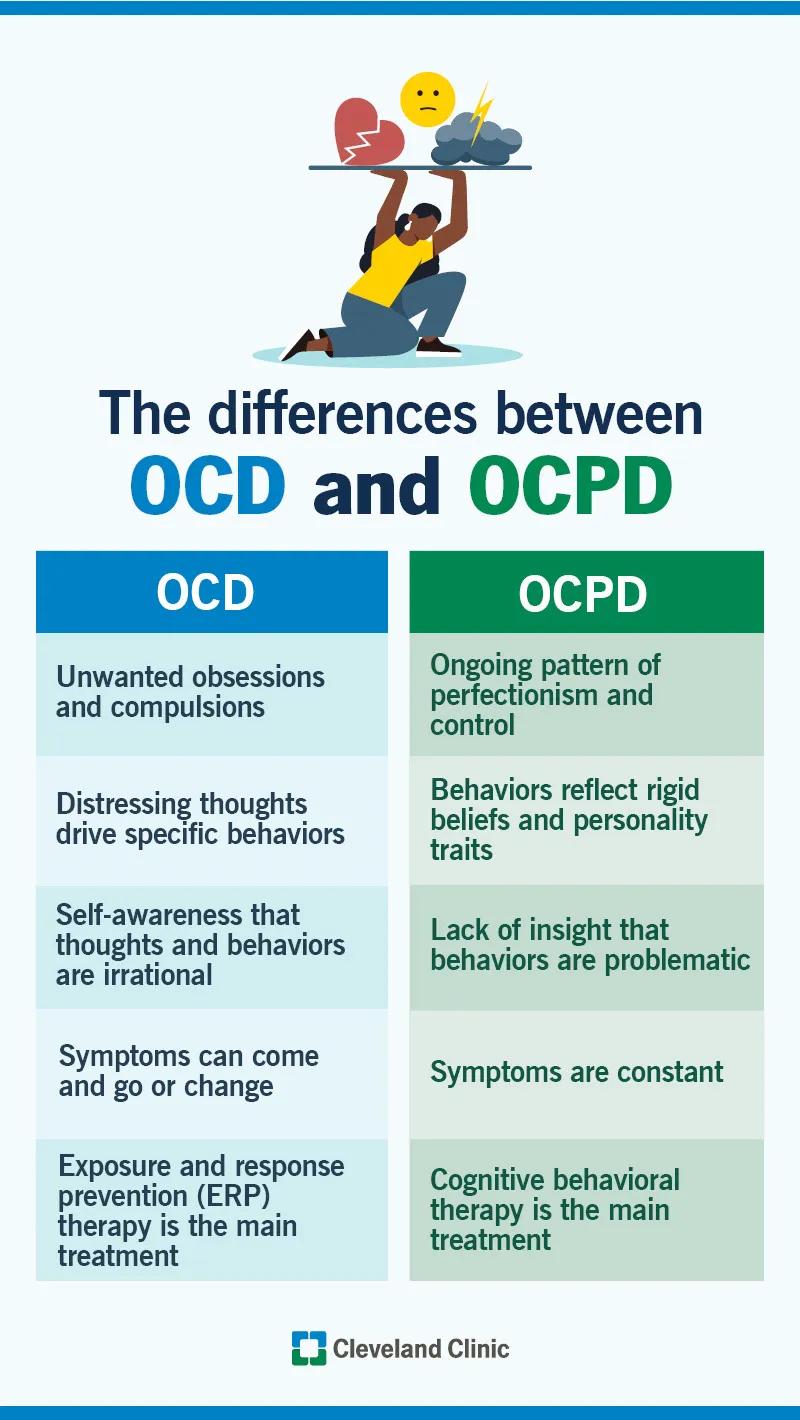
Image content: This image is available to view online.
View image online (https://assets.clevelandclinic.org/transform/69162981-a6df-4cb2-a8a2-fc2f62c15d7f/OCD-versus-OCPD-infographic)
When it comes to OCD and OCPD, it can be easy to get confused. On the surface, they can both look like a rigid need for neatness, control or exactness.
The key difference is why the behaviors happen:
“The behaviors of OCPD are general and show up in all aspects of life,” Dr. Potter explains. “On the other hand, specific situations and thoughts trigger OCD behaviors.
Advertisement
“With OCD, the behaviors are typically senseless or repetitive and may not be rationally connected to the unwanted thoughts,” she continues. “With OCPD, you’re doing something meaningful, but it may be inefficient.”
To help see the difference, let’s look at a behavior such as writing a list:
Another key difference is the level of insight or self-awareness you have with each condition, Dr. Potter says.
If you have OCD, you often want to stop the behavior but simply can’t. It feels out of your control and doesn’t align with how you see yourself.
With OCPD, you don’t see anything wrong with how you think and behave because you feel it’s the correct way to be.
OCD symptoms fall into two categories: obsessions and compulsions.
Some examples of obsessions include:
Some examples of compulsions include:
“Many people think OCD is only about cleanliness or keeping things organized, but that’s not the case,” says Dr. Potter. “Obsessions and compulsions can take many different forms.”
Symptoms of OCPD are ongoing and affect work, relationships and everyday situations. Some signs include:
“You have these OCPD traits from sunrise to sundown — they’re constant,” she adds.
While both conditions are typically treated with talk therapy, the approaches aren’t the same.
“Exposure and response prevention therapy is the gold-standard treatment for OCD to help you face fears without doing compulsions,” says Dr. Potter. “For OCPD, cognitive behavioral therapy can help you identify and change unhelpful patterns of thinking and acting.”
Advertisement
Sometimes, your healthcare provider may suggest antidepressants to help limit obsessive thoughts linked with OCD. Currently, there aren’t medications that directly treat OCPD.
If you’re wondering whether OCPD is simply a milder form of OCD, the answer is no.
“They’re two distinct conditions,” Dr. Potter emphasizes. “One isn’t a mild or more extreme version of the other. But it is possible to have both at the same time.”
Without treatment, both can significantly affect your daily life. OCD is more likely to cause internal distress from intrusive thoughts and compulsions. OCPD is more likely to create tension in relationships and with work.
If intrusive thoughts, repetitive behaviors or perfectionism are making it harder to get through your day, you have to try to figure it out on your own. A healthcare provider or mental health professional can help determine what’s going on and connect you with the right treatment.
“It’s very difficult to recover from either condition on your own,” Dr. Potter stresses. “But with time, treatment can be very effective in helping you feel better.”
Advertisement

Sign up for our Health Essentials emails for expert guidance on nutrition, fitness, sleep, skin care and more.
Learn more about our editorial process.
Advertisement

While they may feel validating, the four types of OCD can limit understanding and treatment

Mood stabilizers promote long-term mood stability, while antipsychotic medications work faster to manage acute episodes

Different medications can help manage different aspects of this condition

Self-stimulating behaviors can help you self-regulate or cope with intense emotions

Fishing for compliments, provoking conflict and pouring on the melodrama are all ways of expressing an unmet need

By setting boundaries around how much you give, you can save your time and resources while also being a good person

Whether it’s playing hooky or faking cancer, malingering behavior is always motivated by personal gain

Causes range from psychological conditions like PTSD to physical conditions like fibromyalgia
Researchers say components of a snail’s mucus could help hydrate your skin and minimize future wrinkles

Despite rumors, science hasn’t shown that creatine causes hair loss

Fad diets make big promises with little or no science behind them
 Search