Locations:





What to expect from a supervised walking program

Image content: This image is available to view online.
View image online (https://assets.clevelandclinic.org/transform/3f31d7f6-9e0d-45e3-a711-842d3196946f/PADwalkEx-649796136-770x553_jpg)
Individual running on a treadmill
If you have peripheral artery disease (PAD), you know all about the pain that can come from just a short walk.
Advertisement
Cleveland Clinic is a non-profit academic medical center. Advertising on our site helps support our mission. We do not endorse non-Cleveland Clinic products or services. Policy
PAD occurs when plaque builds up inside your arteries. Over time, plaque hardens and results in severely restricted blood flow within your legs, causing pain when you walk.
But numerous studies have shown that a form of noninvasive treatment — supervised exercise therapy — can help people with PAD walk farther with less pain.
Supervised exercise therapy for peripheral artery disease is reimbursed under Medicare. It includes up to 36 exercise sessions supervised by a medical professional over the course of 12 weeks.
“The goal is to enable patients to prolong the amount of time that they are able to walk without experiencing what we call claudication in their legs,” says Erik Van Iterson, PhD, MS, Director of Cardiac Rehabilitation. Claudication is the medical term for discomfort or pain caused by too little blood flow to the leg muscles that you use to walk.
A recent study analyzed 25 clinical trials on supervised exercise therapy and found that total and pain-free walking distances improved for those participating in regular walking. Researchers have also found that supervised exercise therapy for PAD may be just as effective as leg stent treatment.
In order to see that kind of improvement, you’ll need to consistently walk to a level of moderate to strong discomfort.
Advertisement
“That feeling of discomfort in your legs when you walk is actually the body’s signal to let you know that blood flow down in the arterial vessels is working its way through the muscle and delivering the intended benefit,” Dr. Van Iterson explains.
In supervised exercise therapy, you’ll likely be recommended to attend three weekly sessions where the general goal over the course of your program is to work toward accumulating up to one hour of walking time on a treadmill. A typical session may look like this:
Dr. Van Iterson notes that the people most likely to benefit from this treatment are those who commit to walking consistently — and not just on the days of supervised exercise therapy.
“That means pretty much every day,” he says. “Yes, you’re only in supervised exercise therapy three days a week, but you really need to be doing similar levels of walking on your own for the other four days.”
The ultimate goal is to get to the point where you can navigate activities of daily living, like walking to get the mail or going grocery shopping, without being burdened by physical pain caused by PAD.
That may not happen in 12 weeks, and if it doesn’t, that’s OK. Lack of major improvement at the end of 36 supervised exercise therapy sessions doesn’t mean walking therapy is not working. Dr. Van Iterson explains that part of the idea is that exercise therapy will help you establish a baseline of habit, so that you can keep up this type of exercise indefinitely. There is a dose-benefit response to walking therapy, so the more you walk on a consistent and long-term basis, the more likely you are to see a benefit.
If walking therapy does not improve your symptoms, your doctor may recommend other potential treatment options.
Advertisement

Sign up for our Health Essentials emails for expert guidance on nutrition, fitness, sleep, skin care and more.
Learn more about our editorial process.
Advertisement

Lying on your back with your head slightly elevated may help improve circulation and provide modest relief from leg pain

Expert advice on different heart-friendly diets

Engage your core with poses like plank, boat, chair and more

This experimental peptide isn’t approved to treat or prevent any health condition

Managing your weight through physical activity may lower your chances of getting this common cancer

Physical activity, even a couple times a week, can potentially benefit your sex life and overall health over time

It helps to build up your strength and balance before tackling these more resistance-heavy TRX exercises
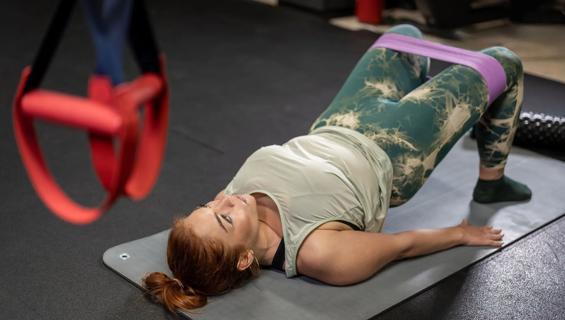
Glute bridges are simple bodyweight exercises worth adding to any workout
Managing your weight through physical activity may lower your chances of getting this common cancer

It typically starts in October and winds down in early spring, with cases at their highest in the middle of winter

Anxiety disorders, health conditions and past trauma can make driving nerve-wracking — help is available
 Search










