Locations:





 Search
Bursts of higher-intensity activity can bring big results in a short time
Image content: This image is available to view online.
View image online (https://assets.clevelandclinic.org/transform/f072646b-9e29-4a37-a1f9-5846d187f8a6/HIIT-Training-13060380107-770x533-1-scaled_jpg)
person doing HIIT class in gym
High-intensity interval training, or HIIT, sounds pretty intimidating. But HIIT workouts are FOR EVERYONE — and they’re especially good for those of us who are older or sporting a body type that isn’t exactly fit-tastic.
Advertisement
Cleveland Clinic is a non-profit academic medical center. Advertising on our site helps support our mission. We do not endorse non-Cleveland Clinic products or services. Policy
View HIIT as more of a broad concept than a rigid fitness activity that ratchets the intensity level off the charts, says exercise physiologist Katie Lawton, MEd. It’s a way to work out, not a specific regimen.
“What’s ‘high intensity’ is very relative,” Lawton explains. “You set the bar where it works for you.”
So, here’s how you can ease into HIIT to build a stronger, healthier body.
Video content: This video is available to watch online.
View video online (https://cdnapisec.kaltura.com/p/2207941/sp/220794100/playManifest/entryId/1_hukqbjq9/flavorId/1_5f3sgelj/format/url/protocol/https/a.mp4)
What's the Difference: Tabata vs. HIIT
The game plan with HIIT is to mix repeated short bursts of higher-intensity aerobic exercise within a workout. (Notice that it’s “higher” and not “high.”)
“The focus is on varying the intensity level during the workout,” says Lawton. “That can mean going from low to medium intensity or from medium to high, then dropping back down before revving up again.”
But if you’re aiming for high intensity, that would be a level of exertion where you can only talk for a few words at a time. (Basically, expect to huff and puff.)
To get a bit more specific, high-intensity exercise typically means upping your heart rate to more than 70% of your maximum heart rate. The basic formula for calculating maximum heart rate is 220 minus your age. (Learn more about exercise heart rate zones.)
Other formulas exist, too, and may be beneficial to set a better target. Lawton suggests the Karvonen method, or heart rate reserve calculation, which also uses your resting heart rate to establish a max heart rate number.
Advertisement
Think of it as a series of mini-challenges. Basically, you push harder for a short duration (20 seconds to a few minutes) before slowing down for an equal or slightly longer active recovery period.
Repeat this back-and-forth process throughout the workout. A beneficial HIIT session can last as little as 10 minutes, plus time for a warm-up and cool-down. Twenty to 30 minutes is typical. Rarely do HIIT workouts extend beyond an hour.
Aerobic exercises — the type of activity that can quickly elevate your heart rate — fit nicely into a HIIT session, says Lawton. Potential activities include:
How often you do HIIT depends on the intensity level of your workout, but two to three days per week is a good target.
For starters, HIIT means being physically active — a sweaty status that far too few people reach on a regular basis. Research shows that only 28% of Americans meet weekly exercise guidelines.
Adults should aim to get 150 to 300 minutes a week of moderate-intensity aerobic activity, or 75 to 150 minutes of vigorous activity, according to recommendations from the U.S. Department of Health and Human Services.
HIIT can help you hit that goal and stay healthy. (Fast fact: Nearly half of the adult population in America has a preventable chronic disease — and 7 of the 10 most common chronic diseases can be “favorably influenced” by regular exercise. Pretty obvious connection, right?)
Benefits of HIIT include:
Advertisement
As mentioned, HIIT can often help lessen symptoms of chronic diseases, such as heart disease and different types of arthritis, including rheumatoid arthritis and psoriatic arthritis.
Still, it’s best to talk to a doctor or a healthcare provider before starting a routine.
“They can help you set guidelines to exercise safely and successfully,” advises Lawton. “The goal should be to develop a program that you can do consistently in order to see the potential benefits.”
Lawton offers these half-dozen tips to enter the world of HIIT:
Advertisement
Advertisement

Sign up for our Health Essentials emails for expert guidance on nutrition, fitness, sleep, skin care and more.
Learn more about our editorial process.
Advertisement
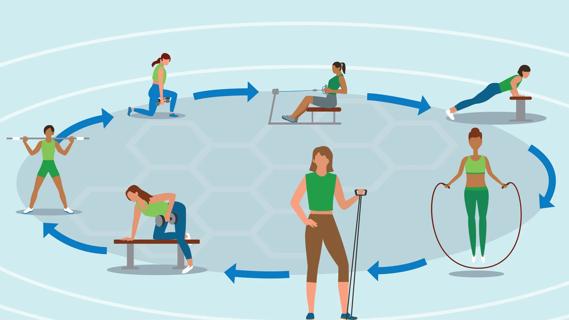
Circuit training combines strength and cardio exercises into one efficient workout

One helps with quick, intense bursts, while the other helps carry you for the long haul

It depends on your symptoms and where you feel them in your body, but you may want to sit this one out
This 75-day challenge provides a balanced approach to physical fitness, mental health and healthy habits

Kettlebells are versatile, space-friendly weights that can help you build strength from head to toe

Get ready to squeeze your glutes, lift your quads and reverse some crunches

This outdoor activity can boost your mood, strengthen your body and support your long-term health

Stay slow and controlled as you work your way up past the bar

Your chronotype reflects when your body naturally wants to sleep and wake — and why your energy peaks when it does

This type of test can spot problems early, but it can come with tradeoffs, like false alarms, high cost and added stress

Stretching won't increase your height, but it can help you stand taller











