Locations:


This simple grounding technique uses sights, sounds and movement to bring your attention to the present moment
When anxiety starts sending your thoughts into a spiral, grounding practices can give your brain something else to focus on.
Advertisement
Cleveland Clinic is a non-profit academic medical center. Advertising on our site helps support our mission. We do not endorse non-Cleveland Clinic products or services. Policy
One way to do that is with the 3-3-3 rule. It’s simple: Notice three things you see, listen for three things you can hear and move three parts of your body.
“Anxiety and worry are usually about what might happen in the future, not what’s happening in the present moment,” explains integrative medicine physician Melissa Young, MD. “Grounding exercises like the 3-3-3 technique can help bring you into the present.”
Dr. Young explains how the 3-3-3 rule may help you manage anxiety.
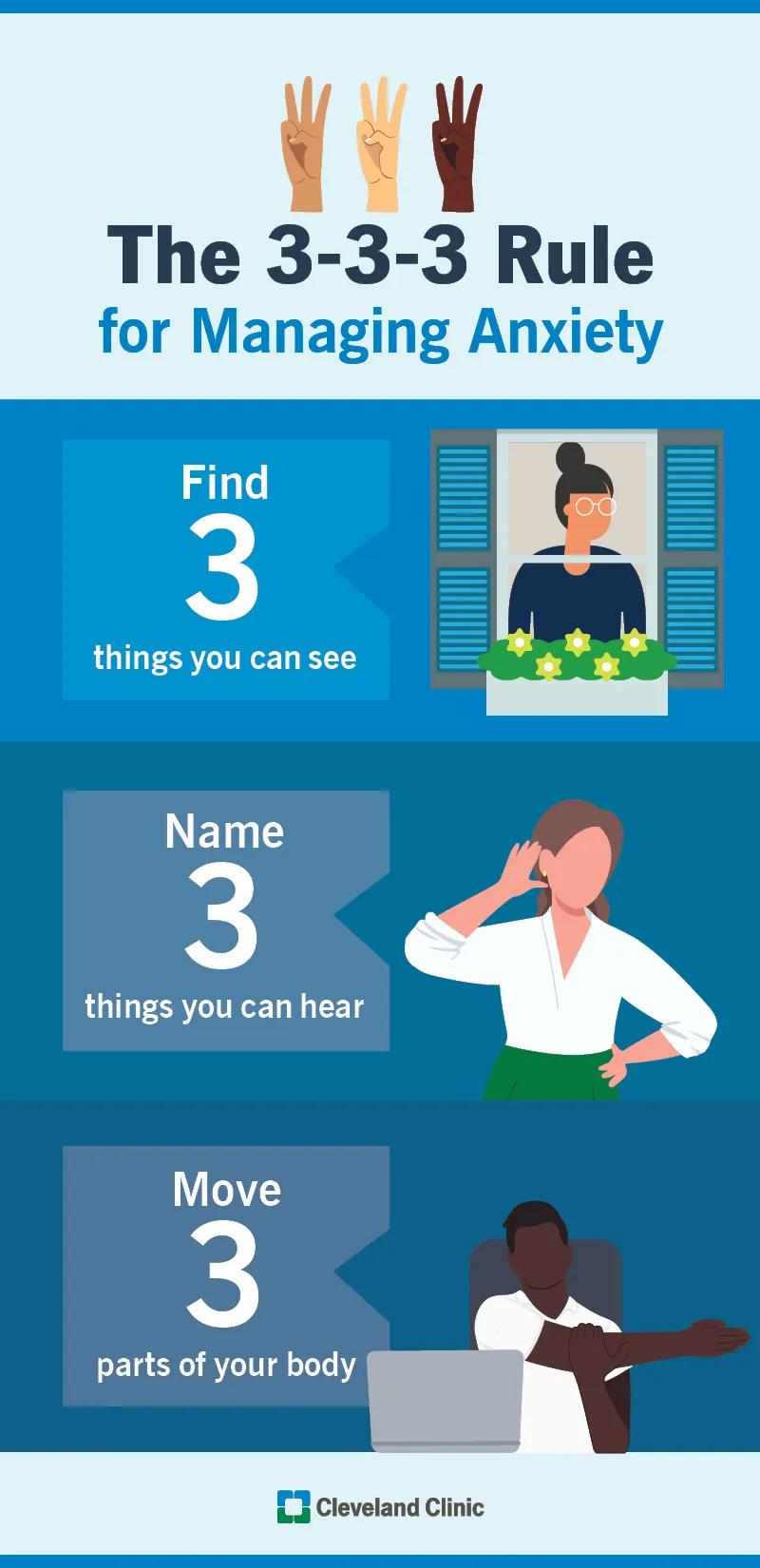
Image content: This image is available to view online.
View image online (https://assets.clevelandclinic.org/transform/6e1f0d02-0b45-4aa0-8efd-81dd462e1a33/333-Rule-Custom-Infographic)
3-3-3 grounding is a mindfulness technique that can help interrupt anxious or overwhelming thoughts by redirecting your attention to what’s happening right now.
It just takes three steps:
Advertisement
And don’t get too hung up on the numbers. The point isn’t to check off the boxes on your mental scavenger hunt. It’s to shift your attention away from racing thoughts and toward things that are actually happening in the here and now.
“The numbers are really just a way to frame your thoughts and keep you engaged,” Dr. Young says. “It doesn’t have to be that literal.”
Think about what happens when anxious thoughts take hold.
Your thoughts start to venture toward the hypothetical:
Grounding directs your attention in the opposite direction: Instead of focusing on the what ifs of the future, you deliberately notice what’s actually happening right now.
“Grounding is a common practice used in therapy to help interrupt anxious thought patterns and distract us from emotional pain,” Dr. Young explains. “It can help to focus on something other than difficult emotions so you can work through them from a place of calm.”
The scientific evidence specifically studying individual grounding exercises like the 3-3-3 rule is limited. But these techniques are widely used in clinical practice, particularly in psychology, Dr. Young notes.
And one advantage of the 3-3-3 rule is how easy it is to do. You can try it while you’re:
Like other stress management techniques, grounding may also become more useful with practice.
“The more you do this on a consistent basis, the more likely it is to help when you need it,” Dr. Young says.
And when you do feel yourself becoming overstimulated or in the midst of spiraling thoughts, try grounding early.
“The sooner, the better,” she advises. “It’s easier to calm yourself when you’re coming down from a 10 than when you’re coming down from 100.”
3-3-3 grounding may be a helpful addition to your mental health toolbox. But it’s just that — one tool.
Seek help if you’re experiencing anxiety that is:
It may be that you’re dealing with an anxiety disorder, and grounding techniques alone may not be enough.
Talk with a healthcare provider or mental health professional. They can help you understand what’s behind your anxiety and recommend treatment and coping strategies, like therapy or medication, that fit your needs.
Advertisement
Advertisement

Sign up for our Health Essentials emails for expert guidance on nutrition, fitness, sleep, skin care and more.
Learn more about our editorial process.
Advertisement

Anxiety disorders, health conditions and past trauma can make driving nerve-wracking — help is available

This simple mindfulness exercise can help interrupt anxious thoughts by bringing your attention to your five senses

Challenging negative thoughts and making a game plan for future events can help

The terms are often used to describe intense feelings of fear and anxiety

Going home isn’t always easy, but there are ways to ease any stress you might feel

This fast-acting anxiety medication should never be taken with alcohol, despite what you may see on The White Lotus

Deep breathing, positive mantras and tackling negative thoughts can help get you out of your head and cool down your anxiety

Focusing on what you can see, feel, touch and hear can help you feel more present in the moment

Managing your weight through physical activity may lower your chances of getting this common cancer

It typically starts in October and winds down in early spring, with cases at their highest in the middle of winter
Anxiety disorders, health conditions and past trauma can make driving nerve-wracking — help is available
 Search