Locations:





This simple mindfulness exercise can help interrupt anxious thoughts by bringing your attention to your five senses
When anxiety starts to build, your thoughts can easily spiral into a tornado of what-ifs. Grounding techniques aim to do the opposite — turning your attention away from hypothetical worries so you can focus on here-and-now realities instead.
Advertisement
Cleveland Clinic is a non-profit academic medical center. Advertising on our site helps support our mission. We do not endorse non-Cleveland Clinic products or services. Policy
Integrative medicine physician Melissa Young, MD, explains how one of these strategies, known as 5-4-3-2-1 grounding, can be a helpful tool for calming a storm of racing thoughts.
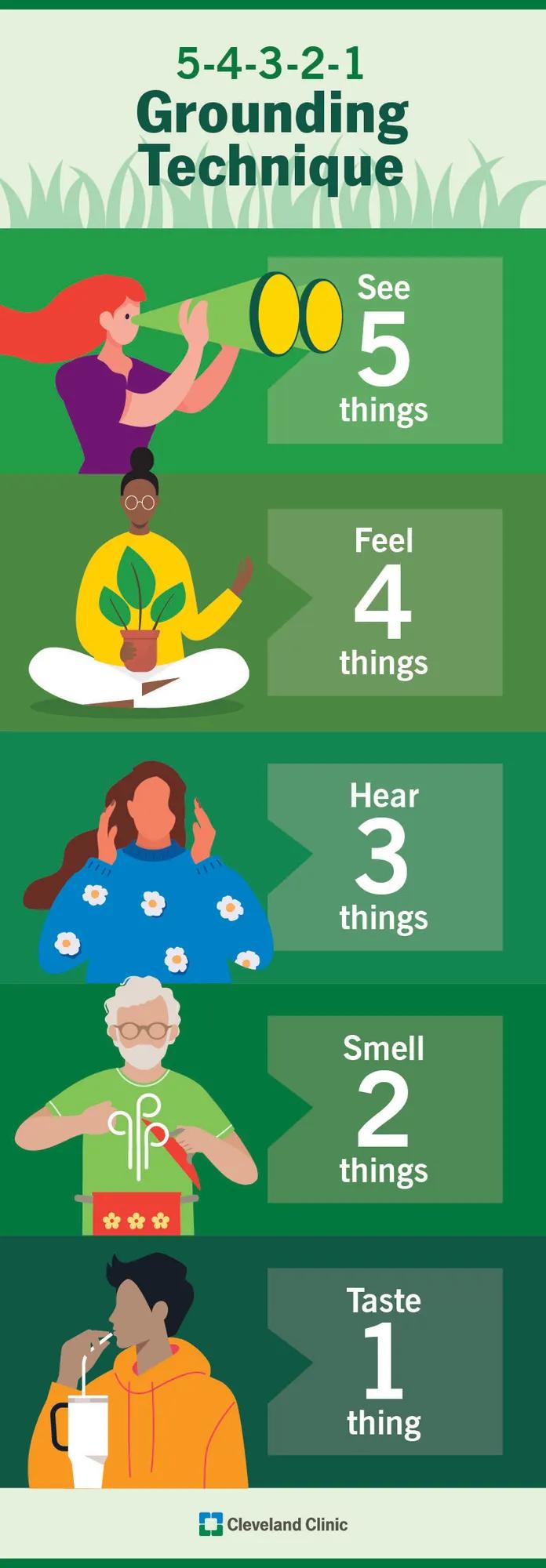
Image content: This image is available to view online.
View image online (https://assets.clevelandclinic.org/transform/e486a7b7-6a6d-4d2e-9458-2704a6ebee95/grounding-infographic)
The 5-4-3-2-1 grounding technique is a mindfulness exercise. It engages each of your five senses to help interrupt overwhelming emotions like anxiety, anger or sadness. As with other grounding strategies, the goal is to anchor your attention on the present moment to reduce racing thoughts and emotional reactivity.
“Anxiety and worry are usually about what might happen in the future, or what happened in the past — not what’s happening right now,” Dr. Young explains. “Grounding techniques like 5-4-3-2-1 bring you into the present moment.”
The exercise follows a simple pattern where you acknowledge:
As you do it, keep this in mind: Perfection isn’t the goal. There’s no reward for correctly identifying a magical number of things with each of your senses. It’s more about bringing your awareness to each of your senses in a systematic way.
“The numbers are really just a way to frame your thoughts,” Dr. Young clarifies. “It doesn’t have to be that literal. But the more you engage your senses, the more your attention moves into the present moment.”
Advertisement
She walks us through each step.
Start by looking around you and (silently or out loud) name five things you can see. Don’t just glance at them. Spend a moment noticing details.
For example, instead of simply thinking I see my backpack, you might notice that it’s green and blue, has silver zippers and is leaning against a chair.
You may also notice things like:
Next, notice four things you can physically feel. This could be the texture of your shirt, how your feet feel against the floor or the support of your chair against your back.
Other ideas include:
Take a moment to appreciate how each feels against your skin, rather than rushing through the list.
Now, focus on the sounds around you. You don’t have to search for noises or create them. Just notice what’s already there.
You might hear:
“There isn’t a right or wrong answer,” Dr. Young reiterates. “It’s simply what’s in your immediate environment.”
Next, identify two scents.
Sometimes that’s easy, like smelling coffee brewing or a nearby vase of flowers. Other times, you may notice the scent of your soap, shampoo or even the fresh air outside.
If you don’t notice much at first, that’s OK. Again, the goal is simply to pause and pay attention.
Finally, notice one taste. Maybe it’s the lingering flavor of your toothpaste, a sip of tea or coffee or a mint you’ve been sucking on.
“Grounding is a common practice used in therapy to help interrupt anxious thought patterns and reduce emotional distress,” Dr. Young explains. “It can help to have someone focus on something other than difficult emotions so they can work through them from a place of calm.”
Like other stress management practices, this technique tends to work best when you practice it regularly — not only when you're feeling overwhelmed.
“The idea is that the more you practice, the more it can help your nervous system learn how to move into a calmer state,” she adds.
Even a few minutes each day may help make the technique feel more natural when you need it.
You can do 5-4-3-2-1 grounding almost anywhere. Sure, you can go full-on meditation and sit cross-legged on the floor. But you can also try it while sitting at your desk or riding the bus to work.
Advertisement
You might turn to grounding when you’re:
Engaging the 5-4-3-2-1 grounding technique can be most helpful when you first notice anxiety, anger or sadness — before those feelings really gain steam.
“The sooner, the better,” Dr. Young advises. “It’s easier to calm yourself when you’re coming down from a 10 than when you’re coming down from 100.”
She emphasizes that grounding works best as part of an overall approach to mental health.
If anxiety is becoming difficult to manage or interfering with your daily life, don’t rely on grounding techniques alone. Talk with a healthcare provider or mental health professional about the treatment options that may be right for you.
Advertisement

Sign up for our Health Essentials emails for expert guidance on nutrition, fitness, sleep, skin care and more.
Learn more about our editorial process.
Advertisement

Anxiety disorders, health conditions and past trauma can make driving nerve-wracking — help is available

Challenging negative thoughts and making a game plan for future events can help

The terms are often used to describe intense feelings of fear and anxiety

Going home isn’t always easy, but there are ways to ease any stress you might feel

This fast-acting anxiety medication should never be taken with alcohol, despite what you may see on The White Lotus

Deep breathing, positive mantras and tackling negative thoughts can help get you out of your head and cool down your anxiety

Focusing on what you can see, feel, touch and hear can help you feel more present in the moment
Performance anxiety and stage fright are outsized stress responses that can creep up when you’re put on the spot

Managing your weight through physical activity may lower your chances of getting this common cancer

It typically starts in October and winds down in early spring, with cases at their highest in the middle of winter
Anxiety disorders, health conditions and past trauma can make driving nerve-wracking — help is available
 Search










