Locations:





Your path lab report contains detailed information about your tumor — your care team can work with you to turn it into a care plan
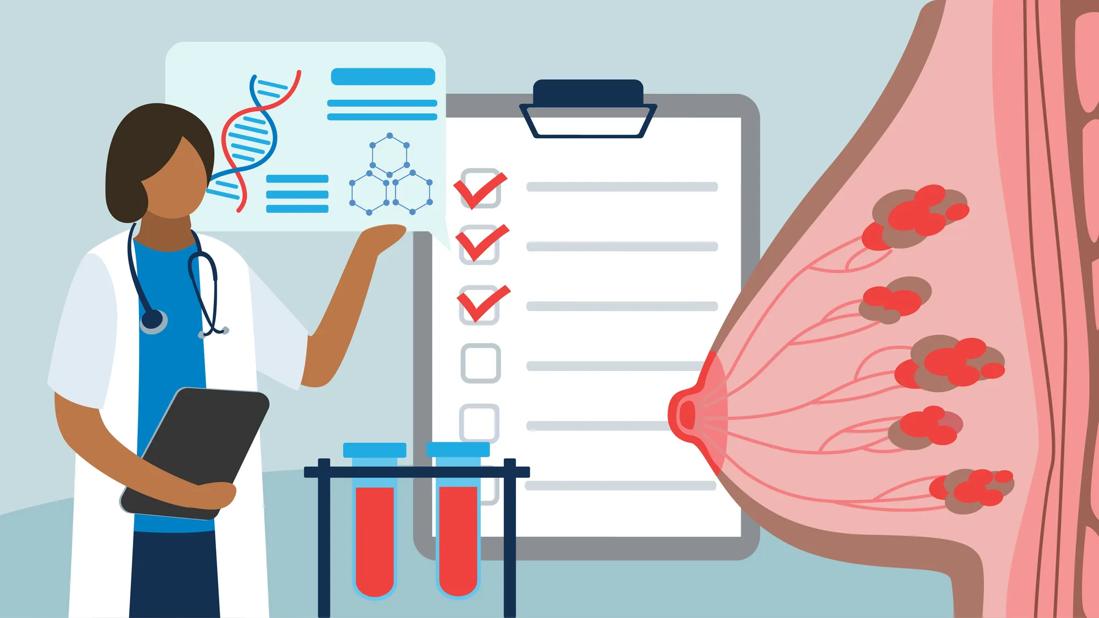
Image content: This image is available to view online.
View image online (https://assets.clevelandclinic.org/transform/8d028598-7447-41e7-bcbb-b87c87f9b42e/breast-pathology-labs-doc-1401941429)
Healthcare provider reviewing pathology report, with oversized breast and lab work
Soon after a breast biopsy, you might see a pathology report pop up in your online medical record. But if you open it up and don’t know what exactly you’re looking at, you’re not alone.
Advertisement
Cleveland Clinic is a non-profit academic medical center. Advertising on our site helps support our mission. We do not endorse non-Cleveland Clinic products or services. Policy
That’s because breast cancer pathology reports are written by doctors, for doctors. The language is technical, and the findings are often nuanced.
“Most of these reports are designed for physicians to communicate with each other,” says breast medical oncologist Azka Ali, MD. “They’re not necessarily written in a patient-friendly way.”
The report contains important information about your cancer that will influence your team’s care recommendations.
Here’s a closer look at what you may find inside your breast cancer pathology report — and why it’s important to lean on your healthcare team to help make sense of it all.
A breast cancer pathology report is a detailed document that describes what pathologists found when they examined your biopsy under a microscope.
The exact format can vary. But in general, here’s what you can expect to see.
The report often begins with basic information about the tissue sample that was tested. This section describes things like:
Advertisement
These details help doctors confirm exactly what tissue was examined and how.
One of the most important parts of the report is the pathologist’s interpretation, which describes what the cancer looks like under the microscope.
“The pathology report won’t just say ‘breast cancer,’” Dr. Ali notes. “It will have descriptions that describe what type of cancer it looks like.”
The tumor type includes where in your breast the cancer originated:
It also describes whether the cancer has spread beyond its original site:
The pathology report may include additional details about the tumor itself, such as:
“When the whole tumor is removed, the report will describe how big the tumor measured and how many sites of cancer were present,” Dr. Ali explains.
These measurements help doctors understand how extensive the cancer is.
You may also see a grade listed in your pathology report.
“Grade is basically how ‘funky’ the cancer cells look to the pathologist,” Dr. Ali says.
Breast cancers are typically graded on a scale of 1 to 3:
Your pathology report will usually include information about hormone receptors — meaning whether or not the cancer cells use hormones to grow.
The report will note whether the sample contains estrogen receptors (ER-positive or ER-negative) and progesterone receptors (PR-positive or PR-negative).
These markers are important because they help determine which treatments your team is most likely to recommend.
Another key marker for breast cancer is a protein called HER2. It can affect how breast cancer grows.
You may see your HER2 status (HER2-positive or HER-2 negative) noted on the pathology report. But not always.
“The HER2 test sometimes requires confirmation,” Dr. Ali explains. “If the first test is unclear, the pathologist may run another test to determine whether the cancer is HER2 positive or negative.”
Advertisement
Typically, you won’t need to undergo another procedure for this testing. The sample that was already taken just needs to be re-analyzed. This may take some additional time.
Some pathology reports also include a diagnostic comment or addendum. This section may explain:
These notes help other physicians gain more information about how the pathologist arrived at their findings.
A cancer stage describes whether and how far cancer has spread (metastasized) in your body. Stages are made up of the size of the tumor, whether (the axillary) the lymph nodes are involved or whether the cancer has spread away from the breast or axilla.
The stage is determined based on your biopsy or surgery, as well as other information and test results. So, you won’t always see it on your pathology report. Sometimes, on a surgical report, you may see information about the size of the lymph nodes, depending on the type of surgery you had.
“Because full staging usually requires imaging tests and other clinical information, it’s usually determined after your care team reviews multiple pieces of data, not just the pathology findings,” Dr. Ali notes.
Advertisement
Seeing a pathology report in your patient portal can be overwhelming and scary. And if your gut instinct is to start searching the web or dropping the report into an AI tool to analyze it, again, know you’re not the only one.
But Dr. Ali encourages you to remember that you don’t need to figure it out alone: “You don’t have to be your own doctor,” she says. “We’re here to help with that.”
What’s more, the interpretations you get from your DIY search may be different from your team’s analysis. That’s because breast cancer is highly individualized.
Your team will take more into account than what’s on that report to better understand your cancer and guide their recommendations. For example, they’ll consider imaging, your health history and treatment goals.
So, it’s important not to jump to conclusions, but instead, to meet with your team to review the findings together. During that conversation, your doctors can help you understand:
And perhaps most importantly, they can help turn doctor-speak into an actionable plan that helps you face cancer. Together.
Advertisement

Sign up for our Health Essentials emails for expert guidance on nutrition, fitness, sleep, skin care and more.
Learn more about our editorial process.
Advertisement

Managing your weight through physical activity may lower your chances of getting this common cancer

Not all breast lumps signal cancer, and not all breast cancer causes lumps — it’s important to know the facts
If you’re of Ashkenazi Jewish descent, these tests may be a reasonable starting point — but more thorough genetic testing can go much deeper

Breast cancer treatments can lower estrogen, which has a ripple effect on your bones

Breast cancer treatments can lower your fertility, but egg freezing and other preservation measures may be an option

Practical help and honest conversations can make a meaningful difference

Doctors look at stage, biology, genetic risk and more to recommend your treatment plan
While you can’t change risk factors, like age or genetics, lifestyle choices and regular screenings can help lower your overall risk

Hormonal changes, a slower metabolism and muscle loss can make weight gain more common around menopause — healthy habits can help you manage it

Life-threatening complications include sepsis, stroke, pneumonia and more

Fruity-smelling breath can happen when your body burns fat for energy, and in some cases, can signal a medical emergency
 Search










