Locations:





Circuit training combines strength and cardio exercises into one efficient workout
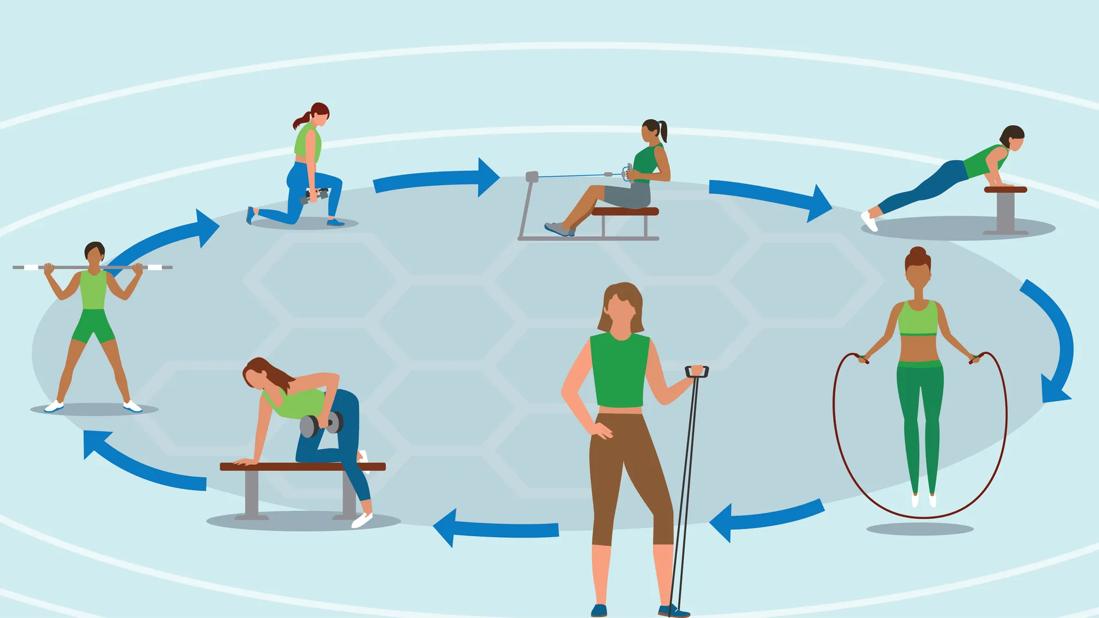
Image content: This image is available to view online.
View image online (https://assets.clevelandclinic.org/transform/64bbe37f-285a-45ce-bd8d-428874019a10/people-exercise-circuit-1253198777)
People circuit training, moving from one exercise station to another
If your workout routine feels stale — or you struggle to find time to exercise at all — circuit training may be worth a look.
Advertisement
Cleveland Clinic is a non-profit academic medical center. Advertising on our site helps support our mission. We do not endorse non-Cleveland Clinic products or services. Policy
With circuit training, you combine quick bursts of aerobic and strengthening exercises into one continuous workout.
“The goal with circuit training is to keep moving,” says sports medicine specialist Jessica Tomazic, MD. “That continuous movement challenges both your muscles and your heart for a well-rounded workout.”
Here’s what you should know before jumping in.
Circuit training involves moving through a series of exercises, called stations, with little or no rest between them.
The stations can be a mix of cardio and strength-training exercises. A typical circuit might include:
You perform one exercise at a time for a set amount of time (or for a certain number of reps) before moving to the next station. Once you’ve completed every exercise in the circuit, you repeat the sequence as many times as you like for the duration of your workout.
A full circuit workout typically takes about 30 minutes.
Some circuits emphasize cardio. Others focus on strength or athletic performance. Many combine all three.
Advertisement
“One of the biggest advantages of circuit training is its flexibility,” Dr. Tomazic notes. “You can tailor the exercises to your fitness level, your goals and the equipment you have available.”
Here are a few ways you can customize your circuit.
Circuit training can be beginner-friendly, but Dr. Tomazic recommends easing into it.
Small, steady increases tend to be safer and more sustainable than trying to do too much too soon. As your fitness improves, you can increase the number of exercises, the amount of weight, the number of reps or the number of circuits you complete.
“I recommend starting by doing each station for just 30 to 60 seconds,” she advises. “As you build endurance, you can gradually add more.”
Here’s what Dr. Tomazic suggests:
Circuit training has become popular for good reason. Dr. Tomazic shares some highlights.
Advertisement
One of circuit training’s biggest draws is efficiency. Because you’re moving continuously between exercises, it can help you fit both strength and cardiovascular training into a single workout.
“If you’re short on time, a circuit training workout can be a great option,” Dr. Tomazic says.
The limited rest periods keep your heart rate elevated throughout your workout. Over time, circuit training can improve your cardiovascular endurance and your overall physical fitness.
A well-planned circuit workout challenges multiple muscle groups during a single training session.
Repeated resistance exercises can help improve strength. And because there’s no stopping between exercises, circuit training keeps you in constant motion, which helps build endurance.
Doing the same exercises over and over can feel repetitive, but circuit training keeps things moving.
“There’s a lot of variety built into circuit workouts,” Dr. Tomazic says. “Many people find that helps keep them engaged and motivated.”
It’s easier to push through exercises that aren’t your favorite when you know you’ll be on to the next thing in a minute anyway.
Whether you’re a beginner or a seasoned athlete, circuit training can be modified to meet your needs.
Advertisement
You can adjust the exercises, intensity, duration and equipment to create a workout that’s appropriate for your abilities.
Like any fitness training program, circuit training is safest when you approach it thoughtfully.
Dr. Tomazic offers this advice to help prevent injury:
Talk with a healthcare provider before starting circuit training or any new fitness program. This is especially important if you have a chronic health condition, are recovering from an injury or haven’t exercised in a while. They can help you design a circuit that will work best for you.
Advertisement

Sign up for our Health Essentials emails for expert guidance on nutrition, fitness, sleep, skin care and more.
Learn more about our editorial process.
Advertisement

It helps to build up your strength and balance before tackling these more resistance-heavy TRX exercises
Glute bridges are simple bodyweight exercises worth adding to any workout

Stay afloat with bicycle kicks, alternating punches and water jogging

Plyometric training uses explosive movements to improve speed, power and agility

One helps with quick, intense bursts, while the other helps carry you for the long haul

It depends on your symptoms and where you feel them in your body, but you may want to sit this one out

This 75-day challenge provides a balanced approach to physical fitness, mental health and healthy habits

Kettlebells are versatile, space-friendly weights that can help you build strength from head to toe

Hormonal changes, a slower metabolism and muscle loss can make weight gain more common around menopause — healthy habits can help you manage it

Life-threatening complications include sepsis, stroke, pneumonia and more

Fruity-smelling breath can happen when your body burns fat for energy, and in some cases, can signal a medical emergency
 Search










