Locations:





One helps with quick, intense bursts, while the other helps carry you for the long haul

Image content: This image is available to view online.
View image online (https://assets.clevelandclinic.org/transform/775e5b88-a9e7-4da1-8be4-a7cadc4e5cf4/person-running-mountains-2251615753)
Person running up rugged terrain on mountain trail
Athletes need to think about stamina and endurance all the time. Whether you’re a runner, a basketball player or a swimmer, your ability to push hard and keep going often determines who wins and who comes out on top.
Advertisement
Cleveland Clinic is a non-profit academic medical center. Advertising on our site helps support our mission. We do not endorse non-Cleveland Clinic products or services. Policy
But endurance and stamina aren’t just important for athletes. They can also affect how easily you tackle everyday activities, like yardwork or helping a friend move.
Exercise physiologist Christopher Travers, MS, explains what sets stamina and endurance apart and how to build up both with a variety of workouts.
Stamina and endurance often go hand in hand — but they’re different.
Think of stamina as how hard you can push yourself, and endurance as how long you can maintain that effort.
In car terms, stamina reflects how hard you push on the gas pedal for a quick jump in speed. Endurance reflects how far you can go before running out of fuel.
Together, they help you reach your destination and achieve milestones in your physical performance.
Let’s dig a little bit more into what makes each unique.
Stamina describes your mental and physical ability to sustain high-intensity effort over a shorter period of time. It’s that quick burst at the starting line, the second-wind sprint you get during the last push of a marathon and the fast acceleration that carries you uphill.
“With stamina, you’re trying to push through at a higher heart rate,” says Travers. “It’s your power, your speed and your repeated burst of effort.”
Advertisement
Endurance describes your body’s ability to sustain low-to-moderate-intensity activity over very long periods of time. It’s the ability to endure a marathon, miles of cycling and long workout sessions without stopping or decreasing intensity.
“With endurance, you’re learning how to maintain a certain level of intensity for the longest period of time,” says Travers. “You’re focused on your breathing, keeping a steady pace and sticking to correct form so you can go longer without running out of energy.”
Building stamina and endurance involves different approaches to physical fitness. Stamina relies on quick bouts of high-intensity exercises, while endurance is less intense but for longer periods of time.
Working on both simultaneously can improve your performance and make a significant impact on your overall health. Let’s now focus on each one individually.
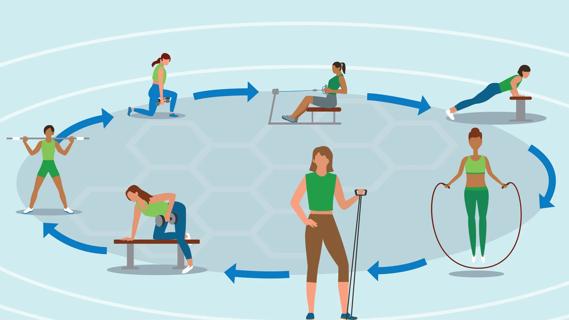
Circuit training is a great way to build stamina because it combines strength and cardio exercises with limited rest. A circuit involves moving through a series of exercises that target different muscle groups with little-to-no break between each one. After completing a circuit, you take a longer recovery before repeating the entire circuit.
“The big thing with stamina workouts is your recovery,” notes Travers. “When you finish an entire circuit made up of several quick exercises, you want a longer recovery so you can come back and do the entire circuit over again at the same high intensity.”
High-intensity interval training (HIIT) can also improve stamina. HIIT alternates short bursts of intense exercise with brief recovery periods, training your body to:
A stamina workout might combine these approaches by using a circuit of high-intensity exercises followed by a longer recovery period before repeating the circuit.
Exercises commonly used in stamina workouts include:
To build endurance, you’ll need to learn how to maintain a certain level of intensity for longer stretches of time.
“With endurance, we’re going for that longer, steady state and gradually increasing our time and our distances,” explains Travers. “Endurance requires consistency over weeks and even months.”
It helps to focus on workouts that keep your body moving for extended periods. Cardiovascular exercises are especially effective at building endurance. But strength training can be adapted to improve muscular endurance, training your muscles to work longer before they become fatigued.
Advertisement
When working on endurance, you want to increase the amount of time, distance or reps as you progress through your training.
Common exercises for endurance include:
Whether your goal is to move faster, exercise longer or simply keep up with the demands of daily life, stamina and endurance can help you get there. Building both takes consistency and practice. But over time, those efforts can pay off in improved performance, better fitness and greater confidence in what your body can do.
“If you train consistently and you’re seeing progress, both your stamina and endurance are improving,” encourages Travers. “It doesn’t happen overnight. It takes time, practice and attention to your overall health.”
Advertisement

Sign up for our Health Essentials emails for expert guidance on nutrition, fitness, sleep, skin care and more.
Learn more about our editorial process.
Advertisement

It helps to build up your strength and balance before tackling these more resistance-heavy TRX exercises

Glute bridges are simple bodyweight exercises worth adding to any workout

Stay afloat with bicycle kicks, alternating punches and water jogging

Plyometric training uses explosive movements to improve speed, power and agility
Circuit training combines strength and cardio exercises into one efficient workout

It depends on your symptoms and where you feel them in your body, but you may want to sit this one out

This 75-day challenge provides a balanced approach to physical fitness, mental health and healthy habits

Kettlebells are versatile, space-friendly weights that can help you build strength from head to toe

Managing your weight through physical activity may lower your chances of getting this common cancer

It typically starts in October and winds down in early spring, with cases at their highest in the middle of winter

Anxiety disorders, health conditions and past trauma can make driving nerve-wracking — help is available
 Search










