Locations:





 Search
More than 20 organs and tissues can be donated, and one donor can help more than 80 people
Every 10 minutes, a new person joins the national waiting list for an organ transplant. “There are many end-stage diseases with no other cure short of transplantation,” says Transplant Center Enterprise Director Charles Miller, MD.
Advertisement
Cleveland Clinic is a non-profit academic medical center. Advertising on our site helps support our mission. We do not endorse non-Cleveland Clinic products or services. Policy
One person’s donation can positively impact more than 80 people, according to the Health Resources & Services Administration. One deceased donation can save eight lives and enhance the lives of 75 more.
Here’s what you should know about organ donation:
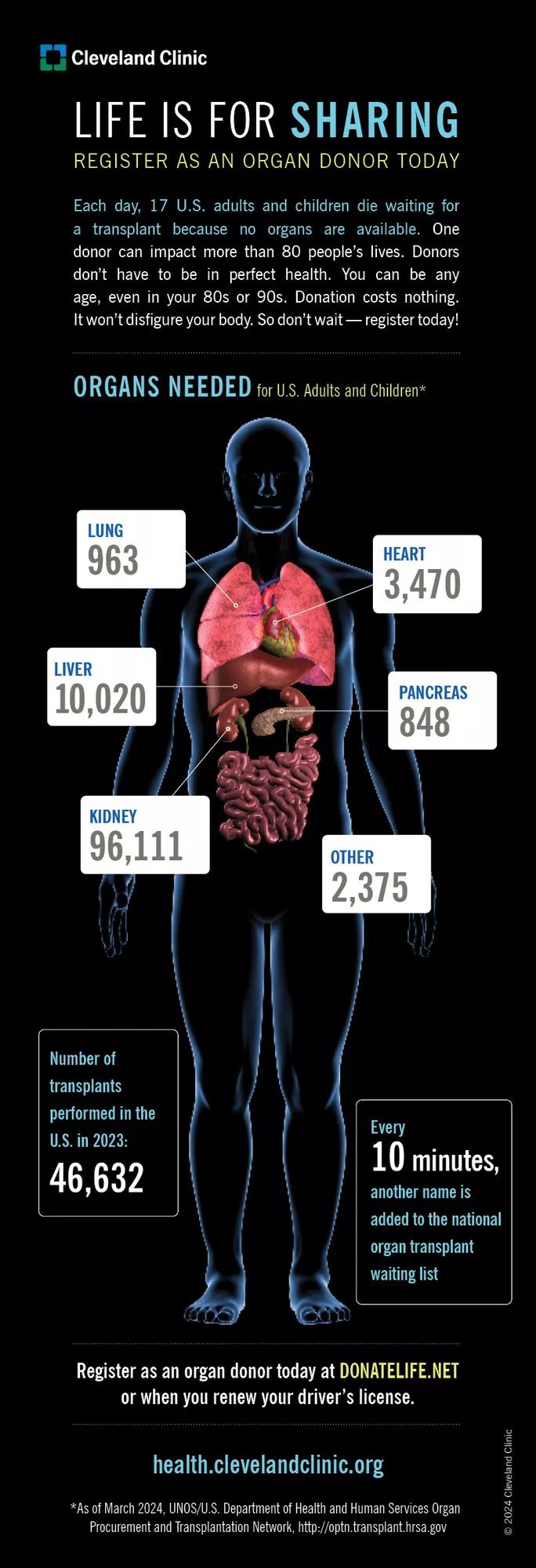
Image content: This image is available to view online.
View image online (https://assets.clevelandclinic.org/transform/13e2e55a-339b-44a4-ba3b-259f3667a676/organ-donation-infographic-2024)
In 2023, more than 46,000 organ transplants were performed in the United States, setting the record for the most transplants in a year. Cleveland Clinic performed a record number of transplants in 2023 as well. Dr. Miller stresses that these milestones could never be reached without the increase in individuals who chose to become donors.
Transplant professionals have great respect for people who donate their organs, he adds. While most organs originate from deceased donors, another important source of organs comes from living donors. These donors can often resume their normal activities soon after their donation.
Becoming an organ donor is a simple process. You can register as an organ donor today at DONATELIFE.NET, when you renew your driver’s license or on the Health app if you have an iPhone.
It doesn’t cost anything to donate and only takes a few moments to register.
Current and prospective donors may wonder which of their organs — and how many organs — they can donate. Living donors can donate these organs:
Advertisement
For deceased donors, these organs can be donated:
Additionally, deceased donors can donate connective tissue and cartilage, as well as corneas and tissue to help restore sight, repair hearts, replace damaged veins and heal burns.
The following tissue can be donated:
Healthy, living donors can also donate blood, platelets, bone marrow and blood stem cells.
“We need to be generous and help one another,” encourages Dr. Miller. “People on the waiting lists have families and children who need them. No one should have to be left in need.”
Advertisement

Sign up for our Health Essentials emails for expert guidance on nutrition, fitness, sleep, skin care and more.
Learn more about our editorial process.
Advertisement
Rest, hydration, protein and light exercise all play an important role in your healing

Track your blood sugar levels and pay attention to any symptoms, like feeling thirstier than normal

Prioritize your health by managing stress, strengthening your social connections and getting quality sleep

Keto can reduce blood sugar, but that doesn’t mean it’s right for everyone

Certain supplements, like licorice root and St. John’s wort, can raise your blood pressure or negatively interact with medication

No, but it momentarily slows down during this involuntary body function

Daily oral hygiene goes a long way to keeping your mouth healthy and your smile bright

Most kids start losing baby teeth around age 6 — but there’s some wiggle room in the timeline

Even small moments of time outdoors can help reduce stress, boost mood and restore a sense of calm

A correct prescription helps your eyes see clearly — but as natural changes occur, you may need stronger or different eyeglasses

Both are medical emergencies, but they are very distinct events with different causes











